Photo by Whitehorse Star
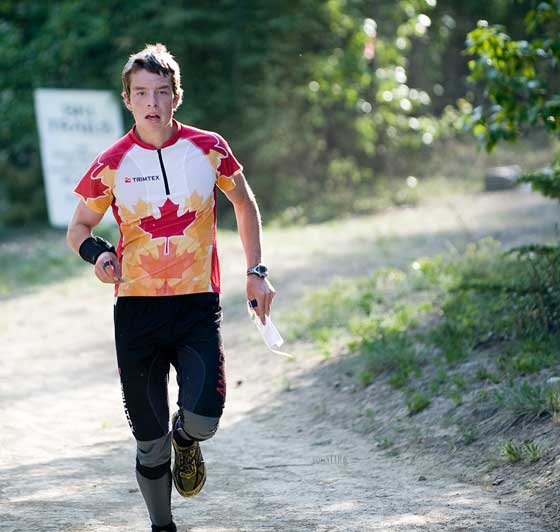
...ON THE PRIZE – Colin Abbott was one of the Yukon Orienteering Association members to add a gold medal to his club's medal haul at the nationals in Ottawa last weekend.
Photo by Whitehorse Star
...ON THE PRIZE – Colin Abbott was one of the Yukon Orienteering Association members to add a gold medal to his club's medal haul at the nationals in Ottawa last weekend.
Yukoners know their way around the middle of nowhere.
Yukoners know their way around the middle of nowhere.
Plunk them in the middle of somewhere, the terrain changed, and racing their way through strange forests becomes more challenging.
Clearly, however, the members of the Yukon Orienteering Association (YOA) who traveled to the Canadian Orienteering Championships (COCs) in Ottawa, from Aug. 15-22, were up for it.
Yukoners went to nationals hopeful after winning 18 medals at last year's event, but returned this year with an association-record 27 medals over three races.
The middle distance, 3.8 kilometres, was held on Aug. 20. The terrain included many rock features such as cliffs and boulders over a dense network of crisscrossing trails.
Aug. 21 featured the sprint race, a completely different style of orienteering, held on the grounds of the National Research Council, which saw a quick pace around the maze of buildings.
The final race, held on Aug. 22, was the long distance, 7.3 kms, over which the athletes' endurance was tested as they navigated the open rocky outcrops between the many small marshes and lakes.
"I thought we'd do really well but we surpassed my expectations,” YOA head coach Brent Langbakk said. "I think it was to our advantage that the terrain was really technical.”
Langbakk, who is credited with developing the Yukon juniors, said the younger competitors led the way.
The junior program began in 2003, he explained, and the club progressed from there, meeting three times per week on trails in and around Whitehorse.
Trevor Bray in the male 15-16-year-old category showed great composure to win gold in the extremely technical middle distance terrain, following up that performance with silver medals in the sprint and long.
Kendra Murray in the female 17-20-year-old category won the grueling long distance over local favourite Molly Kemp by a mere 18 seconds after more than 80 minutes of racing. Murray also earned silver medals in the sprint and middle distance races.
The Yukon also had a triple medal winner in Pia Blake, who showed maturity beyond her years by taking three silver medals. In the middle and long distance races she was running up a category from her usual 13-14-year-old group to the 15-16-year-old group.
Other multiple medal winners included Kerstin Burnett, Leif Blake and Lee Hawkings.
Burnett showcased her technical ability with two bronze medals in the competitive female 17-20-year-old category. On the men's side, Leif Blake came home with a gold in the sprint and a bronze in the middle of the male 12-and-under category.
Junior national team member Lee Hawkings showed why he was selected to represent Canada at the Junior World Championships in Denmark earlier this summer by earning bronze medals in the middle and the long.
"We have pretty much the best terrain possible – that's the advantage we have over other parts of Canada, the terrain and the large number of maps,” Hawkings said, adding that the YOA is blessed with having Langbakk, who Hawkings calls the best junior coach in the country, a coach who "pours his heart and soul into the sport.”
In the lead up to nationals, Hawkings traveled to Ottawa a week early to the Sass Peepre Junior Training Camp, which helped him get used to the terrain and mapping.
Matching different maps to new terrain can throw orienteers off, he added.
"One of the biggest challenges in the sport is that it's often totally different to match what the map symbols mean compared to the course. It's definitely a challenge but you can prepare well by coming down a couple of days early.”
Colin Abbott and Dahria Beatty also earned the Yukon juniors two additional gold medals.
Abbott, who was at the Junior World Orienteering Championships with Hawkings, earned a gold in the long on the final day by beating second place Graham Ereaux of New Brunswick by more than a minute and a half.
Beatty blazed around the sprint course to win the female 17-20-year-old category, edging out teammate Murray by 12 seconds.
Abbott, who is roommates with Hawkings at Carlton University, took a break from orienteering between the world championships and the nationals.
"I went to the COCs without orienteering for a while, so at the start I was just trying to enjoy myself,” Abbott said. "There were a lot more water features and bare rock (in Ottawa).”
In and around Whitehorse there is more lakebed terrain, he added.
"It's one of the best places in Canada; it's nice to have that at your front doorstep.”
Adding to the Yukon medal haul were masters competitors Ross Burnett, Nesta Leduc and Langbakk, who each earned three medals.
Burnett said he had trouble adjusting the map to the new environment.
"I had some mistakes in the two forest events, basically at interpreting the map and the contours,” Burnett said. "We don't have that kind of terrain here in Whitehorse. I was running a little too quickly, I wasn't being as cautious as I usually am.”
Burnett, who competed in the 45-50-year-old category, started orienteering near Vancouver in 1976.
Of course, in such a big city, orienteers had to go a ways outside town, near Whistler or in the Fraser Valley, to find good natural terrain.
The sport started catching on in Whitehorse around 1985, he explained.
"Through luck of geography, we have good terrain right around Whitehorse,” Burnett said.
And orienteers in Ottawa took notice of the Yukon's results.
"Brent's hard work is paying off,” Burnett said. "Club's are a little bit envious of our situation and the terrain we have. Because of Brent, juniors that go out of here to competitive events are a lot more prepared.”
Langbakk said the athletes' dedication and the terrain produces national-level orienteers.
"We've got a really active club with a good tradition,” Langbakk said. "But I think our surroundings are the big thing. Here we're so lucky.”
In order to encourage thoughtful and responsible discussion, website comments will not be visible until a moderator approves them. Please add comments judiciously and refrain from maligning any individual or institution. Read about our user comment and privacy policies.
Your name and email address are required before your comment is posted. Otherwise, your comment will not be posted.
Be the first to comment