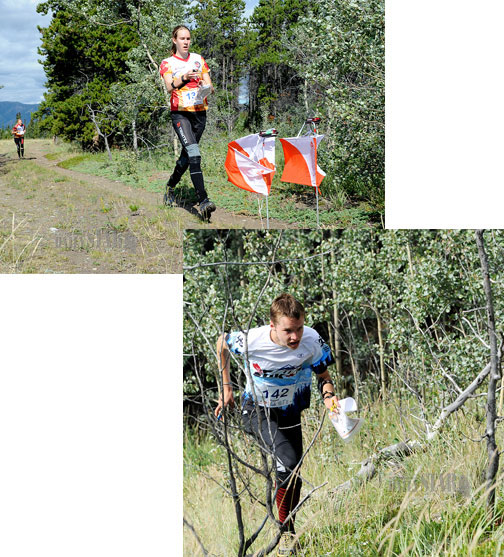
Photo by Whitehorse Star
Photo by Whitehorse Star
Yukon orienteering is evolving on all fronts.
Yukon orienteering is evolving on all fronts.
Programs are popping up. New maps are being marked. And medal counts are rising.
Team Yukon nabbed 38 medals at this year's Canadian Orienteering Championships (COC), held in Whitehorse from July 22-24.
Last August, Yukoners won a club-record 27 medals at the COCs in Ottawa.
Not to mention the Yukon's young elite breaking out of the territory.
Kendra Murray and Lee Hawkings, both of Whitehorse, represented Canada at the Junior World Orienteering Championships (JWOC) held in Poland last month.
Murray and Hawkings are also members of the Canadian Orienteering Federation's (COF) High Performance Program, along with five fellow Yukoners:
Dahria Beatty, Jennifer MacKeigan, Kerstin Burnett, Trevor Bray (juniors) and Colin Abbott (senior).
That's seven athletes out of the country's 29 best, Team Yukon head coach Brent Langbakk pointed out.
"I think there has been a steady progression, and it's been a result of hard work over the past six or seven years.”
Langbakk also took the reigns of the National Summer Training Centre held in Whitehorse over the summer, attracting six of the seven junior athletes who represented Canada at the JWOC.
This is also the first year for the "pre-orienteering” program called Kids Running Wild, which has attracted up to 40 young orienteers.
More than 20 kids have signed on for the 10-12 age category alone, Langbakk said.
"It's been an evolution over the past few years. It hasn't been a jump; I think it's been a steady progression.
"And this is another step again,” he added of this year's COC and Western Canadian Orienteering Championships (WCOC), also held in Whitehorse, from July 16-18.
The new maps marked for the COC and WCOC can only help.
Langbakk cited the Carcross Desert and Lewes Lake maps as rivaling the best marked in the world.
"They're just top notch. These maps are a legacy. It's world-class terrain. Both the Carcross map and the Lewes Lake map are absolutely fantastic, really well done and just incredible terrain,” Langbakk said. "This is part of the legacy. We're talking about having all these programs, but part of what makes us successful is the fact that we have all this amazing terrain nearby, and these maps just add to it.”
The Lewes Lake map is brand new. The Carcross Desert map, for all intents and purposes, is brand new, having no new additions since 1990, Langbakk said.
"Not only was it really out of date, but the mapping standard actually changed a lot. Today's orienteering maps are way more detailed. So to have two new maps that are world class is just amazing.”
These maps should help the Yukon's current orienteering stars improve, while the new programs should help young athletes surpass the current group in the future.
Though that won't be easy, as evidenced by performances from Yukoners last weekend.
Leave it up to orienteers, however, to be disappointed with gold-medal winning performances.
Up-and-comer Pia Blake of Whitehorse was dissatisfied with winning three gold at Canadians and three gold at Westerns. Hawkings also won six medals – albeit of varying colour – and he shared Blake's sentiment that medals and times mean less if the athlete hasn't competed to his or her potential.
Langbakk is hoping to open his students' eyes to the big picture in future events.
"It's something we'll have to talk about as a team,” he said. "We were trying to get the kids to focus on process a lot. The tendency, when you race, is to be worried about what other people are doing. If you're thinking about what place you're going to be finishing in while you're competing, then that just becomes a distraction and you make mistakes.
"I try to emphasize to the kids to focus on their own performances. I know sometimes they're a little bit overly critical of themselves, but they really should be pleased with how they did. It was very, very technical terrain and I think it was very, very challenging for everybody. We saw that even in the men's elite classes. Some of the best in the country were making mistakes.”
Langbakk was one of them, he admitted. But he sounded pleased with how he performed.
His best result was a third-place finish in the M21-34 elite class of the 4.5-kilometre middle distance event on Sunday.
"It obviously wasn't really the focus for me. I don't really have any pressure to perform anymore, so I was totally relaxed and laid back about the whole thing, which I think is good for performance; you don't have any stress or pressure.
"Maybe some of the kids took it a bit to the extreme to the other side. Mostly they did very well, mostly they did the tasks they set out to do very well – better than anybody else in the country – and they should really give themselves a pat on the back.”
In order to encourage thoughtful and responsible discussion, website comments will not be visible until a moderator approves them. Please add comments judiciously and refrain from maligning any individual or institution. Read about our user comment and privacy policies.
Your name and email address are required before your comment is posted. Otherwise, your comment will not be posted.
Comments (1)
Up 0 Down 0
Melba Disco Dancing Queen on Jul 27, 2011 at 9:52 am
Fantastic! I love to see you guys and gals out there with your maps and compasses, doing your thing. Orienteering is one of those sports that everyone can do, and winning it means having more than one skill. What a great activity. More stories and pictures on this please! Happy stuff.