Photo by Vince Fedorof
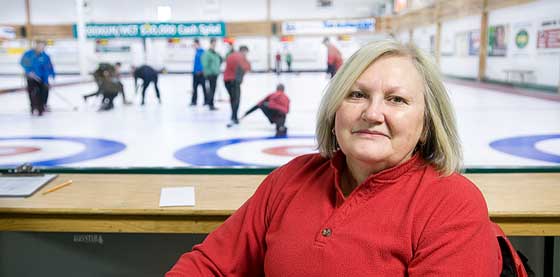
OLYMPIC DREAM – Marg White is currently at the Olympics doing timing for the curling events, as well as volunteering at Canada's Northern House.
Photo by Vince Fedorof
OLYMPIC DREAM – Marg White is currently at the Olympics doing timing for the curling events, as well as volunteering at Canada's Northern House.
From the moment Vancouver was awarded the 2010 Olympic Winter Games in July 2003, Marg White was bent on being there to assist as a curling official.
From the moment Vancouver was awarded the 2010 Olympic Winter Games in July 2003, Marg White was bent on being there to assist as a curling official.
The 57-year-old, lifelong Yukoner was practically raised with a curling broom in her hand.
Most everybody growing up in Mayo was, she says in an interview before departing for the Games last week.
White says longtime residents of the community were teaching kids how to sweep and throw rocks long before it was ever in vogue as part of the school curriculum.
Back in the 1960s, in the early days of the Yukon Polar Games when communities like Cassiar and Fort Nelson would participate, curling was one of the events, she recalls.
Though first in touch with the sport from a young age, White never went beyond the recreational level.
As a person with a competitive streak, if she couldn't put in the required time to maintain an advanced game, she preferred to curl for just fun, and still does every week in the Wednesday Ladies League.
White, however, always had a shining for the officiating end of sport in general, with a personality which likes to ensure rules are applied equally, fairly.
"I am sort of a detail type person in that way,” she says. "It's one of those things, you play by the rules, and the rules are for everybody, and it is a level playing field for everybody.”
White isn't only known for her officiating at curling events, but for her involvement in pretty much anything that requires a stop watch; the Klondike Road Relay, weekly running and cycling events in town.
The mother of two daughters timed a biathalon event at the Grey Mountain gun range the weekend before she left for Vancouver.
So it was with her flare for fair play that White eventually elevated her involvement in curling when she helped officiate the 1990 national seniors' championship hosted by Whitehorse.
She moved on to the national junior championship in 1994 in Regina.
And ever since, she's officiated at numerous national women's championships – the Scotties Tournament of Hearts – and several other top curling events, including last year's Olympic test event, the 2009 World Junior Championships.
In Vancouver, as an official timer she is responsible for making sure the play clock for each team is switched on and off at the right time.
Each team, she explains, has 73 minutes and two, one-minute time-outs to complete the 10 ends.
As soon as the first rock crosses the T-line a split-second after the lead comes out of the hack in the first end, the clock starts ticking for the first team.
White switches the timer to the other team not when the rock comes to a stop at the other end, but when the skip leaves the house or "relinquishes” the house to the opposing skip.
The skip, she said, doesn't necessarily have to physically leave the house to relinquish it, but turns it over when he or she is obviously done with their shot and are moving aside to make way for the next skip.
It can be a somewhat subjective call, determining exactly at what moment the skip has relinquished the house, at what moment to switch the clock, she says.
Guarding the timer, White suggests, is one of the more involved officiating positions in curling.
"You have to stay focused,” she says. "Sometimes I don't even know what the score of the game is because I am too busy watching. You are watching the movement of the rocks, and like I say, the people.”
It can get dicey if it comes down to last rocks in the final end with no time outs left, says White.
She has never seen a skip run out of time, though she has seen them come very, very close.
A team's last rock does not have to come to a full stop before the clock runs out, but it must cross the T-line at the release-end before the big hand hits zero.
White says she has seen the clock expire after the rock has crossed the T-line, but before it comes to a stop at the other end.
For the love of sport, she remains tied to curling, though over the years it's also become something of a family affair.
She's on a first-name basis with Canada's Kevin Martin rink, having watched most of his curlers come through the ranks going all the way back to the 1990s when they were competing in the national junior level.
"I can remember these guys from the juniors,” she says. "Like John Morris (Martin's third), I was at both of his national junior championships in '98 and '99.”
During her stay in Vancouver, White points out, she's sharing a condo with three other women who've befriended each other through the years they've been officiating together.
"You only see each other once a year, but it's one big family.”
For the first part of this week, the four are working the 6 p.m. to 10 p.m. shift, but will be working the day shift from Saturday through until next Tuesday, the end of round-robin play.
For the medal round, beginning Feb. 25th, the governing body will be decide who works, and when.
As a volunteer, White doesn't get paid, nor does she have her transportation or accommodations covered.
She did receive a volunteer uniform, and was among the thousands of guests for last Thursday's dress rehearsal of the opening ceremonies, though everybody had to sign a note promising they wouldn't spill the beans before Friday's main event.
Even though her Olympic experience is all on her own dime, White wasn't about to miss the opportunity.
She had her application in the mail as soon VANOC started shopping around for officials in 2008.
"A bunch of us applied,” says the Yukon government's manager of land use. "I thought, ‘you know, it is going to be in Canada only once every 20 years and this opportunity may never happen again.'”
In an interview yesterday morning from Canada's Northern House where she's working her second volunteer gig as a part-time host for the pavilion, White says Tuesday night's draws were electrifying.
Kevin Martin's rink won handily 9-4 in nine ends over Germany.
The game she was officiating between France and China, however, went down to the last rock. The French won on a take-out raise with the hammer to score two and win by one.
"It was a really close game,” White recalls. "It was tied coming home and both teams were low on time, the lowest I have seen in a long time.”
White says by the time the last and winning French rock stopped in the 10th end, France had just four seconds on the clock, and China 13.
But she wasn't nervous.
"You know you've done it before,” she says while on a short break from her day job as a pavilion host. "We did it last year, and we did a couple of practice sessions down here.
"You just have to concentrate.”
The curling venue was packed Tuesday night and she says she actually felt a little sorry for the skips from the other countries because each time Martin's rink made a shot, the applause and foot-stomping on the bleachers was deafening.
Other teams, says White, were having to use hand signals to communicate sweeping instructions.
"As soon as people started clapping and stomping, the whole building vibrated.”
In order to encourage thoughtful and responsible discussion, website comments will not be visible until a moderator approves them. Please add comments judiciously and refrain from maligning any individual or institution. Read about our user comment and privacy policies.
Your name and email address are required before your comment is posted. Otherwise, your comment will not be posted.
Be the first to comment