Top level coach returns to work with speed skaters
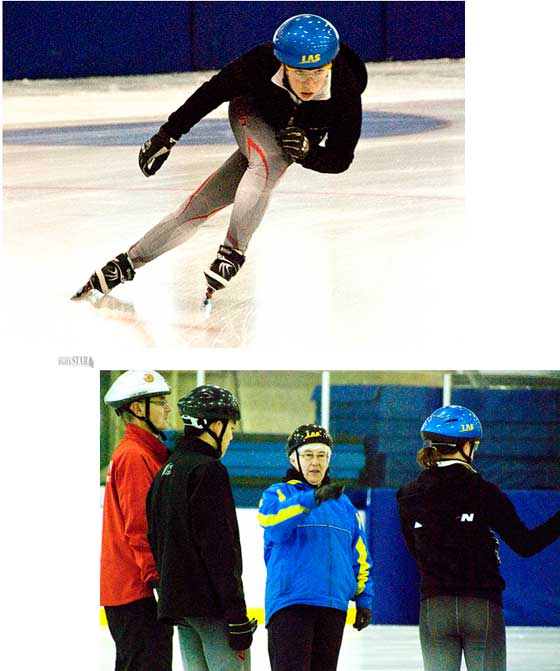
Debby Fisher stands at centre ice in the middle of a group of speed skaters.
By Jonathan Russell on September 28, 2010
Debby Fisher stands at centre ice in the middle of a group of speed skaters.
Above the white noise of the rink at the Canada Games Centre you can hear Fisher saying, "Remember: line up your nose, knee and toe.”
With that, the skaters disband to go for a few lapse, striding slowly and deliberately, to focus on technique rather than speed.
That's the name of the game, for now, says Fisher, a member of Speed Skating Canada's Hall of Fame and team leader of the developmental program at the Olympic Oval at the University of Calgary from 1998 to 2009.
Since then, she has started up her own business, Global Innovations in Sport, and continues working at the Olympic Oval in a consulting capacity.
"I didn't want to stop doing what I'm doing, and I was doing this type of work when I was at the Oval, so I'm continuing now on my own, through my own company,” Fisher said.
"I'm kind of like your traveling coach.”
Fisher held a speed skating camp at the Canada Games Centre over the weekend, when she worked with two groups, beginners and experienced, from Friday to Sunday.
The visit was a part of what she now focuses on: traveling around the country to help with the development of skaters, mentoring coaches, to focus on technical development.
She has been holding camps in Whitehorse one to two times each year since 1998, including camps before the 2007 Canada Winter Games in Whitehorse.
"I can really see the development of the skaters and the progression of the coaches too, and their knowledge and understanding of the sport, so that they can take that knowledge and make their skaters a lot better here,” Fisher said, adding that numbers, enthusiasm and skill level are all a part of that improvement.
"I used to come up here years ago and the skill level was not anywhere near what it is now, and there's a lot of younger kids coming up. That's a good thing, you need a good solid base to keep the upper part of the club growing.”
Whitehorse Rapids Speed Skating Club member Heather Clarke said she's noticed a major improvement in herself since Fisher began coming here.
"Even over this weekend I've improved already; I have a lot of things that I can think about and work on during the year,” said the 15-year-old, who already has six years' experience behind her.
"I remember Debby right from when I started skating, pretty much, she's always been here.”
Clarke is one of four speed skaters with the Rapids who is eligible for the 2011 Canada Winter Games in Halifax, N.S. in February.
She kicked off her season with the Top Blades camp in Calgary last month, where she saw a familiar face in Fisher.
"She's really good with the technique stuff. We get a lot of other coaches up here that will get us doing lots of laps, fast laps, but Debby really goes back to the basics and gets us working on technique,” Clarke said, noting that she has learned about improving her technique with straight away strides and weight transfers.
Attending such camps and traveling away to meets are the only ways to gain experience for the Canada Games, Clarke said.
"We don't really get a lot of competition up here; it's kind of hard, because we're always skating with the same group of people,” she said, adding that her club works with the Alaska Speed Skating Club in Anchorage to gain a different perspective on the sport.
"There's always something that I can work on, and there's a lot of stuff to think about whenever you're skating.”
Further preparation for the Canada Games will include possible meets in Medicine Hat and the Fall Classic in Edmonton over the fall.
Like Clarke, Donald Fortune hit qualifying times for the upcoming Canada Games in the Arctic Winter Games in Grande Prairie, Alta., where he won silver in the junior males 500-metre and fourth in the 777-metre.
Fortune, 17, has been with the Rapids for five years, and was with Clarke at the recent Top Blades camp, which was also attended by national team coaches.
"There's always improvement in these camps; the improvement isn't always in time but it's always visible,” Fortune said.
"We're really just going over the basics, just like they do everyday in the Calgary training programs.”
With Fisher's camp, you get to think about angles and alignment, Fortune added.
"Usually we focus more on the technique; if you have no technique, any amount of strength training you do is almost useless,” he said.
"It's kind of like a balance between power and precision.”
The Rapids train for an hour and a half three times each week, plus dryland training.
Fortune volunteered for the 2007 Canada Winter Games in Whitehorse and is eager to attend the national event as an athlete.
"It's really fun,” he said of the atmosphere surrounding the games. "However, once you get onto the rink it's just really intense.”
Whitehorse Rapids coach Phil Hoffman said the purpose of the September camp was to start those eligible for the Canada Games thinking about the event; but also to gauge grassroots interest for the upcoming season.
Not to mention the technical expertise, Hoffman said, adding that the club invites coaches with many different focuses to work with the skaters.
"All of us pick up something; I pick up things for coaching and the kids pick up things too. Sometimes it helps just to have a different perspective on things,” Hoffman said.
Fisher added, "They like to have different coaches come, because we all offer a little bit different perspective on it.
"It's always nice to have different opinions, different ideas.”
She said northern communities are luckier than you might think, in terms of ice-time
availability.
"They have sometimes more access to ice time, especially in some of the northern, smaller communities; they can get ice, three, four times a week, but down south they might be lucky to get on twice,” Fisher said.
Fisher pointed to Yellowknife speed skater Michael Gilday, who is now on the national team competing in world cups, as someone who can inspire skaters across the north.
"He came out of a club exactly like this one here, in Yellowknife,” Fisher said.
"So if the will is there, the desire is there, and the skill is there, they can go up to any level they choose to go.”
Be the first to comment