Photo by Vince Fedoroff
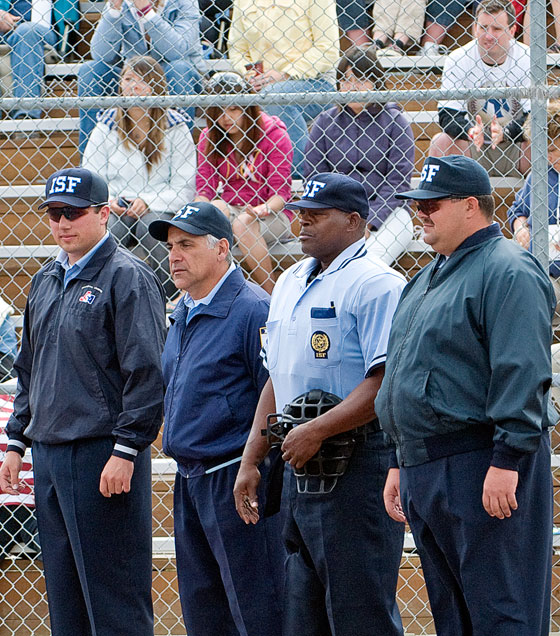
THE BOYS IN BLUE - Officials prepare for a game at the ISF Junior Men's Fast Pitch Championship.
Photo by Vince Fedoroff
THE BOYS IN BLUE - Officials prepare for a game at the ISF Junior Men's Fast Pitch Championship.
From church softball leagues in Saint John, N.B. to the Beijing Olympics, Bob Stanton has come a long way.
From church softball leagues in Saint John, N.B. to the Beijing Olympics, Bob Stanton has come a long way.
"I got some good breaks early," said the umpire-in-chief for this week's 8th ISF Junior Men's World Fast Pitch Championship.
He started out in 1982 umpiring church leagues, quickly moved into the local minor leagues and was working his first provincial championship in 1985. Three years later he was dressed in blue for his first national event, and received his international certification in 1994.
Today, as the International Softball Federation's director of umpiring for the region that includes Canada, United States and Bermuda, the 57-year-old Stanton was selected as umpire-in-chief for this event.
And he'll be travelling to Beijing in August to supervise umpiring during the women's fast pitch Olympic event.
After a brief chat with UIC as he sits in the stands evaluating the 18 working umps who've come from around the world for this championship, one might say there's more to umpiring than meets the eye.
Typically there'll be two umpires at the local softball level, and three for higher level events. But there's four for each game at this junior men's championship. And there may be six for the four weekend playoff games, Stanton explained, depending on what he and the deputy chief decide following today's conclusion of the round robin.
Having six, he said, gives more umpires a chance to be involved. And that's what they're here for, to be involved.
Just like the players and fans, the umps get juiced about the game too.
And as he sits in the stand with clip board and evaluation forms, Stanton's there to not only evaluate, but to help umpires improve their game.
At the end of each game, there's a debriefing with the crew of four on the field.
Each night, they try to have a meeting of all 18 working umps, Stanton and the deputy, Julie Johnson of the U.S., to discuss the day and address anything that arises.
"You are always looking for new improvement to better yourself on the field," Stanton said while in sitting in the VIP section overlooking diamond number two, his clipboard in hand.
"You are always looking for better angles, better places to see the play.
"That's really what it's all about, is to get an angle to see of the tag has been made, and the based has been touched, sort of thing."
As with other sports, the calibre of softball is growing, pitching is faster, and players are faster.
"You have to find a way to adjust to that.
And it's anything but cut and dry.
After January's selection of the 18 working umpires from a field of 50 applicants, Stanton sent out the information package outlining what type of system – how the umps will rotate on the field on certain plays – would be used in Whitehorse.
It gave the guys in blue time to practice at home, to get a few umpiring buddies together and work it through.
"If you are looking for new positioning, or trying to teach new positioning, it's always better to get on the field and try them out."
With a four-ump system, as Stanton explained, there's a lot of moving around.
For each fly ball to the outfield, one of the base umpires has to leave his bag and witness the catch, should a ruling be required. In right field, the first base ump goes out, centre field is covered by the second base ump and third covers left.
If there's a fly ball to centre for instance, the third base umpire becomes responsible for covering second, and first. The home plate umpire moves half way down the third base line and becomes responsible for home plate and third base until he can commit to third entirely, once the first base umpire can leave his bag to take over full responsibility for home plate, with the third base ump now looking over second and first.
And the list of fixed rotations goes on.
"The biggest problem we have is when a third-base umpire goes out and we have a runner on third."
Meanwhile, Stanton continues his evaluation from the stands.
Altogether, his evaluation sheet has 51 different categories, from the umpires physical condition, attitude, presence on the field, positioning, reaction to situations, to how the ump performs a routine safe signal or strike call.
They're watched for how they adapt to unusual plays issues arising on the diamond.
Stanton said he doesn't score all 51 categories each game. Not even close.
When he sees something, however, he makes note of it and its raised with the umpire later.
In an international tournament of this calibre, when you have 18 umpires from 12 different countries, language can also be an issue, he said.
Stanton said it hasn't been a problem, as many of the umpires speak and understand a least a little English, as do most of the coaching staff.
And when a home plate umpire pumps his fist in the air, or first base crisscrosses his hands with a wave, the language is pretty much international in any case.
The toughest bag to police? Home plate?
Not for Stanton. First base, he said.
"Because you get a good number of these bangers, and the ball comes to first so quickly, and everything happens so quick."
Stanton still umps local ball back in Fredericton, and he likes to get out a couple of times a week when he's there. The city has two men's leagues, a woman's league, and a junior league for both boys and girls.
But he would also like to stay involved internationally for a few more years.
The umps aren't paid, though their transportation, food and accommodations are provided for. The softball manufacturing company, Mazuma, provides the ISF blues for the umps.
For Stanton, the international event provides a special satisfaction.
"It's is really nice to see somebody from a country that they would probably not get out of if it were not sport."
In order to encourage thoughtful and responsible discussion, website comments will not be visible until a moderator approves them. Please add comments judiciously and refrain from maligning any individual or institution. Read about our user comment and privacy policies.
Your name and email address are required before your comment is posted. Otherwise, your comment will not be posted.
Be the first to comment