Photo by Star Photos by JONTHAN RUSSELL
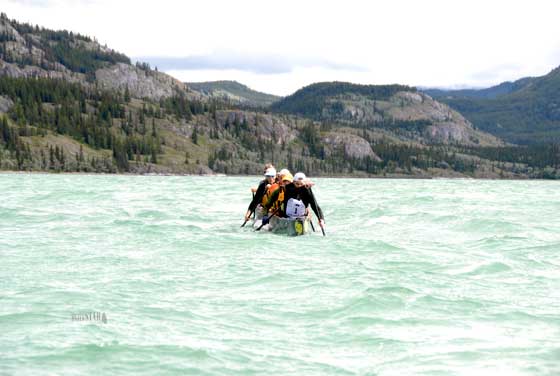
IN SYNC – Yukon River Quest Voyager team Texans paddle across Lake Laberge Wednesday. The Texans were the first team into Carmacks at 6:58 a.m.
Photo by Star Photos by JONTHAN RUSSELL
IN SYNC – Yukon River Quest Voyager team Texans paddle across Lake Laberge Wednesday. The Texans were the first team into Carmacks at 6:58 a.m.
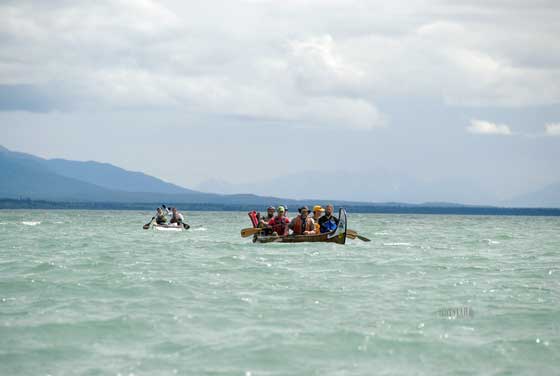
Photo by Star Photos by JONTHAN RUSSELL
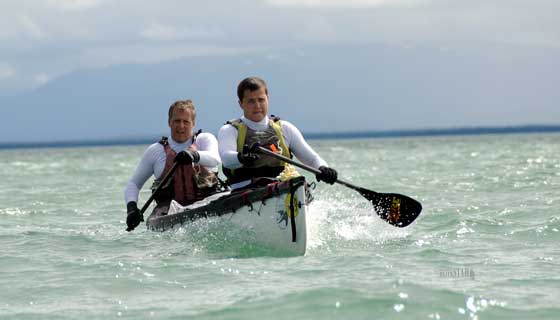
Photo by Star Photos by JONTHAN RUSSELL
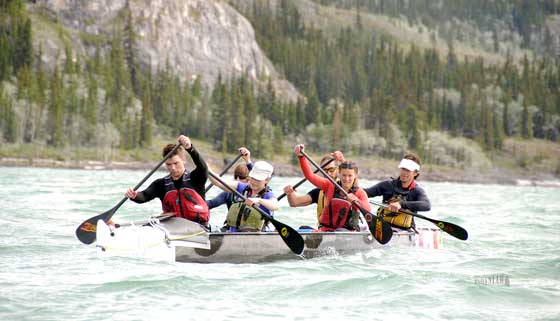
Photo by Star Photos by JONTHAN RUSSELL
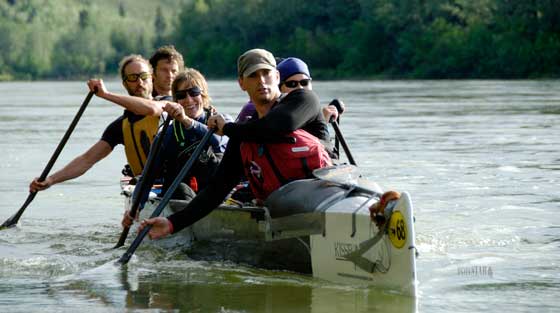
Photo by Star Photos by JONTHAN RUSSELL
COMIN' ON IN – Yukon River Quest Voyager team Sausages and Mussels arrive in Carmacks this morning. They were the first Whitehorse team into the checkpoint.
The Texans voyageur canoe team was the first to reach Carmacks this morning, in a time of 18 hours, 42 minutes.
CARMACKS — The Texans voyageur canoe team was the first to reach Carmacks this morning, in a time of 18 hours, 42 minutes.
The crew tumbled from the boat, each wincing as they were helped out. They arrived at 6:58 a.m. after leaving Rotary Peace Park yesterday at noon.
This morning in Carmacks was a cold morning. It made you cold looking at them. But when you saw them warming to hot soup and blankets, you warmed.
"The whole notion is to try to get to this point,” said Texan David Kelly. "We spent enough energy so we feel pretty roasted, but also enough energy so we know we can recover for the next two legs. We're sore, stiff, tired — we worked pretty hard.”
Kelly, Richard Ameen and Mike Rendon make up the half of the crew which won last year's Yukon River Quest with a time of 42:48 minutes.
They have enlisted the help of new-comers Andrew Stephens, William Russell and R.D. Kissling to win the 13th annual River Quest.
They're on track.
But the journey is not without its torture.
Ameen said the last three hours before docking in Carmacks were wrought with physical pain sprinkled with a jigger of mental anguish.
"You go as hard as you think you can, ‘I'm going to hang onto this thing for 19 hours — oh, I've only hung on for 16,' and now you've got to limp in for three hours,” Ameen said.
He attempted to elaborate.
"I guess what's neat about it,” he paused, staring blankly through the steam rising from his soup. "It is kind of painful,” he added to the laughter of the table before trailing off and lapping up his soup.
The Whitehorse-based Sausages & Mussels mixed voyageur canoe team were second to arrive in Carmacks, at 8:03 a.m.
Last year both teams arrived at the first mandatory stopping point (seven hours) at roughly the same time (7:14 a.m.).
Like the Texans, Sausages & Mussels picked up new members for this year's race.
Dan Girouard, Verena Koenig, Phillippe Mouchet and Joanie Pelletier have eached paddled in the River Quest previously.
Justin Wallace and Cynthia Corriveau are the newcomers.
But pick-ups seemed to be the only similarity between the two teams' disposition as they docked in Carmacks.
Sausages & Mussels members lept from their boat, hugged and kissed, wide-eyed and talkative.
"Our pace was pretty steady,” Wallace said. "I had trouble with my shoulders, but the whole team was super supportive. Come morning, when it started getting lighter, some of the energy came back and we just pushed it in here.”
Girouard said maintaining energy with this team is the easy part.
"Everybody brings a little bit of enthusiasm in the boat, which is good.”
"We had a bit of swearing, but it was all good,” Pelletier put in before adding, "I think the whole Yukon is behind us.”
But it wasn't all sunshine and roses.
Like Ameen, Girouard admitted Carmacks seemed a million miles away on the final approach.
"The last couple of hours were kind of a pain. It's flatter water and there are a lot of turns; you think Carmacks is right behind the hill and it's 14 turns away,” Girouard said.
Regardless of the similarities or differences between the top two teams, the fact remains that the Texans arrived at Carmacks first, will sleep first and leave first.
Kelly said his crew needs to widen the gap between themselves and the trailing teams, a gap he likened to a stretching elastic.
"When we start again, my hands are going to be swelled up, my wrists are going to be swelled up, the first hour is going to be challenging,” Kelly said.
"It's more art than science really. Through experience and practise and all that, we have a sense for what we can do and still recover in time. We know that we've been wet, and it's been windy, and we've just gone through the night for the last 18 1/2 hours, and we also know that as soon as we stop moving we're at our highest risk. We've been moving the whole time.”
And they will have to continue moving furiously to further stretch an elastic which can snap at any time.
In order to encourage thoughtful and responsible discussion, website comments will not be visible until a moderator approves them. Please add comments judiciously and refrain from maligning any individual or institution. Read about our user comment and privacy policies.
Your name and email address are required before your comment is posted. Otherwise, your comment will not be posted.
Be the first to comment