Photo by Vince Fedoroff
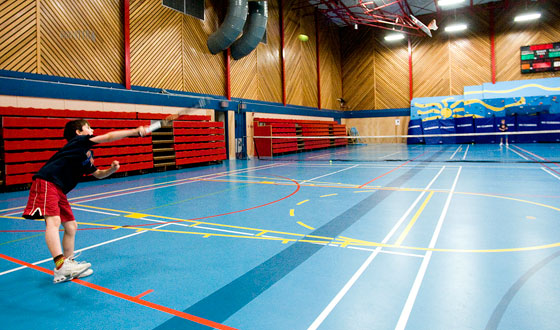
YOUR SERVE – Ewang Halliday serves against Alex Roberts during a training session at Yukon College. The two junior players are adjusting to a new season with reduced practice time.
Photo by Vince Fedoroff
YOUR SERVE – Ewang Halliday serves against Alex Roberts during a training session at Yukon College. The two junior players are adjusting to a new season with reduced practice time.
Tennis Yukon is adapting to a modified schedule as their anticipated court time at Yukon College has been reduced from 15 to ten hours per week, and their practice times have been realigned.
Tennis Yukon is adapting to a modified schedule as their anticipated court time at Yukon College has been reduced from 15 to ten hours per week, and their practice times have been realigned.
Stacy Lewis, president of Tennis Yukon says the organization was informed on Dec. 7 that their request for hours would not be met because the facilities were fully booked.
With the season scheduled to begin on Jan. 2, the club was left scrambling for alternative options.
"I didn't know what hit me when they first told me,” said Lewis. "The prospect of having nothing after stirring up momentum and growth with the program was crushing.”
On Dec. 12, five days after hearing about the initial decision, Tennis Yukon met with the college and brought a petition with nearly 100 signatures to explain their case.
"When we started bringing our situation to their attention, I think it sunk in.
"I don't think they realized the impact a cancelled season would have for the community,” said Lewis.
Tennis Yukon was competing for space between indoor soccer and student-run activities. Because the soccer contract had been formally signed and the students have plans in place for gym use, Tennis Yukon was left out of the equation.
"We've had an increased demand for the use of the facilities,” said Colleen Wirth, Yukon College's director of student services.
"Students are our number one (concern) and our community groups are also very important, so it can be a challenge to find a balance.”
Wirth said the College is continuing to have discussions with the students and the community groups to come up with a schedule that works for everyone.
"It's an ongoing discussion and challenge to do what we can to best meet the needs of everyone,” Wirth said.
The club's original proposal was for the times of 3:45 - 5:45 p.m., Monday to Thursday and 3:45 - 8:45 p.m. on Fridays.
After withdrawing their blanket refusal, the College offered the hours of 9 - 11 p.m. on Monday and Wednesday nights, 2 - 6 p.m. on Tuesday and Thursday and 6 - 8 p.m. on Friday.
Those hours proved to be incompatible with the working adults and junior players and the club ended up settling on 10 hours a week.
Lewis said despite the reduced hours the club was still able to accommodate nearly all of the 65 members who had signed up for lessons.
"It's all decisions for a community to make,” said Lewis.
"You're growing, you want lots of recreational opportunities to keep your community active and healthy but there aren't enough facilities to go around.”
Lewis said the club has an initiative to get the college students involved with tennis program but that it hasn't been well received in the past.
"We've tried to have instructional court time available for the students, we've been doing it over a year but there hasn't been a lot of uptake.”
Lewis highlighted the challenges faced by the local soccer and hockey leagues after the fire at Canada Games Centre (CGC) reduced the available time and forced the leagues to adapt to a new schedule.
Lewis says the modified time is a relief, despite the shortened hours.
"We're a growing club and we thought it was very likely we wouldn't have any hours so I think it's mostly a relief that we have something.”
With the current schedule, Lewis says the club will have to reduce the competitive juniors time in half, while the younger juniors will be forced to train in a larger group and the adult competitive league will most likely be eliminated.
"We are running lessons and have a Friday night league, I just don't think there's enough time to get everything accommodated,” said Lewis. "The late nights are midweek so it's hard for people who work to play tennis until 11.”
Kieran Halliday, who represented the Yukon in tennis at the 2009 Canada Summer Games, called the new schedule ridiculous.
"This is our competitive season and down south they are getting 20 hours of training a week while we get three,” he said.
"We don't have an indoor court so we are playing on basketball surfaces. Three hours a week on a basketball surface is nothing.”
Halliday said the CGC is not an option as there is only one court and it is only available during school hours.
Lewis also doesn't view the CGC as a viable alternative due to the cost and the limited space.
"It's over a $100 dollars an hour to rent the Flexihall for a junior program and more for an adult program,” she said.
"We would have to have a lesson of 12 to 15 people to make the cost the same as we charge at the College for a lesson of four to five players.”
Ken Pham, who has been playing competitive tennis for five years, says the reduced time will make it difficult to advance as a player.
"I'm playing with less competitive guys and for only one day a week,” he said.
"I love tennis so I guess I have to deal with it. That's all I can do.”
Pham says he will increase his training in the summer to offset the winter hours and is looking forward to traveling to outside tournaments to face unfamiliar competition.
The tennis players usually remain indoors until mid-May, when the outdoor courts become free of snow.
Jan Polivka, Tennis Yukon head coach, says the new hours put the competitive players at a disadvantage.
Polivka says the goal with the younger players is to develop their games and have them ready to compete at the Canada Games in 2013.
"I want them to not just participate at the Games but be competitive for the other provinces,” he said.
"They are good enough to compete but the more time we have the better they could be. It's frustrating.”
Ewang Halliday, 10-years-old, said he was disappointed when he learned of the new court times.
"We don't have a lot of time to practice, so having it cut in half is hard,” he said. "In the summer we'll have a lot of time to practice but in the winter we'll have to do as best we can.”
Ewang says his competitors will have an advantage because they have more time practice and compete with a larger pool of talent but says he is still hopeful he can win some tournaments this season.
Alex Roberts, a junior competitive player, was also disappointed with the ruling, saying ideally he would be able to get five to six hours of practice a week.
"I want to practice and get better as player, it's a career aspiration for me.
"But without the time, I can't really do that.”
In order to encourage thoughtful and responsible discussion, website comments will not be visible until a moderator approves them. Please add comments judiciously and refrain from maligning any individual or institution. Read about our user comment and privacy policies.
Your name and email address are required before your comment is posted. Otherwise, your comment will not be posted.
Be the first to comment