Photo by VINCE FEDOROFF
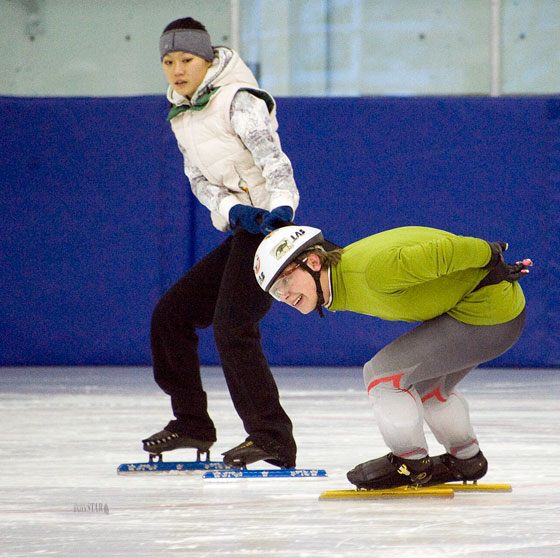
KEY FOR QI – Maggie Qi, coach at the Calgary Olympic Oval, helps Shea Hoffman, right, work technique during a speed skating camp at the Canada Games Centre on Sunday.
Photo by VINCE FEDOROFF
KEY FOR QI – Maggie Qi, coach at the Calgary Olympic Oval, helps Shea Hoffman, right, work technique during a speed skating camp at the Canada Games Centre on Sunday.
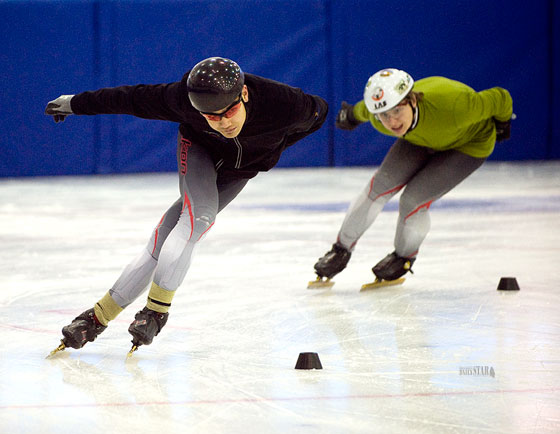
Photo by VINCE FEDOROFF
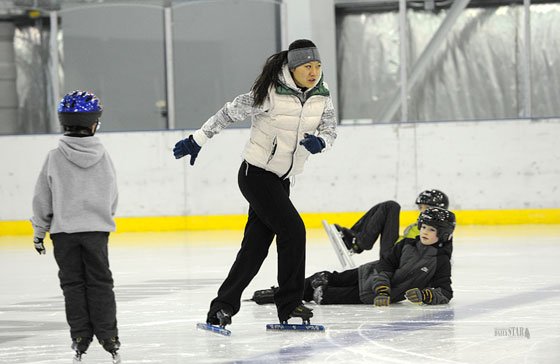
Photo by VINCE FEDOROFF
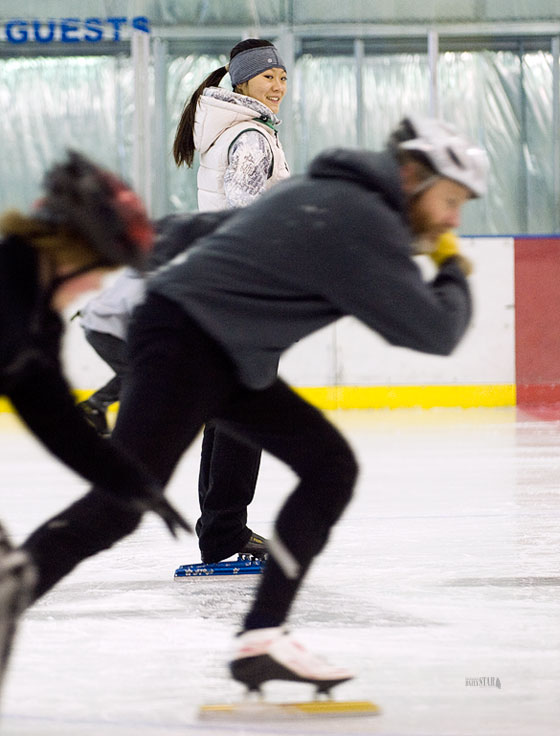
Photo by VINCE FEDOROFF
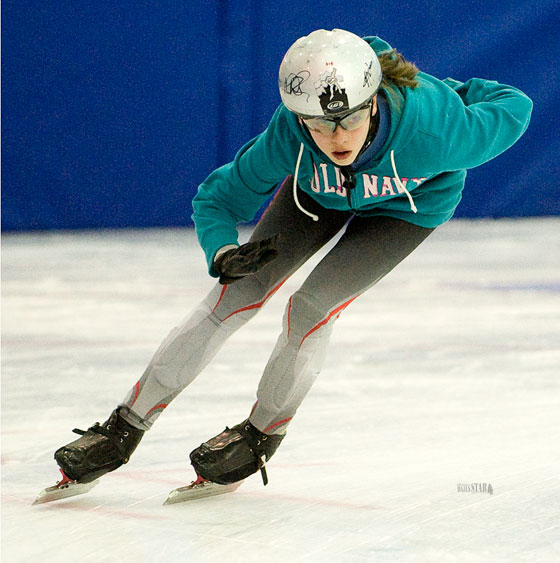
Photo by VINCE FEDOROFF
Speed skater Hanna Wirth has seen steady improvements in her technique since former world champion Mengyao "Maggie” Qi first visited Whitehorse last January.
Speed skater Hanna Wirth has seen steady improvements in her technique since former world champion Mengyao "Maggie” Qi first visited Whitehorse last January.
"She digs out the details of every little thing,” said Wirth, a member of the Whitehorse Rapids Speed Skating Club.
"I've been getting a lot lower and more compact. Our coach takes a lot of the drills and makes them his own, but it's still the same principle.”
Qi further elaborated on those principles last weekend during her second trip to Whitehorse for speed skating camps at the Canada Games Centre. She was the gold medallist at the 2006 World Junior Championships and is a former member of China's National Speed Skating Team.
Qi is now the short track speed skating coach at Calgary's Olympic Oval.
She knows her stuff, Wirth said.
"This camp was a lot about positioning your hips and staying really, really low,” the 13-year-old Wirth said. "Our coach likes to get us to think about it; with Maggie, she really drills it into us, repeats the same thing over and over again so that we really get it into our heads.”
Turns out that repetition works with the Whitehorse speed skaters, according to Qi.
"I saw a lot of improvements through the camp compared to last season. Every skater, they just skated tighter, getting lower, upper-body position lower – that's really good,” Qi said.
"They must have been working on the things they learned from the last camp.”
Qi's job in coming to Whitehorse was to deliver the latest techniques, the same techniques the skaters are working on at the Olympic Oval.
"We're just moving onto the next stage, working more on cross-overs, working more on edging,” she said. "You want to keep the edge parallel on the ice so you can keep smooth; you don't want to shift your edges on ice. It's not safe, not smooth.
We're also working on leaning. We're just hammering on it – again, again, again.”
Whitehorse Rapids coach Phil Hoffman said Qi delivered on the technical wisdom he expected.
"When you get down to it, speed skating looks pretty simple, but there's a lot of fine, technical things that you can do to improve how strong your skating stride is,” Hoffman said.
"Asian skaters have refined skating technique and do it a little bit differently than North Americans, and so she's bringing that kind of a perspective to it and I think she's showing a lot of people at the Oval and the Calgary club as well that you can change things that are done with technique.”
Coaches with the local club also learned a thing or two from Qi.
The Rapids frequently invite coaches to Whitehorse to hold camps, averaging three
per year, Hoffman explained.
"It's definitely cheaper to bring one person up than send a lot of kids out…we can't get out to camps that much or races even.”
Qi stands out because of her focus on technique, he added.
"You always pick up things, little key points to look for that you can reinforce with the kids. She's approaching it differently from what North American coaches did before, so you can always pick up things you can tweak.”
Those tweaks will be especially valuable this year in the lead up to the 2012 Arctic Winter Games (AWG) in Whitehorse in March.
The AWG speed skating trials for Juvenile (11-13) and Junior (14-19) are scheduled for Dec. 4 at the Canada Games Centre.
Wirth, in her last year eligible to compete in the Juvenile age group, was one of the Rapids skaters who competed in the 2010 Arctic Winter Games held in Grande Prairie, Alta., where she picked up a bronze medal.
She's hoping to receive more pointers when Qi returns in January for her third set of camps in Whitehorse.
Qi knows the importance of the AWGs in the development of skaters' development in the North.
"The Games are really important for this group here, and I would like to help out if I can to get them to another stage to race better, get personal best results,” Qi said.
"Western and Northern Canada, its' not that strong in short track. The Quebec skaters are super strong comparatively. If I can go to those little towns, those clubs, to deliver all the technique information to the skaters and also the coaches, hopefully five or 10 years later, the general skating ability and technique will improve so they are competitive with other provinces.”
In order to encourage thoughtful and responsible discussion, website comments will not be visible until a moderator approves them. Please add comments judiciously and refrain from maligning any individual or institution. Read about our user comment and privacy policies.
Your name and email address are required before your comment is posted. Otherwise, your comment will not be posted.
Be the first to comment