Photo by Photo submitted
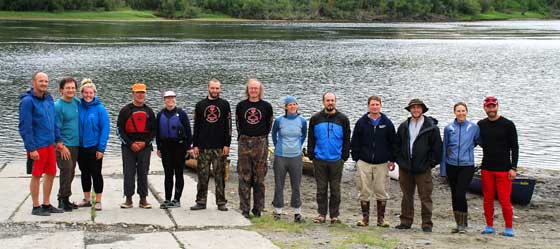
READY TO RACE - Paddlers in the first Yukon 360 Canoe and Kayak race pose for a photo at the start in Johnson's Crossing.
Photo by Photo submitted
READY TO RACE - Paddlers in the first Yukon 360 Canoe and Kayak race pose for a photo at the start in Johnson's Crossing.
The inaugural running of the Yukon 360, from Johnson's Crossing to Carmacks last weekend, went almost flawlessly.
The inaugural running of the Yukon 360, from Johnson's Crossing to Carmacks last weekend, went almost flawlessly.
The race had the same structure as the Yukon 1000, both carrying spot devices, so paddlers could be tracked online, while also providing a safety net for the racers.
The field was small, and almost entirely local, but the organizers are confident that will change in future years.
There were some last minute rule changes. The rules stipulated that teams had to be off the water by 10:30 p.m., and had to stop overnight for eight hours. But the race was on the Teslin River where there had been a recent burn.
There was still some burning and a lot of smoldering between Boswell River and the Livingston Trial. That could be up to three hours of paddling time, so the overnight stop rule was changed to be: "You must be off the river between 11:30 p.m. and 4:30 a.m., and you must be stopped for at least eight hours."
That meant that paddlers had three hours of flexibility on where to stop in the evening. In the event, it turned out that most paddlers opted for an early stop - early start strategy. This time of year, the Teslin starts slow, and stays slow for a frustratingly long time.
Even when it picks up, it still felt slow to the paddlers who were mostly veterans of the Yukon River Quest, which is run when the Yukon is more or less at its crest.
This probably explains why paddlers stopped early, having paddled hard to try to get their GPSs to give the sort of speeds they were used to seeing.
The second day dawned warm and promising, and got better. There were strong tail winds down the Teslin, and for the front of the pack onto the Yukon. But as anyone who has paddled the rivers knows, they do not flow in the same direction for long, and whatever the wind direction is it will be against you somewhere.
For the first five boats, that section was a 3-km stretch of river just before the 4th of July bend.
This is a straight section pointing in exactly the wrong direction and the wind was breaking trees and kicking up waves almost a metre high. And they were short choppy waves because the wind was against the current.
No one in the race, and there were some real river veterans paddling, had ever seen anything like this on the Yukon before. It was quite challenging.
At the finish, paddlers were heard to mutter that they would cheerfully have passed on the tail winds to avoid that one section of head wind.
As the River turned more westerly and less northerly, the sections of headwinds became more frequent, although none were as intense as that one big blow.
Even the leaders abandoned hope of getting into Carmacks on Sunday night.
"Why fight a head wind and exhaust yourself when it will probably by better in the morning?" was the thought. So again, most paddlers opted for an early night.
Monday again started kind to the paddlers, warm even at 4 a.m. when the first paddlers were stirring for start around 5 a.m., and remained kind with less wind and little rain until most of the paddlers were off the river.
There was one last minute withdrawal from the race: Tim Hodgson was not feeling well and felt it better not to start.
If anyone looks at the results page they will see one boat disqualified for "missing required gear."
This paddler did not have a boat. In fact, he was a ghost paddler, and only existed in the form of an extra Spot device, that one of the other boats was carrying down the river. A small prank pulled by the organizers, who may even make a habit of it.
The low water threw off the calculations the race organizers had made about how long the race would take by about three hours, not bad for a first running of a race.
The entry fee for the race was $100 per paddler, and the race costs were very low.
Each paddler was given a race T-shirt and poster, and the prize money (calculated on how much money was left over after costs were subtracted) was $269.71 to each paddler in the first place canoe, $134.86 to each paddler in the second canoe, and $67.43 to each paddler in the third canoe.
No prizes were award for the single kayak entry, although he was given a bottle of Coke.
The organizers are already looking forward to next year's Yukon 360, which will be run on the Pelly River from Faro to Pelly Crossing on Discovery Day Weekend 2010.
Article provided by Peter Coates on behalf of the Yukon 360.
Final times for the racers in the Yukon 360:
"This was your Idea"; Jason Doucet and Kam Davies, canoe (1 day 19 hours and 10 minutes).
"P and J Steam"; Jim Boyde and Pat McKenna, canoe (1 day 20:10)
"WildFeet"; Marc Hebert, solo kayak (1 day 20:33)
"Pelicans"; Peter Coates and Thomas Coates, canoe (1 day 20:53)
"Happy Camper and a Smart Cookie"; Fabian Schmitz and Cynthia Corriveau, canoe (1day 23:59).
"Canoe Dig It"; Joel Lawrence and Max Folk, canoe (2 days 5:15).
In order to encourage thoughtful and responsible discussion, website comments will not be visible until a moderator approves them. Please add comments judiciously and refrain from maligning any individual or institution. Read about our user comment and privacy policies.
Your name and email address are required before your comment is posted. Otherwise, your comment will not be posted.
Comments (1)
Up 0 Down 0
C West on Aug 22, 2009 at 10:48 am
No prizes were award for the single kayak entry, although he was given a bottle of Coke.
WHY?
This guy is the only single racer who finished the race. He came Third! And you think it's okay to give him a bottle of Coke?
What a joke.
You try paddling solo for that long.
Shame on you!