Photo by Jonathan Russell
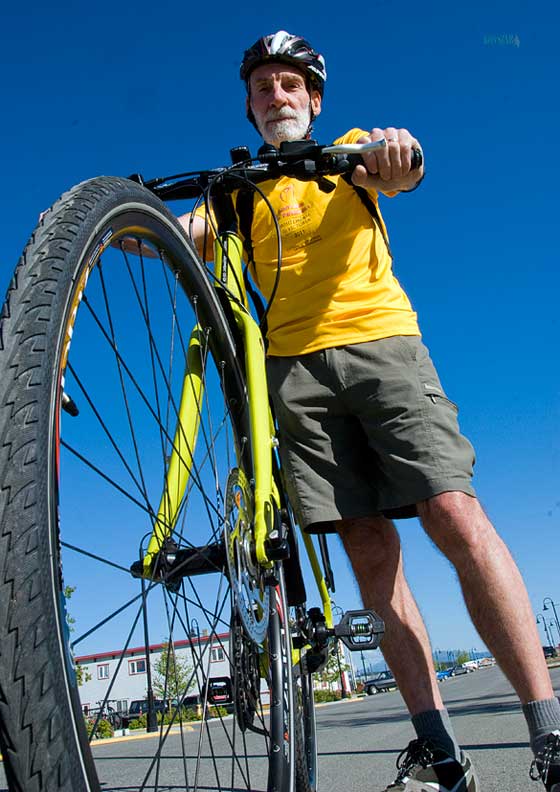
FOR PARKINSON'S – John Crouch, 70, is preparing to cycle from Whitehorse to Victoria to raise money and awareness for Parkinson Society BC.
Photo by Jonathan Russell
FOR PARKINSON'S – John Crouch, 70, is preparing to cycle from Whitehorse to Victoria to raise money and awareness for Parkinson Society BC.
John Crouch has enough motivation to undertake a massive solo journey.
John Crouch has enough motivation to undertake a massive solo journey.
The 70-year-old Victoria, B.C.-cyclist will leave Whitehorse tomorrow to ride 2,350-kilometres to his home to raise money and awareness for Parkinson's disease.
His biggest motivation?
Crouch's nephew Richard Cox, 40, has been suffering from the disease for the past 10 years.
"I have very strong visual images of Richard. Doing something for somebody other than myself will be a motivating factor. That's a blessing and a curse, because I feel incredibly responsible,” said Crouch, a native of England.
"When I go back to England and I see him, I see the ravages of that condition on his life. He had to change his job. He's not on disability exactly, but he gets money from the British government to support himself.
"His life became a misery.”
In an attempt to minimize the pain his nephew and other Parkinson's sufferers feel, Crouch will travel down the Stewart-Cassier Highway before eventually hitting Highway 16 through Smithers and Prince George. From there, he will take to Highway 97 through Williams's Lake and 100-Mile House and then Highway 99 through Whistler.
In Squamish, Crouch will meet up with his son Dan and take the ferry from Horseshoe Bay to Nanaimo, where his wife Lorinda will meet them before cycling down Vancouver Island to the B.C. capital.
Crouch is dedicating his journey to his nephew and raising funds and awareness for Parkinson Society British Columbia.
He received "expedition support” from Mountain Equipment Co-op with a $1,000 Shadowlands bike to reach his home.
Crouch, who expects the trip to take 3 1/2 weeks, will take on the majority of that venture as a solo cyclist, camping after averaging 100 km daily.
"One of the things I like to do if I can is to motivate other people to get out there and be fit and enjoy what is around us,” the older Crouch said. "That's another motivation for me, on a personal level, to be as fit as I can be, because I think that's kind of a responsibility that we have to our own bodies and our own minds and emotional state; but also, if I can motivate other people to get out there.
"Age is the other. There's no barrier to being really active.”
Crouch's age clearly hasn't slowed him down.
In fact, he uses it to push himself.
He won the World Endurance Duathlon Championship in Holland when he was 60 and has been Canadian champion in both duathlon and long-course triathlon over the past decade.
Victoria residents will recognize his name from three guidebooks he's written about the city: Hike Victoria, Bike Victoria and Walk Victoria.
Since the age of 50, Crouch has used his age to challenge himself.
When he turned 60, he mixed up the ritual by swimming 60 laps in the pool.
For his most recent birthday, he swam 70 laps, cycled 70 kilometres and hiked seven kilometres.
"In addition to that, I wanted to do something really significant, basically to prove to myself and anybody else who was interested, that people who are getting older can still do challenging endeavours, particularly of a cardiovascular nature, like endurance stuff.”
Turns out, people are interested.
Crouch contacted the Parkinson Society of British Columbia, which put his profile on their website for anyone interested in donating to his cause.
His profile, entitled "John's Ride for Parkinson's – Whitehorse to Victoria” is at www.parkinson.bc.ca/Events.
After five weeks of being online people have donated more than $7,000 to Crouch's fund-raiser.
"For me it's overwhelming emotionally. People not only donate, but they write comments, and the good wishes and what people say about me is wonderful,” Crouch said.
Parkinson's is initially characterized by tremors in the arms and legs, he explained.
It starts unilaterally and then moves bilaterally, affecting both sides of the body.
Cox, for instance, was first affected in his right arm, then his right leg, before it spread to the left side of his body.
The other major impact is rigidity, Crouch pointed out.
The mid-brain produces less and less of the neurotransmitter dopamine, which smooths muscular contraction and therefore movement.
"That's why when we do things we don't have jerky movements, and that's what tremor is about; the dopamine is not sufficient to smooth out the actions,” Crouch said.
Watching a loved-one experience the disease is "devastating,” he added, because the medication – the side-effects from which include weight-gain, depression and sleeplessness – also takes its toll.
"He was a soccer player, and now that is basically gone. He's losing weight now; he's on a different medication,” Crouch said of Levadopa (L-dopa), the final type of medication.
"But the more he gets into the disease – and this is true for every Parkinson's sufferer – the more Levadopa that they have to take, because the body is making less and less and less, because it's a degenerative disease.”
Roughly 100,000 people are affected by Parkinson's disease nationwide. Some 11,000 are affected in B.C.
Added Crouch: "I thought, if I'm going to do this ride, I would like to support him in some way that I could.”
In order to encourage thoughtful and responsible discussion, website comments will not be visible until a moderator approves them. Please add comments judiciously and refrain from maligning any individual or institution. Read about our user comment and privacy policies.
Your name and email address are required before your comment is posted. Otherwise, your comment will not be posted.
Be the first to comment