Photo by Photo Submitted
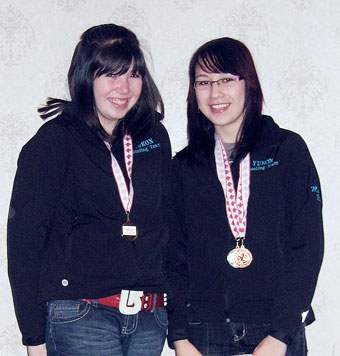
Yukon Shooting Federation members Kara Lepine, left, and Danielle Marcotte, right, pose for a photo at the Canadian airgun grand prix, held in Toronto from Feb. 22-24.
Photo by Photo Submitted
Yukon Shooting Federation members Kara Lepine, left, and Danielle Marcotte, right, pose for a photo at the Canadian airgun grand prix, held in Toronto from Feb. 22-24.
In a competition featuring close to 200 shooters, three athletes from the Yukon Shooting Federation managed to make their mark just by shooting to their full potential.
In a competition featuring close to 200 shooters, three athletes from the Yukon Shooting Federation managed to make their mark just by shooting to their full potential.
Danielle Marcotte, Kara Lepine and Nicholas Rittel all had strong performances at the Canadian airgun grand prix, held in Toronto from Feb. 22-24.
"I am very pleased with the results," said Jim Sias, president of the Yukon Shooting Federation.
"I know they can shoot this good here when they are at the range by themselves, but it was really nice to see that they were able to shoot like that in a major competition with all of the pressure."
The Canadian airgun grand prix is an international competition, attracting shooters from all across Canada and the United States.
The event is one of the premier airgun competitions in Canada and on the same level or higher than the nationals.
There are no qualifications for the event and it is open for to anyone who pays the entry fee.
Despite not having to qualify to take part, the Yukon Shooting Federation had their own selection criteria to determine who was eligible to attend.
Since the Canadian grand prix features such a high level of competition, members of the Yukon Shooting Federation had to shoot consistently at 75 to 80 per cent before being selected to the team.
Sias said the organization would have sent additional competitors if more people were interested and could shoot at that level.
"It is a high-level competition and to send somebody who wasn't prepared would probably discourage them more than anything," he said.
"Nobody wants to finish way out of it and everybody wants a chance to be competitive and if you can shoot at that level you will be competitive."
Airgun competitions are all shot at a fixed distance of 10-m and athletes have a choice of shooting with either an air rifle or air pistol.
Participants have a set amount of time to fire all their rounds and have to change targets after every shot.
Each competitor at the Canadian grand prix shot once a day over two days and their final scores were tallied up after the second round.
There is also separate competitions for men and women. Individuals were divided into a specific age category, including master, expert, junior and sub-junior.
At the grand prix, the male competition featured athletes shooting a 60-shot course using their choice of air rifle or air pistol within the one hour and 45 minute timeframe.
The female competition at the event was similar, but participants had to shoot a 40-shot course using the air rifle or air pistol over the time of one hour and 15 minutes.
The targets are round rings, numbered one to 10.
One is the largest, while 10, being the smallest, is worth the most points.
The size of the 10 ring in an air pistol target would be smaller than a dime, while in an air rifle event it would be just a tiny dot.
Marcotte, 15, and Lepine, 15, both competed in the sub-junior age category using the air pistol.
On one of the days Marcotte's lowest point total, after 10 shots, was an incredible 90.
Her highest came in the second round of 10 shots when she finished with 93 points.
Her final score over her two days of shooting was 735 out of 800, which was high enough for her to win her age category.
Marcotte's total score was high enough to qualify her for the competition's finals.
The ladies final consisted of the top eight female shooters in the air pistol event, who competed in one more round to determine the winner.
When the ladies final was over she had a total score of 831.9, which placed her fourth overall.
Marcotte just missed coming in third by half a point.
Lepine also shot very well, finishing in seventh place in her age category with a score of 643 out of 800.
On one day her average score over the four rounds, firing 10 shots each, was more than 80 points.
Her highest score came in the second round when she accumulated 87 points.
Rittel, who competed in the men's junior category using the air rifle, finished with an impressive score of 1,112 out of 1,200.
The point total put him in eighth place in his age category.
Sias said all three exceeded his expectations with the way they performed at the event.
"I think it's probably the biggest match any of them have been to or definitely one of the biggest, so the pressure is really the determining factor," he said.
"You can be the best shooter in the world, but if you go in and crack under the pressure you are not going to hit anything.
I think they handled the pressure very well, so it's definitely a good experience for them."
He said their success is a credit to Yukon Shooting Federation coach, Ken Speiss.
"He (Speiss) has worked very hard with all three of them for the last two years, leading up to the (Canada Winter) Games and after the Games," Sias said.
"They were well prepared going into this and it worked out really good."
Sias said the best part from all this is just the experience they gained by shooting against that calibre of athletes on the national stage.
In order to encourage thoughtful and responsible discussion, website comments will not be visible until a moderator approves them. Please add comments judiciously and refrain from maligning any individual or institution. Read about our user comment and privacy policies.
Your name and email address are required before your comment is posted. Otherwise, your comment will not be posted.
Be the first to comment