Photo by Annalee Grant
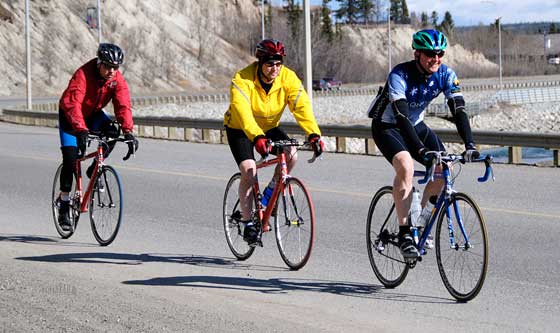
SHARING THE ROAD – Scott Kerby, right, leads a group of cyclists up Robert Service Way on May 8 during one of the VeloNorth Cycling Club's group rides.
Photo by Annalee Grant
SHARING THE ROAD – Scott Kerby, right, leads a group of cyclists up Robert Service Way on May 8 during one of the VeloNorth Cycling Club's group rides.
A fatal crash involving a group of cyclists in Montreal last week is sending shockwaves across the country.
A fatal crash involving a group of cyclists in Montreal last week is sending shockwaves across the country.
Three road cyclists were killed and three injured on a highway east of Montreal while training for a triathlon, after they were struck from behind by a pick-up truck.
VeloNorth Cycling Club president Scott Kerby said the deadly crash is something the Yukon has been lucky enough not to have experienced.
"I think we've been fortunate to not have any serious accidents between vehicles and bicycles on the local highways,” Kerby said.
The road cycling club president said that many of the Yukon's highways are built for cycling with wide shoulders that help protect riders from traffic.
"The wide shoulders on the Alaska Highway near Whitehorse have allowed for a place for cyclists to ride that is separate from the traffic lane,” he said.
Highway 112, where the fatal Quebec crash occured did not have paved shoulders for cyclists to use.
Even with the wide shoulders, Kerby said it is still important for both cyclists and motorists to be cautious.
"Both drivers and cyclists still need to pay attention, however, when a vehicle is passing a cyclist,” he said.
Kerby offered these tips to help motorists share the road with cyclists.
"When passing, it is appreciated if drivers can allow some space between the vehicle and cyclist, but only when safe to do so,” he said.
Kerby adds that it is important for cyclists to be cognizant of vehicles on the road.
"Ideally, the cyclist should ride predictably and stay to the right hand side of the shoulder or lane (if there is no shoulder),” he said.
The South Klondike Highway is one that Kerby said does not boast wide shoulders for cyclists, but it happens to be a very popular ride.
"In those situations where there is no or minimal shoulder, cyclists need to stay as far right as possible, and it is appreciated if drivers slow down and/or give space between the vehicle and cyclist, especially at highway speeds,” he said.
Kerby said one of the most important things is that cyclists and motorists learn to share the road, as well as physical structures that can be built to put cyclists out of harm's way.
"I think there is both implementing physical structures to create safer riding conditions and developing attitudes of ‘sharing the road' that can assist in reducing the risk of collision,” he said.
Those structures include designated bike lanes, which Kerby said the City of Whitehorse has been supporting, such as the one on Hamilton Boulevard leading up to the Canada Games Centre and beyond.
Larger cities in Canada have designated bike roads as a physical barrier between cyclists and traffic.
Kerby said that raising public awareness of safety issues, and what can be done to improve safety is important as well.
"Physical safety can also be addressed through public education on safety – reflective clothing for cyclists, ‘driving alert' for drivers,” he said.
Kerby added that sometimes sharing the road is a tough subject to tackle with drivers and cyclists, but is happy with how Whitehorse residents react to their fellow road users.
"Regarding attitudes for ‘sharing the road', that might be more difficult, but I do think, for the most part, that our community does well in that regard,” he said.
Whitehorse has many commuter cyclists and recreational bike riders.
"Most drivers do ‘share the road' and allow for extra space, or slow down, when passing a cyclist,” Kerby said.
One thing that helps is that Whitehorse's cyclists are drivers too – and have learned to appreciate the extra space.
"In places where cycling is a large part of the culture, many drivers are also cyclists and appreciate the need for safe driving,” Kerby said.
The bottom line is, that in a crash, a cyclist is not going to win against a vehicle.
"When there is a collision, it will always be the cyclists who will suffer greater physical injury,” Kerby said. "Creating physical structures, developing ‘share the road' attitudes, and promoting safe riding and driving skills will be ways of at least decreasing the risk of collision.”
Kerby has used his bicycle as transportation, as well as for bike touring and road riding all over the Yukon and other countries.
In order to encourage thoughtful and responsible discussion, website comments will not be visible until a moderator approves them. Please add comments judiciously and refrain from maligning any individual or institution. Read about our user comment and privacy policies.
Your name and email address are required before your comment is posted. Otherwise, your comment will not be posted.
Be the first to comment