Pan-territorial basketball camp breaks new ground
The top young basketball players in the North have a lot to teach each other.
By Jonathan Russell on April 19, 2011
The top young basketball players in the North have a lot to teach each other.
Both on and off the court.
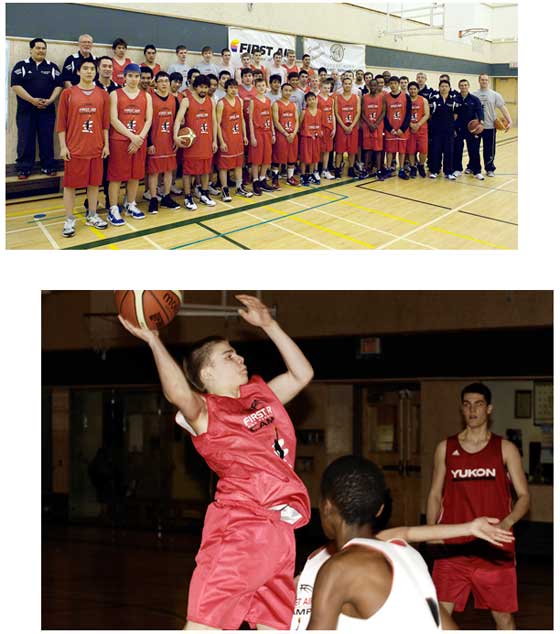
That's what Basketball Yukon president Tim Brady had in mind when he coordinated the first ever All Territory Men's High Performance Basketball Program and Team Tournament, held in Yellowknife from April 11-16.
"I think at the end of the day, all of these guys mesh pretty well, as did coaches. And it was good to see. If you're playing as a territory, you need to do that, get over the differences and really appreciate the things that we're doing together to try to improve collectively,” Brady said.
Fourteen players from each territory between ages 13 to 17 spent the week working on personal development on and off the court as part of a pan-territorial basketball player development initiative.
A typical day consisted of basketball skill and concept sessions in the morning, followed by a life skills program that focused on nutrition, career choices, conflict resolution, stress and stress reduction, decision making and leadership. Each evening, players competed against each other as one of four teams.
As part of the off-court portion, four-time Olympic cross-country skier Sharon Firth of Aklavik, N.W.T., gave an inspiring speech to the group.
(In 1972, twin sisters Sharon and Shirley Firth were the first aboriginals to represent Canada at the Olympic Games.)
The technical director for the camp was former Canadian Olympic basketball player Greg Francis, who is now the men's basketball coach at the University of Alberta.
That was a highlight for 17-year-old forward Peter Hanson of Whitehorse.
"He was really informative and helped a lot of players out. He went to the Olympics and played with Steve Nash on Team Canada. He's got a lot of background,” said the Porter Creek Secondary student.
Turns out Canada's basketball community isn't so big.
Francis was one of Brady's contacts whom he's been looking to bring to the North for the better part of five years.
Three months ago, Brady asked Francis to come up and be part of the camp.
"Maybe I just caught him at a good moment, but he was more than willing to come,” Brady said.
"He really was able to connect to the kids there, a great communicator, a great teacher of the game, built great rapport with everyone – coaches and athletes – and has a lot of playing and professional knowledge of the game as well as coaching. He's played at a high level, he's represented Canada at the Olympics and he's played professionally in Europe.
"He's really an up-and-coming coach in Canada, and it really showed in his approach.”
The objective of the camp was to give serious players the chance to train with a high-performance coach like Francis in a high-performance camp setting.
"The other goals were to help identify potential players and athletes that would be interested in participating on our all-territory men's team, which competes at the Canadian National Championship tournament each year,” Brady explained.
This year's Canadian National Championships will take place in Toronto from Aug. 1-6 in both the U15 and U17 age groups.
The North has sent an all-territory team to nationals for the past six years.
Hanson is one of the five returning Yukon players vying for a spot on this year's squad.
And there is no shortage of skill to choose from, Hanson said.
"Coming from small populations, it's good to see diversity and play with other players. It's great to have other players to play against.”
The team selected to head to nationals will converge on Whitehorse in July for a month of intensive training.
Last week's camp gave Brady and Basketball NWT president Damien Healy and Basketball Nunavut president David Penny the chance to mix and match players from various parts of the North.
"This gave us a better chance to really look at kids and to see them play in different settings and with different combinations of kids,” said Brady, who has been the head coach of the pan-territorial team since it began.
He noted the differences in style and skill between the three territories.
"I think in some areas (the Yukon players are) advanced compared to some of their counterparts. Our guys maybe have a little bit more of a jump in some of their footwork, and their understanding of some of the concepts of play that we were teaching them; have a better understanding maybe of playing off of penetration a little bit, that type of thing.
"It's not a night and day difference, but they're pretty close to being at the forefront. I think Northwest Territories had some really good kids, as did Nunavut.
"The Nunavut kids tend to play a little bit more up-and-down in style, they like to run; they're very fast and very quick, and they like to get into a full-court running style game, whereas we're a little bit more methodical and we try to maybe play a little bit slower and take advantage of mismatches. I think Nunavut likes to go up-tempo with their kids and play fast – because they are fast, they are very, very quick.”
Brady also noted that this camp gave Nunavut's premier players the chance to meet – for the first time – because that territory is especially spread out.
The coaches at the camp combined players from each territory onto teams that played together and hung out off-court, in part to "break down some of the barriers that may exist between them,” Brady said, adding that the territories have a tremendous rivalry which will be on display at the 2012 Arctic Winter Games in Whitehorse.
"But when they play together, they have sort of an adapted mentality – it's us against everybody else, and that's how they play.”
Be the first to comment