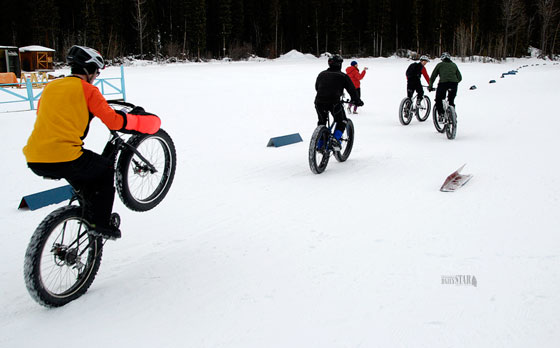
Photo by Sam Riches
FAST START – A group of racers begin a lap at the biathlon range on Grey Mountain Road. Jonah Clark led the field by completing seven laps of the 6.5 km trail.
Photo by Sam Riches
FAST START – A group of racers begin a lap at the biathlon range on Grey Mountain Road. Jonah Clark led the field by completing seven laps of the 6.5 km trail.
On Sunday morning, 23 winter bikers took to the Grey Mountain trails to test their skills, endurance, and courage in the first ever "Five Hours of Light Fat Tire Festival.”
On Sunday morning, 23 winter bikers took to the Grey Mountain trails to test their skills, endurance, and courage in the first ever "Five Hours of Light Fat Tire Festival.”
The riders attacked a 6.5-kilometre loop trail starting at the biathlon range and cutting north before winding back to the range.
Jonah Clark led all riders by completing seven laps for a total of 46 kilometres.
Sierra van der Meer led all female riders with three laps and team "Pearsons and a Girl” led their field with seven laps.
The race was inspired by the traditional 24-hour bike race format, said van der Meer, who also helped co-ordinate the event. The racers competed from sunrise to sunset, which on Sunday was for five hours and 49 minutes.
For the majority of the racers, one lap of the trail took about 45 minutes. The competitors were free to rest as long as they wanted between laps, many taking cover in one of the range's cabins and enjoying chili, hot drinks, and discussing the day.
"It would be nicer if it were colder outside so the trail would be harder,” said Mario Villeneuve, another of the event's co-ordinators. "But in snow biking you have to push, it's not a bike race unless you're pushing for a few kilometres.”
Villeneuve said the race began as a joke. "We were meeting with the club (Contagious Mountain Bike Club) and we were saying how we have a race for the longest day of the year so we should do something for the shortest day. Eventually, it turned into this.”
"We're hoping it turns into an annual event,” said Jenn Roberts. "I think there could be as many as 60 snow bikes in town now so there's definitely a community for it.”
Van der Meer said four years ago there were about four winter bikes around the city and in recent years there has been an explosion.
"It's like riding a skinny bike,” she said. "Or riding in really wet mud. You don't have the same control but you do have a very soft landing…unless you hit a tree. But generally you're bailing into a snow bank and then it's fun.”
After that, and perhaps absentmindedly, I agreed to join the racers for one lap around the trail.
"Not to be micromanaging, but you're really not dressed for this,” one of the bikers told me as I stood in the warmth of the cabin, wearing jeans, loafers, and no gloves.
The racers were quick to offer me adequate gear and one of their bikes.
As I climbed onto it, I was immediately surprised by how sturdy the bike felt.
The fat tires provided suspension and the packed snow at the starting line was easy to ride.
That initial sturdiness lasted about three minutes.
After completing the first turn and then the first climb, I began thinking to myself how easy this was.
‘These guys are just putting it on,” I thought. "This really isn't much different then regular biking.”
Seconds later, I was face first in a snow bank.
Lesson learned.
The rest of the pack rode by, shouting words of encouragement or just shrieking, which I came to learn is in the mountain biking code of conduct.
Determined, I hopped back on the bike and pedalled as hard as I could.
Immediately my back tire slide out from under me and I was face first in the snow again. We had ridden about 500 metres.
As the trail progressed there were sections with sharp turns, steep declines, switchbacks and eventually a monumental drop-off that would surely severely injure anyone who attempted to ride it.
The comparison of riding in really muddy conditions is adequate but I would go one step further and say winter bike racing is more closely compared to insanity.
Clark, the superstar of the day, approached the drop at the same time as I did.
He waited patiently as I partly walked but mostly slid down the hill, opting to push my bike rather than perish in a snowy demise.
After planting my feet on even ground, I looked back up the hill and saw Clark proudly standing on the edge of the drop-off.
With about seven of us watching on, he slowly moved forward before flying down the hill at an incredible speed.
As he reached the bottom, there was an explosion of snow.
Clark had "augered.” Mountain bike slang for falling or taking an involuntary geological sample, usually with one's face.
The group cheered as Clark slowly rose to his feet, snow covering his entire body.
"That could have been dangerous,” he said.
From that point on, I realized my falls into the snow were baby steps compared to Clark's warp speed bail.
The rest of the day became even more enjoyable as I learned to embrace the face-plants.
As I made it back to the range, I joined the other racers in the warmth of the cabin. It was clear everyone was enjoying the atmosphere and rejoicing after a day of riding.
"There's no big prize,” Roberts said.
"It's really about getting people out and enjoying the social experience.”
"People are really just racing against themselves.”
The top riders for the day were awarded homemade medals: blue stars adorned with shiny blue ribbons.
"Hopefully this is the start of something,” said Villeneuve, with a smile. "It would be great to do this every year.”
In order to encourage thoughtful and responsible discussion, website comments will not be visible until a moderator approves them. Please add comments judiciously and refrain from maligning any individual or institution. Read about our user comment and privacy policies.
Your name and email address are required before your comment is posted. Otherwise, your comment will not be posted.
Be the first to comment