Ex-baseball player finds redemption in Whitehorse
Keigo Tokura sits across from me in the International office at Yukon College.
By Sam Riches on January 13, 2012
Keigo Tokura sits across from me in the International office at Yukon College. He wears a navy blue hooded sweatshirt. The Boston Red Sox logo is stamped across the chest. We are joined by Yoshie Kumagae, a translator and the International Education Coordinator for the college.
Tokura leans back in his chair and breathes in deeply.
He's been in Whitehorse since September, when he began studying English at the school. At just 24 years old, he's working toward his second career.
His first stint in the workforce was unconventional and ended unceremoniously.
He had spent one season as a catcher with the Mie Three Arrows, a professional baseball team in Shikoku Island League Plus, a baseball league on the islands of Shikoku in Japan.
His rookie season had been underwhelming, he was a good player but he was inexperienced compared to his veteran teammates.
Motivated to close that gap he spent the following off-season refining his game. He was determined to make a significant impact with the team the next season and take the next step to the highest professional league.
He was used to a life that revolved around the sport. He began playing baseball competitively when he was six years old. In his youth he would train six hours a day, six days a week.
"I wanted to play baseball every day and all time time,” he says. "It was everything.”
His favourite player was Motonobu Tanishige, a catcher in the Nippon Professional Baseball league, the highest level of baseball in Japan.
He's known for his defensive abilities and understanding of the game.
"He's not so tall, like me, and he's a baseball genius,” Tokura says proudly.
After his first season with the Mie Three Arrows, Tokura trained as much as he could. He was a versatile player, able to play any position in the infield and even spent some time on the mound as a pitcher.
His strength was at the plate, though. Some games he would play as the team's designated hitter. He wasn't a power hitter but he was smart offensively, reading the opposing teams defence and placing the ball with accuracy.
As the off-season concluded and training camp began, his efforts had paid off.
There were noticeable improvements in his confidence and skill set.
But a routine play changed everything.
After smacking the ball down the baseline during a spring training game, he was rounding the bases when his right hamstring tightened up like a piece of hard rubber.
The injury seemed routine but the damage was severe.
Tokura weighed his options. He could attempt to rehabilitate his leg but he would miss the season and not get paid during his recovery. He thought about retirement, about leaving the only profession he had ever known and forgetting the dream he had been chasing his entire life.
"I was very disappointed,” he says softly. "I talked to many, many people to figure out what to do with my life.
My life had been baseball and without it I was lost.
"If I wanted to come back and play baseball again I needed lots of treatment and training for recovery. The time I needed to get proper treatment to play at that level again, it was going to take too long.
"So the team decided to fault the contract and I decided to retire.”
It wasn't an easy decision to make, but as he looks back years later he feels it was the right one.
He still wrestles with thoughts of the game, of what could have been. His passion for the sport still burns deeply.
In December, he woke in the middle of the night, stirred from his sleep by a nightmare. Even in his deepest state of rest, thoughts of baseball still ran through his head.
The dream made him realize that had yet to make peace with the game.
A situation he hopes to remedy by learning to embrace the sport again. He wants to be able to watch baseball, a task that sounds simple, but can be painful when the scenes of a game carry him back to his own playing days.
He also would like to work as a coach for younger players, a position he's held in the past and a constructive way to pass on his knowledge and experience of the game.
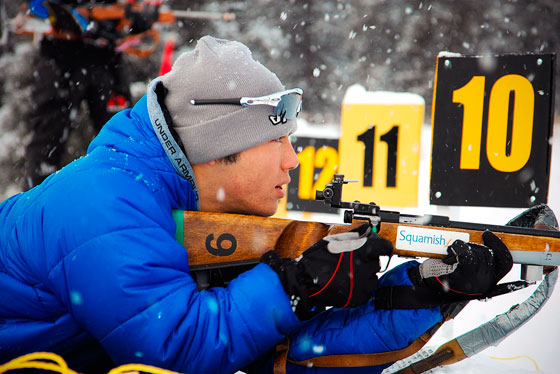
In the meantime, he's taken up biathlon.
A sport he remembers watching during the Olympics as a child in Japan. He says
it's a great experience to now be able to participate in the sport on the other side of the world.
"Everyone has been so kind,” he says of the local range. "They are all very nice people.”
He enjoys the opportunity to compete, even at a recreational level, and the opportunity to speak English.
He's picking up the sport quickly, and will decide along with members of the club,
whether or not compete in any of the events this season.
He says the instruction he receives at the range is similar to the professional coaching he received in Japan.
"They work to understand me, to see where my skills are and where I can improve,” he says.
It's a far cry from his younger days, where stern coaching and strict regiments took credence. Once he reached the professional ranks, the coaches became more understanding.
"It was easier,” he said. "All I had was baseball, no school, no work.”
Some of his teammates are still playing, some have found other careers, and some have reached the highest professional league.
Part of him still desires to return to the competitive field but he knows the window of opportunity is coming to a close.
"I will be 26 by the time I graduate Yukon College,” he says. "It's time to start a living.”
He's unsure if he will return home upon graduation. He says he enjoys living in Canada and he's focused on obtaining work as an international business trader.
He says he doesn't miss being home, except for the food. Specifically a fermented soybean dish called Natto. Kumagae laughs at this and wrinkles her nose. "I can't eat it,” she says. "It's too stinky.”
Tokura defends the traditional dish, saying it's high in protein and low in fat. Even in retirement, he still thinks of eating healthy and staying in shape.
His dedication to baseball has now been transferred to his studies. He knows the next two years of his life will be dedicated to his education and it's a challenge he's embracing. His competitive spirit remains but between classes, recreational sports, and his aspirations for the future, he feels at peace.
He's ready for his next career.
Be the first to comment