Photo by ANNA CRAWFORD
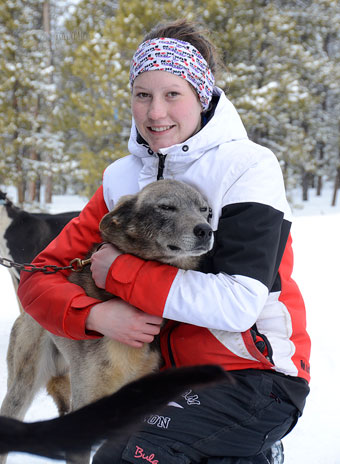
IMPRESSIVE PERFORMANCES – Rachel Kinvig continued her dominance on the trail at the 2012 Games.
Photo by ANNA CRAWFORD
IMPRESSIVE PERFORMANCES – Rachel Kinvig continued her dominance on the trail at the 2012 Games.
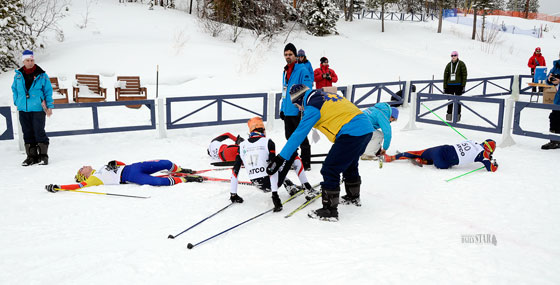
Photo by ANNA CRAWFORD
IMPRESSIVE PERFORMANCES – Cross country skiers collapse after crossing the finish line in the 10-kilometre classic race on March 8th.
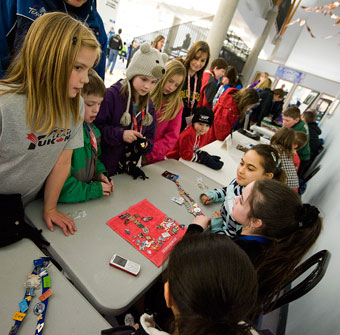
Photo by VINCE FEDOROFF
TIME FOR A TRADE – A crowd gathers to indulge in some pin trading during the Arctic Winter Games. Pin trading is a traditional element of the Games.
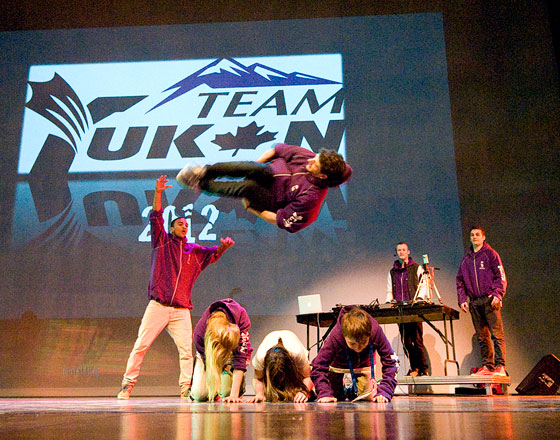
Photo by
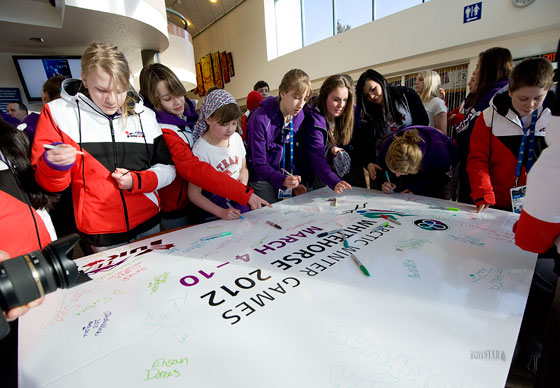
Photo by
Photo by
For the past week, over 300 Yukoners competed against international athletes from across the circumpolar North.
For the past week, over 300 Yukoners competed against international athletes from across the circumpolar North.
It was the 22nd running of the Arctic Winter Games and the sixth time Whitehorse has hosted the event.
By all accounts, it was one of Yukon's finest performances.
The territorial athletes collected 122 ulus (medals) with 46 of them coming in gold.
They ended a 26-year medal drought on the volleyball court, with the junior males capturing gold and the junior females winning silver.
They set records, with Rachel Kinvig collecting her eighth gold medal on the dog mushing circuit and remaining undefeated in two years of AWG competition.
They represented the Yukon and exemplified the spirit of fair play and friendly competition.
The Games were made possible with the support of over 2,000 volunteers, coming together to work for seven days.
"It was amazing to see everyone work together,” said Chris Milner, general manager of the Games.
"You come to learn that people have great problem solving skills. They have great creativity. They just come to work and solve things as a team.”
The AWG is primarily a volunteer driven event with only 10 staff members.
Milner was responsible for providing support to the staff and volunteers, keeping everyone connected and directing the Games as they progressed.
"Everything went great. I'm really happy with how everything unfolded,” he said.
"There's always challenges when you introduce 5,000 new clients into a community over a short period of time but I think Whitehorse stepped up and delivered a great Games.”
George Arcand, president of the AWG host society, also said he was impressed with the support of the community.
"The community really stepped up, if they weren't volunteering, they were certainly coming out to watch,” he said.
"The response I've been getting from everyone has been really positive. They seemed to love it.”
Arcand referred to the performance of the territorial athletes as amazing.
"Typically we're behind the N.W.T in the medal count but the kids came roaring out and just never stopped,” he said. "We had kids that were winning biathlon and a number of sports where they weren't expected to win. It was amazing. They were great.”
Milner said the success of the athletes could be traced back to the support of the community.
"Yukon's success is a huge testament to our sports system,” he said. "Yukon has a really high quality and diverse system built on a volunteer coaching and officiating structure and it's a benefit to where we live. A lot of people give a lot to the community. And the kids benefit a lot from those experiences.”
A former athletic participant in the Games, Milner said he was most impressed with the Arctic sports competition.
"I had no idea the complexity of the Arctic sports,” he said. "I was amazed at how it unfolded and in particular how the athletes all help each other even when they're
on opposing teams.”
That spirit of fair play is the reason the Games happen, said Milner.
"It's a big complex project, delivered on a fairly small budget and held to a high standard. It happens because people care about them, they really love the Games, and they invest a lot of their own time and energy to make them happen.”
For their efforts on the court, field and ice, nine Yukon athletes were awarded fair play pins.
Pin trading is a traditional element of the Games. The athletes, coaches and everyone involved in the event tend to get swept up in the trades.
"For me a highlight was the kids and the pin trading,” said Arcand. "The interaction that promotes amongst all the kids is really neat to see.”
Brad Anstey, head coach of the N.W.T midget boy's hockey team said he couldn't help but get involved in the pin trading.
"One of the assistants got me into it,” he said. "And before you knew it, all the coaches and the players were doing it and we forgot we were here to play hockey. It's a ton of fun.”
Aside from athletics, the Games are also a celebration of northern culture.
The cultural component of the Games was rife with performance and visual artists, showcasing the local and international talent.
The cultural ceremonies were sold out, said Arcand, with the community coming out in throngs to support the exhibitions that ranged from throat singing, modern dance, traditional crafts, snow carving and others.
"There was lots of support, lots of smiling faces, people were really happy with how things unfolded,” said Milner.
"We accomplished a lot in a short period of time and that's not something every community is able to do.”
In order to encourage thoughtful and responsible discussion, website comments will not be visible until a moderator approves them. Please add comments judiciously and refrain from maligning any individual or institution. Read about our user comment and privacy policies.
Your name and email address are required before your comment is posted. Otherwise, your comment will not be posted.
Comments (1)
Up 0 Down 0
Arlete on Mar 20, 2012 at 9:54 pm
There is a critical shortage of informative articles like this.