Photo by Vince Fedoroff
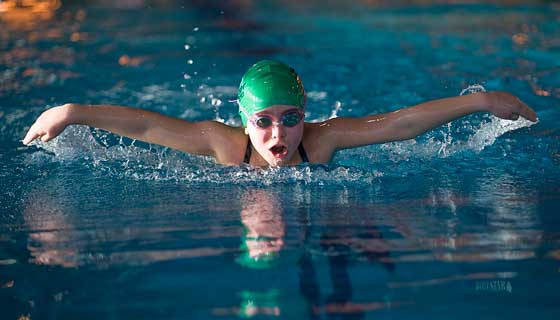
EIGHT FIRSTS – Rennes Lindsay, pictured swimming at the Canada Games Centre today, recently won eight first-place ribbons in eight events at the Dino Cup at the University of Calgary.
Photo by Vince Fedoroff
EIGHT FIRSTS – Rennes Lindsay, pictured swimming at the Canada Games Centre today, recently won eight first-place ribbons in eight events at the Dino Cup at the University of Calgary.
Rennes Lindsay loves her sport.
Rennes Lindsay loves her sport.
And it shows, both in her results and her giggles while speaking about it.
The Whitehorse Glacier Bear won eight first-place ribbons in eight events at the Dino Cup at the University of Calgary last weekend.
"Um, happy,” she laughed once asked how winning all those ribbons made her feel.
This was the second straight year Lindsay went eight for eight in the Dino Cup, the only swimmer to win every one of her races there.
She is, as you can imagine, happy about that second feat as well.
Swimming in large meets for the first time can make a young competitor nervous.
Lindsay is the same way, she said.
Except.
"When I get in the water, it doesn't make me so nervous,” she said.
Kathy Zrum, who coached the Glacier Bears over the weekend and also coaches the Black Bear 2s, said if Lindsay is nervous it doesn't show.
"She's just improved in leaps and bounds in all her strokes, so it was neat because she won first in a lot of different strokes, it just wasn't all in freestyle,” said Zrum.
"(Rennes) won her backstroke, her breaststroke and her 200 IM, she just had a fantastic race. She was quite ahead of some of the other swimmers – she lapped a couple people in that race. She had a solid performance all weekend.”
Lindsay won first in the following events: 50-metre freestyle (38.55), 100 free (1:27.2), 50 backstroke (47.92), 50 breaststroke (58.22), 100 breaststroke (1:56.7), 50 butterfly (48.71), 100 individual medley (1:44.3) and 200 individual medley (3:33.6).
Not to mention that she also won the aggregate in the eight-year-old female group with 72 points.
"We've been working a lot on technique and trying to find ways to be as efficient as we can as we swim, and she's really been incorporating that technique and efficiency into her practices,” Zrum said.
"We spend a lot of time on turns and her turns are getting to be a lot quicker, she's developing more as a swimmer as she gets older. She's still only eight years old.”
Zrum said that both Rennes and her sister Cassis are very committed swimmers.
Their mother was a high-level Australian swimmer.
"I think both of them have a really good training and work ethic and that really shows,” Zrum said.
Cassis won second twice, in the 50 free and 50 back, as well as two fourths, in the 50 fly and 50 breaststroke, and the rest in the top six in the 10-year-old female category.
This is not to suggest winning is a family affair, unless you consider the Glacier Bears a family, which mightn't be too much of a stretch.
They certainly do win together.
Celeste Findlay won five firsts, one second, one third and one fourth at the Dino Cup.
"Three of those girls work extremely hard, and they really understand that how hard you work in practice is going to reflect how well you can swim at competitions,” Zrum said.
Eight-year-old Hannah Kingscote, in her first swim meet, nabbed a third in the 25 fly.
"As a whole, I think it was an extremely wonderful opportunity for some swimmers like Shailyn Moore, Hannah Kingscote had never been to a swim meet before, and then kids like Liam (Diamond) and Alex (Petriw) have been to a couple Alaska meets, but this was bigger,” Zrum said.
She pointed out that there were more than 200 swimmers from 15 teams across Alberta, British Columbia and the Yukon, ages seven to 10.
One of the key aspects to competing in such a meet is to get the young swimmers used to competing Outside, she added.
"The kids have to be focused and they have to remember about the next event,” for instance, Zrum said, adding that would have been much more difficult without the help of co-coach Tim Sellars.
"Every kid swam their races. Which is phenomenal, because you think, eight and nine, sometimes they can wander off, get lost; but they were all asking, ‘When do we have to go up to get marshaled,' ‘Is it time to go up yet,'” Zrum pointed out.
Swimmer Dana Sellars, nine, was moved to the wrong lane by an official, whom she corrected, but still swam the race.
Kingscote re swam her 25 back the following day because the timing gear failed.
These are just examples of what can happen at large meets, Zrum said.
"So it wasn't without things that happened, but the kids just rose to the occasion and just performed really well.
"Five, six hours is a long time to be at a pool, but they kept themselves entertained, they found things to do between heats, staying hydrated, eating good, healthy snacks – a lot of the behaviours you want to see later on at meets they were getting the opportunity to try.”
Once all this falls into place, she added, winning races is just icing on the cake.
"I think it just reflects on how hard all the kids have been working in the club throughout the season and how much they're improving at this age,” Zrum said.
"And I saw those behaviours. As a coach, having the success and improving not just time-wise, but skill-wise, technique-wise and being able to have the focus to be able to race and be in the moment for that five, six hours that you're at the pool.”
The Glacier Bears have a history of success nearly unparalleled with clubs and associations in the Yukon.
Alexandra Gabor was recently awarded a full scholarship to Stanford University in Palo Alto, Calif., near San Francisco, following years of success on both the national and international stages.
MacKenzie Downing competed in the 2010 Commonwealth Games in Delhi, India, and held a national record in the 100 fly.
Not to mention countless other swimmers who continue to nab incredible results, particularly while considering the population in the Yukon and the distance it takes to get to a swim meet Outside.
"I think cross country skiing has some pretty consistent results too,” Zrum said. "But I like to think we're doing some consistent things, and I think maybe one reason is that we're keeping kids, so you're able to develop them over three, four years. I've worked with some of the kids I have for the past two years, and they've been in the club for maybe four or five years, so you get that consistency, and they grow and develop and improve.”
In order to encourage thoughtful and responsible discussion, website comments will not be visible until a moderator approves them. Please add comments judiciously and refrain from maligning any individual or institution. Read about our user comment and privacy policies.
Your name and email address are required before your comment is posted. Otherwise, your comment will not be posted.
Be the first to comment