Photo by Jonathan Russell
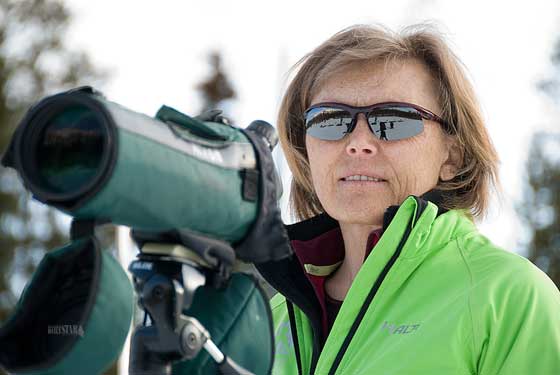
BACK TO BASICS – Judy Hartling retired as senior coach for Biathlon Yukon after the 2011 Canada Winter Games in Halifax, N.S. She began as a coach for the Bears program in the '90s.
Photo by Jonathan Russell
BACK TO BASICS – Judy Hartling retired as senior coach for Biathlon Yukon after the 2011 Canada Winter Games in Halifax, N.S. She began as a coach for the Bears program in the '90s.
Judy Hartling has been coaching biathlon since the mid-late '90s.
Judy Hartling has been coaching biathlon since the mid-late '90s.
She has difficulty pinpointing the exact year.
"Ninety-six? Ninety-seven?” she says.
More important for her is the date Feb. 16, 2011.
That's the day Biathlon Yukon athletes Erin Oliver-Beebe, Jennifer Curtis and Jeremy Johnson finished their last race at the 2011 Canada Winter Games in Halifax, N.S.
And it's also when Hartling had decided to retire.
She's put in a lot of time.
"At first you don't realize it's happening,” she said. "How would you describe it? It's not like it's a death – it's just a huge, huge change. You have to psychologically deal with it and prepare yourself. I suppose it would be like an athlete who's been a professional athlete; you have to prepare yourself for the day when it's going to end.”
Her athletes fared well that last day against the country's best.
Oliver-Beebe finished 11th and Curtis finished 16th in the 10-kilometre pursuit.
These results were especially gratifying because both 16 year olds competed in the junior women category at the Games rather than in senior girls, in which biathletes rack their rifles, Hartling explained.
"And there were national team members skiing there, so they had tremendous results,” she said.
Oliver-Beebe's best result in Halifax was 11th in the 10-km pursuit, while Curtis excelled in the 12.5-km individual with a 12th-place finish.
The Games were a fitting end to Hartling's coaching career.
And she knew it some years ago.
"What I had said, about four years ago, was that I would commit myself to coaching them until the Canada Winter Games 2011,” she said, adding she failed to realize the demand of such a plan until it was over.
"And then you go, ‘Wow – that was pretty intensive.'”
Hartling began in the sport like many parents get involved with sports.
Her son Lars had been in the Jackrabbits at the Whitehorse Cross Country Ski Club at Mount McIntyre, where she had been a coach.
Before Lars was 10 years old he began losing interest in skiing.
"His dad said, ‘Well, lets give him a gun,'” Judy said, "because his dad was a biathlete.”
So they made the jump over to Grey Mountain.
In fact, about five Jackrabbits made the jump that year.
There was a lull in the cycle and no coach for the young group, Hartling said.
"There wasn't an organized Bears, so I said, ‘I'll do it, but you have to teach me which end of this thing the bullet comes out of.' And that's exactly what happened.”
Biathlon coach Lars Fossum helped her out with that.
Current Biathlon Yukon president Keith Clarke came over with a few kids, and within two, three years there were more than 20 young biathletes.
This particular group of biathletes kept coming back year after year, Hartling noted, and she eventually made the jump from the Bears program (ages nine-13) to being head instructor of the juniors (14-17 years old).
"There really wasn't a coach to stay with them, so I just kind of grew with the kids. I educated myself. I took coaching courses, keeping in mind I already had my ski instructor course and my ski coaching courses.”
She took her level one biathlon coaching course in Whitehorse, and followed that up with her levels two and three by attending courses in Canmore, Alta., in 2002 – in addition to already having her level one coaching certificate in cross country skiing.
"If I was going to coach the kids as they were growing they needed a coach who was knowledgeable of the sport, so I went out and ensured that I was knowledgeable and I could pass it on,” she said.
"Because biathlon's a complex sport, both with skiing and shooting, you have to educate them on their heart rate, their pacing, and you have to teach them how to put it together.”
All the pieces were falling into place.
"I love the sport. I fell in love with the sport. I bought my own rifle,” she said.
"That's what I did to keep up with the kids so that they could really have an opportunity to be good biathletes. And ultimately, we kept a pretty sizeable group together for biathlon for many years.”
The group started going to Outside races in Alberta to get used to competing, and eventually started going to Western Canadians and nationals.
In fact, Hartling noted, the first nationals that team went to they won bronze in the relay in 2008 – the same year she was given the Carl Zeiss Female Coach of the Year honour at the Biathlon Canada Annual Awards.
"We ended up with a team that became very competitive,” she said.
Competitive right through to seniors.
She was on the executive initially, but had to devote her time to coaching the senior team.
"You go from coaching the Bears on a Sunday afternoon, every Sunday afternoon, you prepare those lessons and you prepare yourself, and it's all volunteer, and that was fine and I took it very seriously and I was very conscientious about being ready and prepared; so they become juniors, so then you start coming twice a week, and then you start having to do lesson plans and then you start going out of town,” she said.
"And I really had not anticipated the amount of hours that I would ultimately have to put in coaching the senior team, because you're here three times a week, you're preparing daily lesson plans, you're preparing yearly plans, you're traveling with them, you're taking time off of work – it's pretty intensive.”
But she's not stepping away from biathlon completely.
She's still involved up at the range and intends to continue volunteering, just not in the same capacity.
For instance, she is on the venue committee for the 2012 Arctic Winter Games in Whitehorse.
But she has to limit herself, she said.
"I enjoy the kids. But you get attached to them. I mean, young people are the promise of tomorrow, and you really want to make sure that you prepare as best you can to give that to them. So I want to step back from the coaching, because I can just see myself getting back into it and doing this sort of thing again and spending too much time with it.”
Hartling added: "I guess all I can say is it's been a tremendous experience. I've had a really committed, consciencious group of kids, and it's been an honour to coach them up to the level that they are now.
"Some of the kids came, and they couldn't even shoot on the bull; and to watch them just even grow into the rifles, that's been good.”
In order to encourage thoughtful and responsible discussion, website comments will not be visible until a moderator approves them. Please add comments judiciously and refrain from maligning any individual or institution. Read about our user comment and privacy policies.
Your name and email address are required before your comment is posted. Otherwise, your comment will not be posted.
Be the first to comment