Photo by Star photo by JUSTINE DAVIDSON
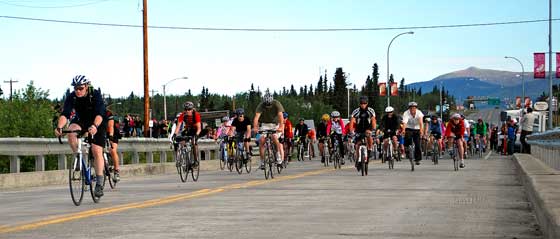
OUT OF THE GATE – Riders leave Haines Junction on leg one of the Kluane Chilkat International Bike Relay on Saturday.
Photo by Star photo by JUSTINE DAVIDSON
OUT OF THE GATE – Riders leave Haines Junction on leg one of the Kluane Chilkat International Bike Relay on Saturday.
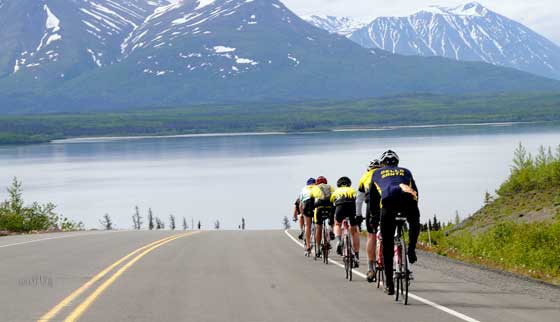
Photo by Star photo by WILL JOHNSON
KNOWING WHEN TO BREAK – A pack of cyclists draft to reduce wind resistance during leg two of the Kluane Chilkat International Bike Relay overlooking Dezadeash Lake Saturday.
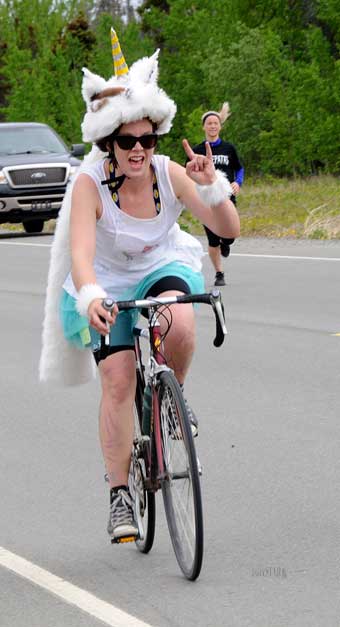
Photo by Star photo by JUSTINE DAVIDSON
ROCKSTAR UNICORN – One of the more stylish cyclists entered in the road relay enters a checkpoint.
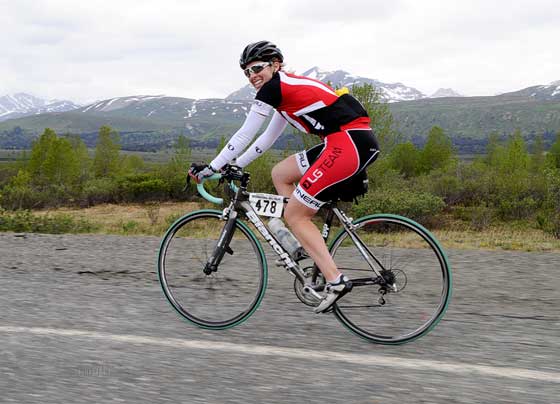
Photo by Star photo by WILL JOHNSON
ALL SMILES – Nancy Hanneman of the four-person women's team the Sprockettes gladly braves the damp conditions on leg six.
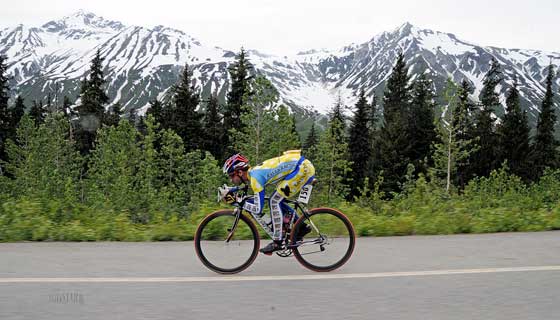
Photo by Star photo by WILL JOHNSON
TUCK AND ROLL – William Coleman tucks down a hill during his men's solo class. The Fairbanks cyclist finished fifth in the class with a time of six hours, 35 minutes, five seconds.
After cycling roughly 240 kilometres, mere seconds separated Stephen Ball and Ian Parker.
After cycling roughly 240 kilometres, mere seconds separated Stephen Ball and Ian Parker.
The two Whitehorse riders finished one and two in the solo men's class of the Kluane Chilkat International Bike Relay (KCIBR) from Haines Junction to Haines, Alaska, on Saturday.
Ball sprinted to the finish for a time of six hours, eight minutes, 20 seconds, 17 seconds ahead of Parker, who clocked a time of 6:08:37.
"We're both really even riders, and it just kind of depends on the day, who's feeling better than the other guy,” Ball said.
"With something like this, it just depends on who's feeling the best at the finish, really. It could go either way. It's a long way, and some days he's going to be feeling better and some days I'm going to be feeling better,” he added.
The two were neck-and-neck down the home stretch.
Parker, a strong climber, chose to make his move up the last hill before the finish line.
Unfortunately for Parker, the hill leveled off too soon, and Bell, a natural sprinter, took advantage.
"There was a little climb, and he knew and I knew that I was going to have a go on the climb. I think I left it a little too late,” Parker said.
"The final hill was a little shorter than ideal for me. So I had a go, and once I saw that Steve's wheel was right on mine, I was happy to enjoy for it for the last couple hundred metres. Why not, hey?” he laughed.
The two were drafting – when cyclists ride in a pack to reduce wind resistance –
with different groups along the way.
That, combined with ideal conditions and tailwind, helped the pair achieve those fast times, Ball said.
"You end up with a group, and hopefully that group is pretty strong and they work together. If everyone does an even amount of work and shares it out then you definitely go faster; it's way fast riding with a bunch of people than what it is by yourself.”
Parker agreed linking up with a good group of riders is key for the Haines to Haines race.
"With those winds, you get on some of the more exposed legs, and to be with others is just a huge advantage,” he said, noting there were roughly 10 minutes when he and Ball were alone on the road.
"But even that was great because we're around the same level, and we can work together and strategize together and never really felt too isolated; and we were lucky enough to catch on with a group of young skiers from Whitehorse and a two-person team from Fairbanks who were great,” Parker said.
"It's probably the biggest challenge riding solo, deciding which attacks are worth going with and which ones you really want to lay off of, because you can't burn too many matches too early in the race because it's a long race. And when you're racing against guys who are getting fresh legs every two legs or every four legs, you really got to be cautious with your energy output.”
Ball added that drafting helps share the workload.
"If there's four of you, you're going to go faster than if it's just one person. If everybody's taking their turn at the front, you're getting more rest, so you're essentially moving faster. So it is important to get a good group,” Ball said, adding that you don't want to break from the group until it's absolutely necessary.
"You want to keep the group together as long as possible because you're going to go faster. That's pretty much what this race is all about, is trying to get in a good group.”
The two cyclists are familiar with each other, both competing against each other in VeloNorth Cycling Club events and training together.
The pair competed in the Tour of Fairbanks stage race from June 9-12 for training for the KCIBR.
The stage race consisted of five events: a prologue, a time trial and three road races, the longest of which was 120 kilometres with nearly 7,000 feet of climbing, Parker explained.
This was Ball's fourth time competing in the solo class of the KCIBR – and his best result.
"By far,” he said. "It was a fast day – super fast – good winds the whole way, nice tail winds, fast times, and we had a really good group to work with. There were four of us, probably from leg three onwards, and everyone was working pretty well together.”
He attributes his success to putting in more time training this year than in the past.
"I'm probably sick of getting third,” he laughed. "I really wanted to give it a good go this year.”
Parker had top three finishes in the KCIBR in the two-person and team classes.
This, however, was his first shot at the solo class.
"I was expecting to learn a lot,” Parker said
"It couldn't have worked out any better; it was the perfect outcome. Stephen
deserved to win, and I was stoked to be with him at the end. It's a fickle sport, but sometimes things just work out, and this is one of those times where it just worked out perfectly as far as I'm concerned. He deserved it.”
Added Parker: "That's what's cool, when everyone ends up in Haines, you can have a beer and enjoy the scenery and just love the fact that we live in the north where we can do stuff like this.”
In order to encourage thoughtful and responsible discussion, website comments will not be visible until a moderator approves them. Please add comments judiciously and refrain from maligning any individual or institution. Read about our user comment and privacy policies.
Your name and email address are required before your comment is posted. Otherwise, your comment will not be posted.
Be the first to comment