AWG host society welcomes chef de missions
For the host society, the 2012 Arctic Winter Games, set for Whitehorse from March 4-10, is quickly becoming a reality.
By Jonathan Russell on October 20, 2011
For the host society, the 2012 Arctic Winter Games, set for Whitehorse from March 4-10, is quickly becoming a reality.
Chef de missions from each of the regions represented at the Games, from as far away as Yamal, Russia, and Greenland, landed in the Yukon earlier this week for meetings in Whitehorse from Oct. 19-22.
"It makes it real, because in a lot of cases this is sort of a test event for us, in that we're showing people what we think our plans are, testing it against what they think our plans should be, and learning a bit from them along the way and adjusting in the last four months,” said Chris Milner, general manager for the 2012 Arctic Winter Games.
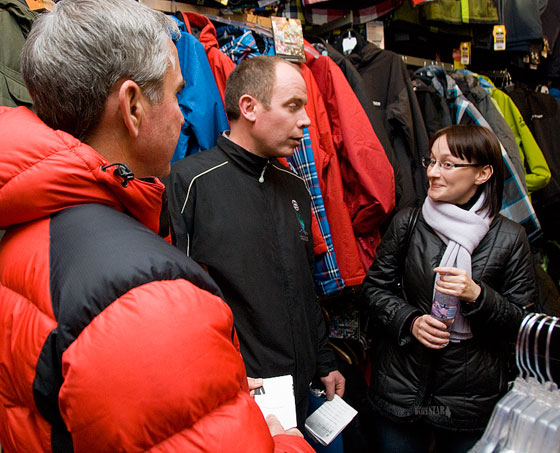
The host society welcomed chef de missions, the international committee and volunteers to a meet-and-greet held at SportsLife Wednesday evening.
"It's the first time that they've all come together for the week of meetings that we'll have,” Milner said.
Meetings continued this morning and will resume Friday morning, with a poker/scavenger race set in venues this afternoon and a mock badminton competition set for Friday afternoon.
"We're trying to create opportunities for people to talk, because generally in a meeting format you're going to get information going back and fourth, but what you really want to learn is what people have to say in the down time, so we're creating opportunities like this here at SportsLife with the merchandise and the volunteers and the interactions that happen between the management and the volunteers,” Milner said.
"We're going to go over everything over the next couple days. They want to know where their athletes are going to stay, what they're going to eat, where they're going to eat, how we're going to bus them around, what hotels we're using; they want to know what our venues look like, how ready they are.
"They mostly want to meet our volunteers, because those are the people that really make it happen.”
Checking out the venues is another highlight, Milner added.
"The Arctic Winter Games are typically held in the North, so these guys are blown away by the Canada Games Centre. There's no other facility in the circumpolar north that's like that. That's something we're really lucky to have.
"They were obviously saddened by the fire and impressed with how quickly everyone banded together to fix that.”
A June fire closed the Games Centre throughout the summer, but is expected to be fully functional within the next three weeks, with the Northwestel NHL ice scheduled to reopen Nov. 1 and the Olympic-sized ATCO ice set to reopen Nov. 14.
Milner noted that nearly half of the athletes will end up competing in or near the Canada Games Centre, with curling and cross-country skiing taking place at Mount McIntyre. Five sports will be held in the Games Centre.
The venues have received much praise from the visitors, especially the Canada Games Centre, which opened in 2006 for the Canada Winter Games the following year.
Greenland's chef de mission Claus Nielsen first visited the Yukon when Whitehorse hosted the 2000 Arctic Winter Games.
"I'm impressed; it's good facilities you have here,” said Nielsen, who left Greenland on Monday to stopover in Copenhagen, Denmark, Tuesday morning. Twenty-six hours later, he said, he was in the Yukon.
"In 2000 it was well organized. I'm excited to see how it will be this time. I hope there will be a lot of volunteers and everyone will be happy when we arrive in March.”
Greenland, which is the most northerly jurisdiction of the represented regions, has been participating in the Arctic Games since 1990, and hosted the event in its capital, Nuuk, for the first time in 2002.
This week marked the first time Alexandr Eirikh, chef de mission for Yamal (Russia), visited Whitehorse.
But Yamal is no stranger to the Games.
Russia sent cultural delegates to the Arctic Games for the first time in 1990, and has since sent small contingents of athletes and cultural performers to each Games since 1992. But it wasn't until 2004 that Yamal made its first appearance as a team, when 37 members competed in table tennis, traditional winter sport events and cultural activities. Yamalo-Nenets is an Autonomous District (similar to provinces or states) within the Russian Federation.
Eirikh spoke through a translator, his assistant Yana Vroublevskaya, to express his first impressions of the territory.
"We like the city and it seems to be very cozy and home-like, and also we see that the host society is on their way to the Games, and everyone is preparing for the best organization and the best final result of the Games,” Eirikh said, adding that there will be much information to absorb over the next few days.
"I think we will receive the full information about how the Games will go and how to prepare our team to come here and what to be prepared for, and I'm absolutely sure our impressions will be perfect.
"We would like to wish to the host society and the organizers of the Games good luck, and to the people of Whitehorse, just to have a truly amazing celebration of sport and culture.”
Competing in 19 sports, nine regions will participate in the 2012 Games: Alaska, Alberta North, Greenland, Nunavut, Northwest Territories, Nunavik, Que., Yamal, Sápmi, and Yukon.
Milner noted that bringing together so many diverse cultures poses its own challenges, such as the differences in language and currency.
"There's challenges, but I think people are in this for the right reasons,” Milner said. "Everything takes a little bit longer. Like we spent a couple hours this morning just sorting out the charter for Team Russia to get here, and it's looking really positive that that's going to work out, but merging the Russian financial system with Canada's financial system is not always the easiest to figure out. So little things like that. But with people with the right attitude and the right intentions, you come out with the right answers.”
And for Gerry Thick, president of the AWG International Committee, these are necessary components to achieving the ultimate goal: that the athletes have fun.
"The most exciting part for me, personally, is when the Games are on and the kids are all here and they're all happy, they're all happy to be here and having a good experience – it's very rewarding to see that,” said Thick, who has been involved with the Games since 1984. "For a lot of these youths, this is the biggest event that they're going to be able to go to.”
Nielsen agreed that, after all the planning, his favourite part of the Games is seeing its positive impact on the athletes.
"To see all the young people have fun, and to experience all the cultures and make friends – that's the biggest thing, to see how happy they are after, when we come home and talk about the Arctic Winter Games in a good way,” Nielsen said.
"That's the good thing, the youth have a good experience.”
Milner can still recall when he participated as a basketball player at the Arctics in Yellowknife, N.W.T., in 1990 and as a soccer player in Whitehorse in 1992.
The amount of work that goes on behind the scenes is difficult to know from an
athlete's perspective, he said.
"I don't think you know that until you get behind the scenes,” Milner said.
"What always surprises me is that we've been working away on this for over a year now, and that's not very long for planning this event. Normally people have another year in addition to that. You look around the room and there are new faces and new people, and you know that everyone of these people is doing something very useful, so there's a lot of pieces to this puzzle. So I think unless you're in the puzzle you don't know the complexity behind it.”
Be the first to comment