Photo by Vince Fedoroff
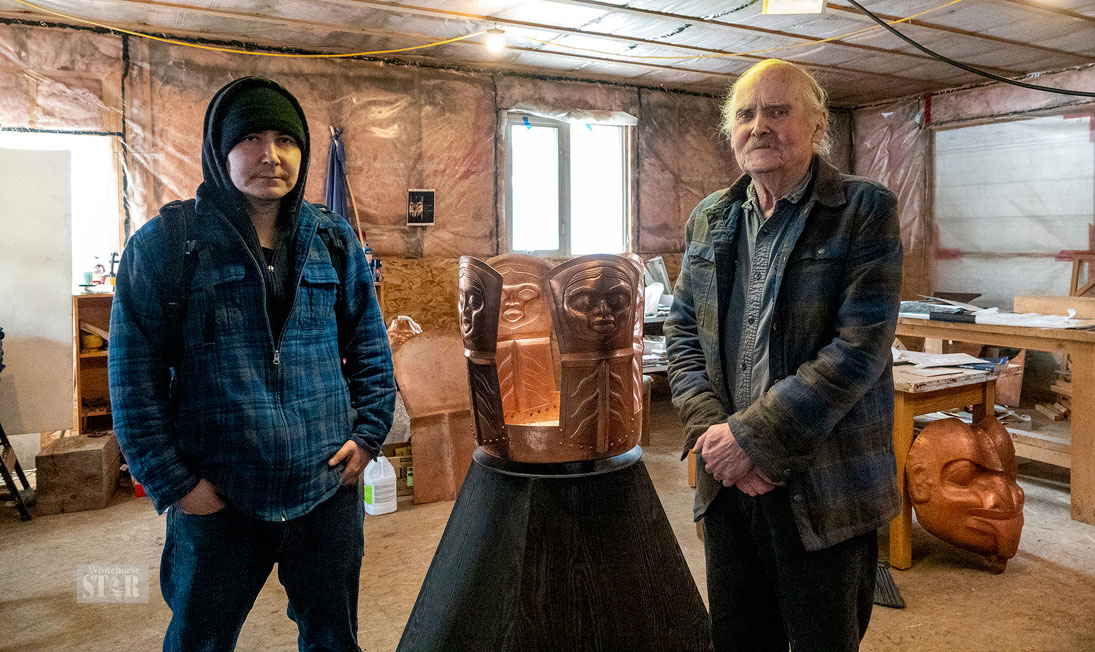
A WORK OF ART – Copper sculptor Brian Walker, right, and his son Justin Smith stand with the Arctic Winter Games cauldron they had created for the Games last Thursday in Walker’s studio.
Photo by Vince Fedoroff
A WORK OF ART – Copper sculptor Brian Walker, right, and his son Justin Smith stand with the Arctic Winter Games cauldron they had created for the Games last Thursday in Walker’s studio.
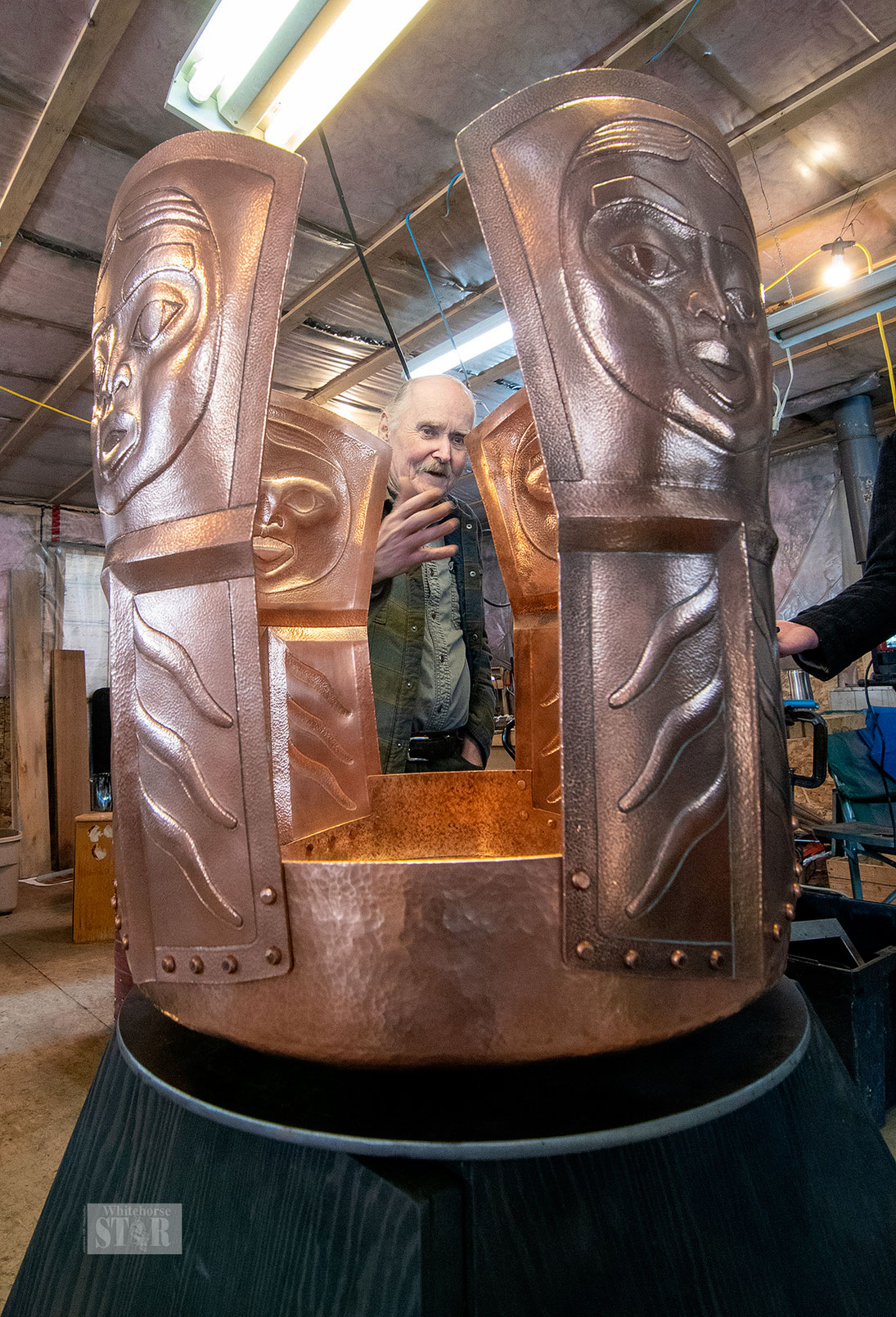
Photo by Vince Fedoroff
EXPLAINING THE WORK – Walker said he was inspired by children and the four directions when designing the cauldron that would have been the centrepiece of the Arctic Winter Games opening ceremony.
The cauldron to hold the 2020 Arctic Winter Games flame was to be introduced to the athletes, volunteers and many fans on March 15 – the opening ceremonies that marked the Games’ 50th anniversary.
The cauldron to hold the 2020 Arctic Winter Games flame was to be introduced to the athletes, volunteers and many fans on March 15 – the opening ceremonies that marked the Games’ 50th anniversary.
The Arctic Winter Games were cancelled on March 7 due to concerns surrounding the novel COVID-19 virus.
Nobody got to see the cauldron lit up, it currently sits in the shop of its creator – copper sculptor Brian Walker.
Walker said there was disappointment when the Games were cancelled because he wanted people to enjoy and be inspired by his work.
“There was (disappointment),” said Walker. “It was going to be the centrepiece at the opening. I just wanted people to see it. I have the privilege to see it. I wanted people to see it because it’s a legacy of the Arctic Winter Games.
“Now, I thought it was appropriate for it to be seen.”
Walker also wanted to see the cauldron at the ceremony with the flames sprouting from the centre.
“The original concept was to have a flame coming up because it was the cauldron for the AWG,” said Walker. “When they were cancelled I had to take it apart, but it was going to be a beautiful yellow flame that came right out. I wanted to see that too. See how it was going to look.”
The Arctic Winter Games Host Society put out a call to metal artists and that is how Walker was chosen to create the cauldron.
“I submitted my idea and I was really appreciative that they chose me. It was a blessing that they gave to me,” he said.
“I was certainly committed to it. It was about four or five months work to do this. I just thought it was a wonderful opportunity to express something like that.”
After an unfortunate accident, Walker said his son stepped in to help him finish the work.
“I worked from September on to do this – all fall,” said Walker. Christmas day, I broke my leg. I was about 80 per cent complete on the project cause I had planned to have it done by Feb. 3. I had to recover so I wasn’t able to do anything for five weeks but then I got back at it again.
“My son Justin stepped in to help where he can.”
The cauldron had four tináa encircling the piece. Tináa is a Tlingit word for copper shield and is an item of wealth.
Walker said many First Nations wear tináa as a small piece of jewelry.
Walker said the inspiration for the tináa came from children and the four directions on a compass.
“The tináa represent wealth,” said Walker. “It’s not money or power. In this aspect, it’s about the wealth of our children.
Then I thought about the development of the children and I wanted to base it on the four directions.
“I thought it was appropriate for the Arctic Winter Games because you are looking at a vast expanse of territories.”
Walker said the cauldron begins in the east.
“The child is dreaming with a slight smile on their face looking forward to life. It’s also where the sun comes up so it’s that space before the awaking,” Walker said before explaining the south.
“The child awakening is in the south. It has half-open eyes and the mouth is open so the child is beginning to express themselves. Of course in the wintertime southern exposure is important with the light.
“It’s awaking to the day but also awakening to the development.
“On the west side is a child that has awareness. Awareness can bring concerns about tomorrow and problems that have to be solved. The mouth is open and expressing their concerns but being aware.
“North we have joy. Joy comes when you solve the problems when you come to a solution. Also, I thought joy expresses how we all feel about living in the north. The north it brings hope and happiness to people.”
Walker said the form represented the simplest form of the human being.
“The thing with copper is you can also see the inside and I think for me it is a whole representation of the human child because it has an outer and an inner light.”
If the Arctic Winter Games had proceeded, upon their completion the cauldron would have been given to the city to put in a permanent position.
Walker said he doesn’t know “the ins and outs” about the plan for his work because of the pandemic but expects it will eventually be put on display.
Walker said he had hoped those involved with the Games could draw inspiration from the cauldron.
“That was my thought,” said Walker. “And it was to remind people that our children are our wealth.”
In order to encourage thoughtful and responsible discussion, website comments will not be visible until a moderator approves them. Please add comments judiciously and refrain from maligning any individual or institution. Read about our user comment and privacy policies.
Your name and email address are required before your comment is posted. Otherwise, your comment will not be posted.
Be the first to comment