Photo by Vince Fedoroff
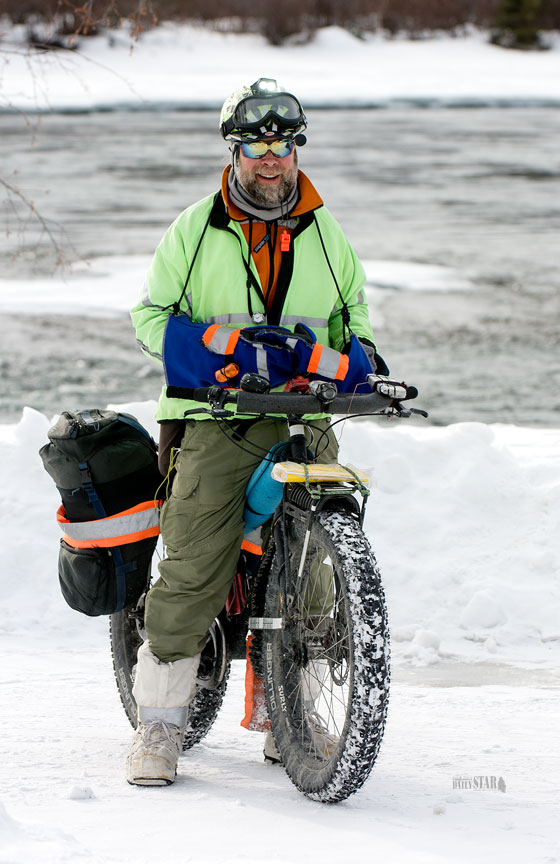
COOL RIDE – Paul Davis, director of -40°C, rides through Riverdale yesterday, mirroring the content of his darkness-saturated film, set for screening next week at a Toronto film festival.
Photo by Vince Fedoroff
COOL RIDE – Paul Davis, director of -40°C, rides through Riverdale yesterday, mirroring the content of his darkness-saturated film, set for screening next week at a Toronto film festival.
A Yukon filmmaker is off to an Outside film festival to screen his bicycle-driven short on prolonged Northern darkness — for the seventh year in a row.
A Yukon filmmaker is off to an Outside film festival to screen his bicycle-driven short on prolonged Northern darkness — for the seventh year in a row.
Paul Davis, 53, will fly to Toronto next week for a festival by the francophone Front of Independent Directors of Canada (FRIC) to show, yet again, the perennially popular work he directed, -40°C.
"The film essentially ... talks about what is the impact of subarctic darkness, what our reality is like, including SAD, absenteeism, alcoholism,” Davis said in an interview yesterday.
He shot the 13-minute movie at -42 C in 2007 to zoom in on the challenges of life in more than 18 hours of lightlessness each day around the winter solstice.
The flick tracks his journey by bike from a Riverdale apartment to École Émilie-Tremblay, where Davis often worked as an on-call teacher.
There is barely a trace of natural light in the whole production, conveying the struggle through inky blackness Northerners endure each winter.
The viewer follows him from his groggy 7 a.m. wake-up — he is called in to teach when an instructor fails to show up, presumably due to the cold — to wooded Riverdale trails, through the Gotham glow of orange street lamps shrouded in ice fog on the Robert Campbell Bridge, up the Alaska Highway and into the fluorescent buzz of the classroom.
The snow squeaking beneath Davis's mega-tired bicycle backgrounds the depressing back-and-forth of fictional radio hosts. They announce a slew of cancellations due to the cold: "Yoga With Fred” – cancelled; Velo Yukon's ice bike race on Hidden Lakes — cancelled; "hip hop with the Little Snags Dance Company” — cancelled.
"If you forgot to plug in your car last night, it's too late now, my friend!” one radio host chortles.
"Winter motorists don't accommodate cyclists well,” Davis tells the viewer as an 18-wheeler whizzes by on the highway, "which is why I'm running eight lights on my bike.
"Every time I get this far I'm not sure I can make it,” he says. "But in the end, I make it.
"Darkness must become a friend we accept and love.”
Shot with a heated film case in inhuman temperatures, the movie is a "travelogue about what it's like to be living and working in the community here during five-and-a-half hours of daylight and what that does to people.
"The film is really about making people aware that this exists.”
It even features a head-mounted, vitamin D-stimulating sunlamp, like a tennis visor from the future.
Davis said Scandanavian countries seem more aware than northern Canadians of the impact sunlight deprivation can have, and more responsive to it.
"The whole darkness thing doesn't seem to be a part of the official culture here, and it should be.”
Davis added that he was excited about his upcoming trip to Toronto, where the francophone film with English subtitles will screen at a smaller downtown cinema on March 26.
Biking is a mandatory part of the visit. He's even being put up in a lavish, cycle-friendly hotel — "the valet will park your bike.”
He said this is likely the last year his production will be showcased at an independent film festival, one of many across the country that have demonstrated an interest in the light his movie shines on northern darkness.
He also added his voice to the continued anxiety over the future of independent and community cinemas in the digital age.
The reels of film many of these cinemas have screened for decades will likely die off, not fit enough to survive the growing use of digital technology.
"Those cinemas have been running on 35- or 70-millimetre for a long time,” Davis said. "But the capital cost of going into the digital system is very high.”
Setting up digital movie projectors in lieu of the traditional 35-millimetre projectors carries a huge price tag.
"And in a Northern context, there won't be film cans to make improvised tent stoves out of,” Davis lamented.
Davis has lived in Whitehorse "almost forever” — since 1995.
"I have a lot of people here that I relate to like a family.”
-40°C, can be viewed for free at the National Screen Institute's website.
It was produced with funding from the Yukon filmmakers fund and the National Film Board's filmmaker assistance program.
In order to encourage thoughtful and responsible discussion, website comments will not be visible until a moderator approves them. Please add comments judiciously and refrain from maligning any individual or institution. Read about our user comment and privacy policies.
Your name and email address are required before your comment is posted. Otherwise, your comment will not be posted.
Be the first to comment