Photo by Whitehorse Star
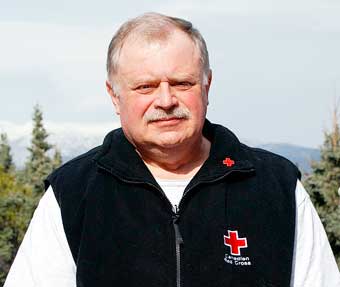
GRIM FALLOUT – ‘The devastation was incredible,' Whitehorse resident Al Alcock says of what he saw in earthquake-stricken Haiti. He assisted with relief work.
Photo by Whitehorse Star
GRIM FALLOUT – ‘The devastation was incredible,' Whitehorse resident Al Alcock says of what he saw in earthquake-stricken Haiti. He assisted with relief work.
It's been almost a full year since the Jan. 12, 2010 earthquake that devastated Haiti.
It's been almost a full year since the Jan. 12, 2010 earthquake that devastated Haiti.
News reports from the island nation in the Caribbean make it clear there's still a tremendous amount of relief work to be done even after all that's gone into providing aid to the Haitians after the 7.0 magnitude quake.
Longtime Yukoner Al Alcock spent five weeks volunteering with the Canadian Red Cross in logistics in Haiti last year, followed by two other Canadian Red Cross missions in Alberta and British Columbia.
During an interview this week, he said he's ready to return and help out in whatever way he can.
"I call it a challenge,” he said when asked about his thoughts on the amount of work that still needs to be done.
It's a motto among Canadian Red Cross volunteers to be flexible – it's the key to keeping their heads up, smiling and focusing on their work.
"That's really what keeps us going,” Alcock said of the humanitarian work, noting it is the most rewarding work he's done through his life.
The people the volunteers are working for are very appreciative of what's being done.
Alcock said whenever he feels he's having a bad day working there, he soon realizes it in no way compares to what those he's there to help are experiencing.
It's that humanitarian work Canadian Red Cross volunteers like Alcock are focused on.
"We don't get involved in politics,” he stressed.
Alcock's role in the relief effort was more of a management-type position drawing on his experience in logistics to assist with the Canadian Red Cross' role in building 15,000 shelters and delivering health programs in conjunction with the Haitian Red Cross.
As Alcock explained, in cases of such disasters, it is up to the Red Cross in that country – the Haiti Red Cross, in this case – to issue the call for help to the International Federation of Red Cross and Red Crescent Societies.
It is then up to that country's Red Cross to either oversee the relief effort or to turn it over to the international Red Cross. Calls may then go out for help from other Red Cross organizations, such as the Canadian Red Cross.
In this case, the Canadian Red Cross was delegated to build 15,000 of the 150,000 shelters to be erected and working on health programs.
The program marks the largest relief effort ever undertaken by the Canadian Red Cross. A December report by the Canadian Red Cross states a total of 2,200 shelters had been built to house more than 11,000 earthquake survivors at that point.
"We never act on our own,” Alcock said of the Canadian Red Cross' role working in collaboration with the Haiti Red Cross.
His job, which started about 3 1/2 months after the earthquake, was to help oversee the building of the shelters in Leogane. That community was the closest to the shaker's epicentre, about 25 kilometres west of the country's capital, Port-au-Prince.
Alcock also helped with shelters in Jacmel in the southern part of the country.
"The devastation was incredible,” he said as he described the rubble in the streets (still being cleared) with nowhere to put it.
One of the biggest problems in building the shelters is finding space.
With roads full of rubble and most of the land in Haiti being privately owned, there's what Alcock described as a "bottleneck” in finding space for the shelters.
As it states on the Canadian Red Cross website: "The number of shelters that will be built is dependent on the assessment of needs, land availability, the clearing of debris and other critical issues brought about by such a large-scale disaster.”
Adding to the problem is the fact the land titles office was destroyed in the earthquake.
The Red Cross doesn't interfere politically, and it is up to the Haitian government and land owners to come to a solution (work that is being done now). However, it means the Canadian Red Cross ends up waiting for land to be freed up in order to build shelters.
Whenever land is made available, the shelters are built, Alcock said.
And that means economic benefits to the local population hired to do the building, which in turn helps build stability in the country, he said.
"That's why it's so rewarding,” Alcock said.
Crews consisting of a foreman, carpenter and three labourers are hired to put up the shelters. If they meet the deadline set to have each shelter up, each worker is given a bonus in addition to the salary he or she makes building the structure.
The shelters closely resemble what many North Americans would recognize as wooden sheds for their yards.
Embedded into the ground with stringent construction, they are designed to be hurricane-proof.
With 7,500 hurricane-proof shelters to be erected in the two towns, for five weeks Alcock oversaw the building work that is done by local Haitians.
And it's something he'd do all over again. He's already asked to go back to Haiti as a delegate to help with the cholera outbreak and once again using his skills in logistics to help with the construction of field hospitals.
Right now though, the volunteer program in Haiti is on hold until June.
As Alcock pointed out, not all the volunteers are retired and able to take on the work in Haiti at any time.
He hopes to return to continue his work in the Caribbean country.
In order to encourage thoughtful and responsible discussion, website comments will not be visible until a moderator approves them. Please add comments judiciously and refrain from maligning any individual or institution. Read about our user comment and privacy policies.
Your name and email address are required before your comment is posted. Otherwise, your comment will not be posted.
Be the first to comment