Photo by Chuck Tobin
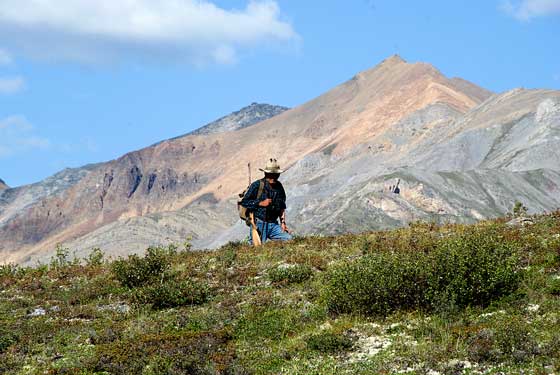
WALKING THE WATERSHED – Northern Tutchone elder Jimmy Johnny is seen in the Peel watershed area earlier this year promoting wilderness conservation.
Photo by Chuck Tobin
WALKING THE WATERSHED – Northern Tutchone elder Jimmy Johnny is seen in the Peel watershed area earlier this year promoting wilderness conservation.
The Yukon government has rejected the land use plan recommended for the Peel River watershed, it announced Friday afternoon.
The Yukon government has rejected the land use plan recommended for the Peel River watershed, it announced Friday afternoon.
The Yukon and the four First Nations governments were scheduled to deliver their official response to the recommendation from the Peel Watershed Planning Commission by the middle of this month.
The parties, however, have agreed to continue meetings to see if they can sort out their differences and reach consensus on a response to the recommended plan by the end of February, the government indicated.
The commission recommended a vast majority of the Peel watershed be protected from industrial development.
A meeting of senior representatives from each government is scheduled for the middle of January to lay the groundwork for future meetings aimed at developing a joint response.
In its rejection, the Yukon government says it does not agree with the planning commission's interpretation of goals and objectives laid out in the Yukon's aboriginal land claim settlements.
It also suggests the land use plan requires a more balanced approach to what activities would be permitted inside the 68,042 square kilometres.
"YG (the Yukon government) felt that a broader mix of uses is achievable within the definition of sustainable development as provided in the final agreements,” says the explanation.
"That is, that beneficial socio-economic change can be realized without undermining the ecological and social systems.”
Furthermore, the government indicated, the plan recommended by the Peel commission is too complicated and its implementation would require ongoing involvement by some independent body, such as the commission.
The Peel plan, the government suggests, needs to look more like the North Yukon Land Use Plan signed off by the Yukon government and the Vuntut Gwitchin First Nation in June 2009.
The North Yukon plan was the first regional land use plan established under the provisions of the aboriginal land claim settlements. The Peel area is the second planning area to go forward, and the Dawson region is next.
The six-member planning commission delivered its 300-page recommendation to the five governments a year ago, after a lengthy and passionate public debate.
In its decision, the commission noted there was no way it could come up with a land use plan which would make everybody happy so it decided to go with a document that favoured wilderness conservation.
The commission pointed out the plan was meant to be one that could be reviewed and changed by the parties in the future but at this point, the wilderness values were the most important to recognize.
While the pro-conservation camp applauded the recommendation, the resource industry condemned it as a plan which would kill exploration and mining in the Peel watershed.
The three aboriginal governments whose traditional territories make up most of the planning area – the Tr'ondek Hwech'in Han First Nation, the First Nation of Na-Cho Nyak Dun and the Gwich'in Tribal Council – have called for maximum wilderness protection.
The Yukon government, however, has the final say if the parties cannot agree, as 97 per cent of the planning area is non-settlement land belonging to the Yukon.
Energy, Mines and Resources Minister Patrick Rouble told the Star this morning he is hopeful the five parties can reach consensus by the end of February.
"It is the intention of the Yukon to work collaboratively with the First Nations to provide a joint submission,” Rouble said.
"I have been informed that was a very positive meeting of the senior liaison committee last week and there was a thorough discussion of the concerns that are there and the interests that were out there,” the minister said.
"And yes, I have the confidence that we will be able to work together on these issues and provide a response.”
Rouble said he was not about to second-guess the results of further meetings by suggesting what might happen if the end of February comes and goes without consensus.
Under the process, the governments can issue individual responses on issues they do not agree on, Jen Meurer, a senior planner with the government, said this morning.
The very fact the parties have agreed to continue meeting should be viewed as positive, she said.
Meurer said the goal of the January meeting of senior representatives is to renew the letter of understanding the parties signed last January which established the process and commitment to provide a response to the recommended land use plan by mid-December.
The objective, she said, is to have a joint response by the end of February, but whether that is an absolute deadline will be addressed in the renewed letter of understanding.
Meurer pointed out once a response to the recommended plan is made to the commission, the commission will review it and then issue a final recommendation to the governments.
In the governments view, she said, the plan recommended by the commission last December did not reflect the goals and balance set out in the final agreement surrounding land use planning and sustainable development.
A year-long moratorium on mineral staking in the Peel watershed was implemented last Feb. 4 to allow the planning process to proceed without any more third party interests arising in the area. The moratorium also applies to oil and gas leases.
The moratorium was extended by the cabinet for another year to Feb. 4, 2012, it was announced Friday.
The government also placed a moratorium on the collection of annual fees required to keep existing claims in good standing
Whether that provision will be extended is a matter to be discussed at the January meeting of the senior liaison committee, Meurer said.
See more coverage on this issue in Tuesday's edition.
In order to encourage thoughtful and responsible discussion, website comments will not be visible until a moderator approves them. Please add comments judiciously and refrain from maligning any individual or institution. Read about our user comment and privacy policies.
Your name and email address are required before your comment is posted. Otherwise, your comment will not be posted.
Comments (1)
Up 0 Down 0
roderick longe on Dec 23, 2010 at 10:16 am
Well people sit back and enjoy the ride.Soon the territory will be a protected park like BANFF. Does anyone wonder why large companies want to mine elsewhere. Maybe Alaska will have the balls to drill anwar.