Photo by Whitehorse Star
Darrell Pasloski
Photo by Whitehorse Star
Darrell Pasloski
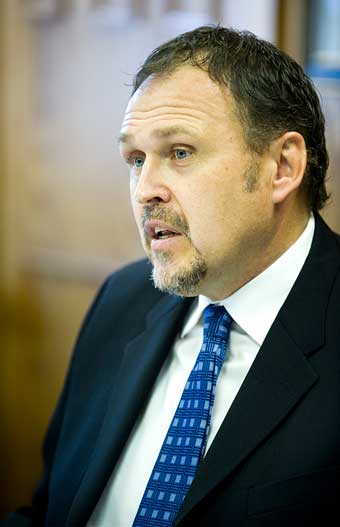
Yukon Party leadership hopeful Darrell Pasloski supports the continuation of free entry claim staking and increasing the share of resource royalties reaped from mining industry profits earned in the territory.
Yukon Party leadership hopeful Darrell Pasloski supports the continuation of free entry claim staking and increasing the share of resource royalties reaped from mining industry profits earned in the territory.
"(It) is of critical importance to the mining industry, and especially for Yukon prospectors who go out and make discoveries,” Pasloski said recently of free entry staking.
On mining and outgoing Premier Dennis Fentie's pledge to get a better resource royalty deal for the territory, Pasloski said, "The current Yukon Party government is going in the right direction.
"And if Darrell Pasloski is the leader of the Yukon Party, Darrell Pasloski will stay on this course,” he added.
The move to renegotiate the Yukon's royalty-sharing agreement with Ottawa comes after the Northwest Territories – still without a devolution deal similar to the Yukon's laid the groundwork for a much more lucrative arrangement.
According to the preliminary devolution and resource revenue-sharing deal between Ottawa and the N.W.T., the Northwest Territories stands to receive 50 per cent of resource royalties up to the equivalent of five per cent of its gross expenditure base.
In 2010, the N.W.T.'s gross expenditures were approximately $1.2 billion, which would allow for that territory to reap up to $60 million in resource royalties.
By comparison, the terms of the Yukon Northern Affairs Program Devolution Transfer Agreement, signed in 2001, resource royalties the Yukon can collect from hard rock and placer mining are capped at $3 million.
Similar royalties garnered from the oil and gas sector are not capped, but follow a sliding scale based on revenue.
Specifically, the Yukon's resource royalty-sharing arrangement with Ottawa, allows hard rock mining operations to be taxed on their net profits – up to six per cent for profits between $5 million and $10 million – with a proportional one per cent increase for each additional $5 million in profits.
For gold mined in the Yukon, the territory assesses a 37.5 cent fee for every ounce – a 2.5 per cent "export tax” based on a $15/ounce gold – miniscule considering gold is hovering at $1,570 an ounce.
The last time it was worth $15 an ounce predates the Klondike Gold Rush that kicked off in 1896.
But Pasloski told the Star he has no plans to increase the rate at which Yukon gold is taxed if he wins the Yukon Party leadership convention on May 28.
For 2009/2010, the Yukon reaped $430,000 in oil and gas royalties, $19,500 from placer gold operations but nothing from the hard rock mining sector.
Meanwhile, the Selkirk First Nation earned $6 million in resource royalties from Capstone's Minto Mine, located on class A settlement land in the Selkirk's traditional territory.
Once revenue from the Bellakino and Wolverine mines is assessed for the current fiscal year, the Yukon will begin to see mineral royalties in its coffers, said Jesse Devost, a Department of Energy, Mines and Resources spokesman.
In 2010, the territory earned $2.6 million from mining and permit fees, as well as claim tags, Devost added.
Wilderness tourism operator Rod Taylor and Economic Development Minister Jim Kenyon are also running for the governing party's leadership.
In order to encourage thoughtful and responsible discussion, website comments will not be visible until a moderator approves them. Please add comments judiciously and refrain from maligning any individual or institution. Read about our user comment and privacy policies.
Your name and email address are required before your comment is posted. Otherwise, your comment will not be posted.
Be the first to comment