Photo by AP
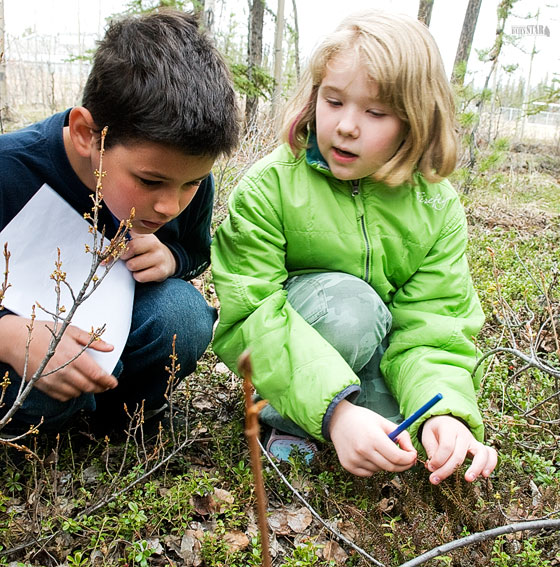
HANDS-ON LEARNING - Dakota (left) and Michaela look for plants at the Elijah Smith Elementary School book launch of 'Paddy's Pond, a Neighbourhood Resource' on Tuesday.
Photo by AP
HANDS-ON LEARNING - Dakota (left) and Michaela look for plants at the Elijah Smith Elementary School book launch of 'Paddy's Pond, a Neighbourhood Resource' on Tuesday.
Daeden Stoker likes to eat flowers.
Daeden Stoker likes to eat flowers.
During a nature exploration with his class, Stoker, a Grade 3 student at Elijah Smith Elementary School, discovered that crocuses are edible.
"Yeah, you just pick all the bugs out, put some sauce on, then you eat it," he said Tuesday afternoon, motioning to a small crocus at his feet.
"They're kinda yummy."
Stoker's class has been learning about traditional medicines, different uses for plant life, and respect for green spaces through a new experiential learning program at the school.
"Trying to identify the plant life in our green belt is like the ultimate scavenger hunt," said Jill Potter, the experiential education teacher. "The kids totally love it."
She also said teachers are trying to give children a sense of the real-life uses of plants.
"When the kids found out you could make ketchup with one of the plants, they flipped out," she said, laughing.
Paddy's Pond, a Neighbourhood Resource was launched Tuesday.
Darby Newnham's Grade 3 class collaborated with local experts Dianne Smith and Peter Long to create the picture book, which features photography of a wide variety of plant life.
"Animals and nature are our teachers. Listen to learn. Watch to learn. Mother Earth provides all the food and medicines we need," reads the first page of the booklet, penned by Dianne Smith, a Kwanlin Dun First Nation member.
Long, a local photographer and nature enthusiast, also has a message in the beginning of the booklet
"We know the objects in our house - our books, cushions, plates, tins of food, windows – but when we go into the outdoors, we often don't even know the common things we see. This booklet is a little peek at some of them."
Each student will be returning home with a copy of the booklet, and it will also be distributed to every school in the Yukon.
Michaela Decook, another Grade 3 student, told the Star her favorite discovery has been the cranberry.
She said it's a lot better than the soapberry, and a very interesting plant to learn about.
Decook warned people not to eat berries unless they know what they are, because otherwise it's not safe. She hypothesized that she would have an easier time surviving in the wilderness, now that she knows what she can and cannot eat.
"I've just gotten so into it while doing research and stuff," she said.
Smith loves working with children, and is amazed by their curiosity. "These young children pick things up so fast," she said.
She spoke about a medicine hike they went on, and talked at length about the local plant life.
"We're trying to encourage children to look at the land in a different way," she said.
Pointing one direction and then the next, she listed off the many uses of the nearby foliage.
Something to help cure moose hide, something to cure bladder infections, a teeth whitener, an ingredient in tea-it seems like she could continue indefinitely.
"How do you think we learned how to make fishing nets? The spiderweb was our teacher. How did we learn which mushrooms were poisonous?
We watch the squirrels," she said.
Smith learned all of these traditional uses from her mother, Annie. She said Kwanlin Dun members will continue to pass this knowledge down from generation to generation.
As she spoke, the children tromped through the forest around her. They picked at leaves, got down on their hands and knees to observe, and even tasted a thing or two.
"We don't just sit and look at trees," said Stoker. "We learn all kinds of stuff. I found out that plants can be male or female."
He also spoke excitedly about the possibility of turning a soapberry into ice cream.
"The more you know, the more you care," Long said while he hung out with some of the kids.
He said he's loved the process of putting together the booklet, and loves integrating his passion for photography with educating the children. He said hopefully educating the public on green spaces will mean increased protection for local plant life.
"I think it's neat to just stop, look, and say, 'Is there something here I don't know about?'"
John Wright, principal of Elijah Smith, spoke optimistically about the experiential learning program.
This is its first year at the school, and he believes it is "an amazing way to deliver curriculum."
He spoke about the bison hunt, held each March, where Grade 7 students camp at Aishihik Lake.
"We brought home two (bison) this year," said Wright. The kids lived off the land for five days, learned how to skin the bison, gut it, and field dress the meat. It was later served at a community feast on April 24.
"It's good for kids to actually do hands-on learning," he said.
In order to encourage thoughtful and responsible discussion, website comments will not be visible until a moderator approves them. Please add comments judiciously and refrain from maligning any individual or institution. Read about our user comment and privacy policies.
Your name and email address are required before your comment is posted. Otherwise, your comment will not be posted.
Be the first to comment