‘You could have seen a little boy scrubbing his skin’
On Terry Ladue’s 52nd birthday,
By Sidney Cohen on June 2, 2017
On Terry Ladue’s 52nd birthday, his family sang him Happy Birthday for the first time.
It happened Tuesday, outside the Kwanlin Dün Cultural Centre, where members of his family had come to share their stories with the National Inquiry into Missing and Murdered Indigenous Women and Girls.
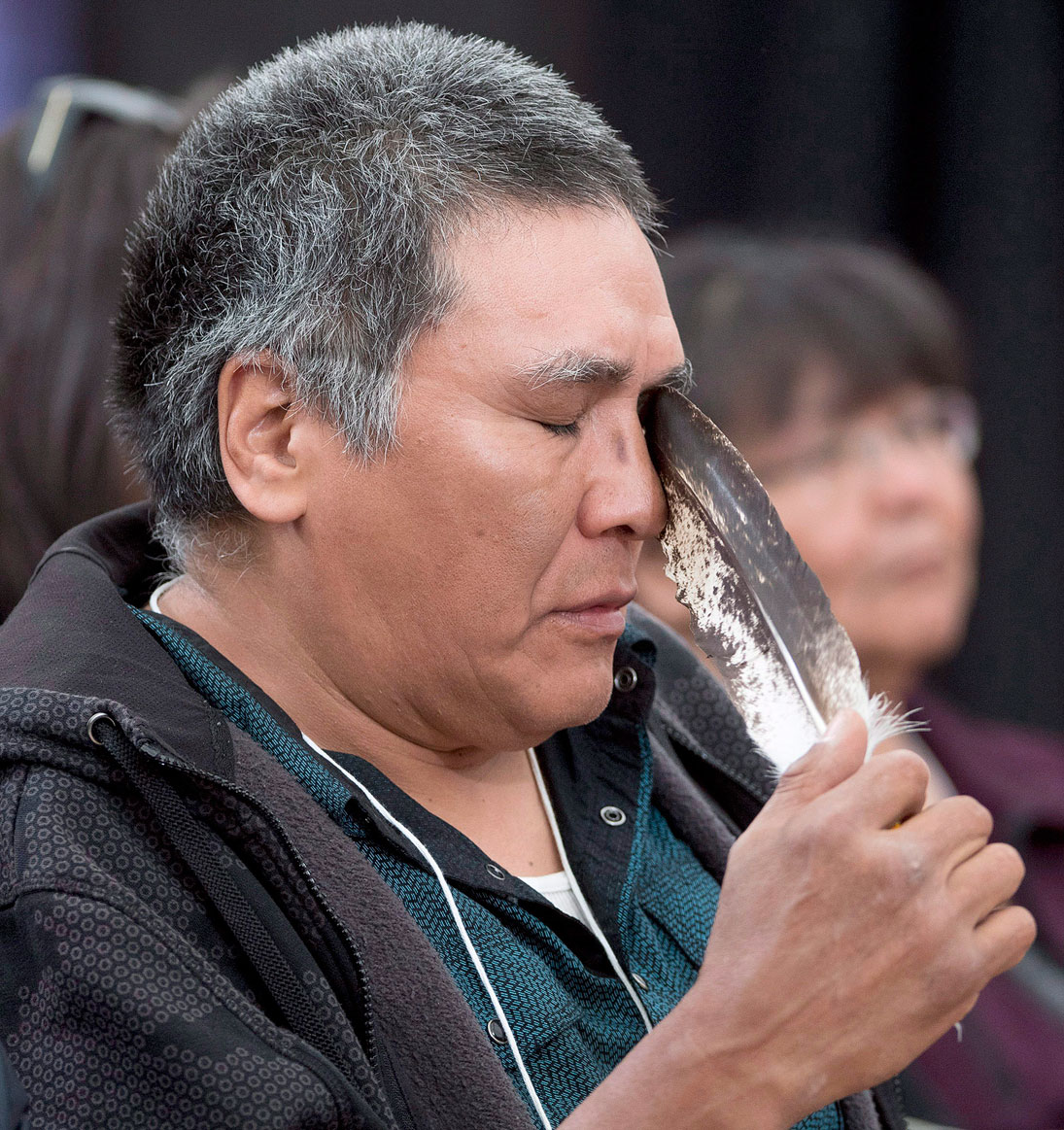
“I swear I saw my mom dancing behind them,” said Ladue, who on Thursday told the commission that his mother, Jane Dick, was murdered when he was a small boy.
“It hurt, but it also made me happy, because for once I felt like I was loved by my mom,” he said.
The inquiry wrapped up its first set of hearings in Whitehorse yesterday. Commissioners will resume gathering statements from families and survivors in the fall.
Ladue implored the commissioners to make this inquiry count.
“I really don’t trust people like you guys, I don’t trust the government, I don’t trust the RCMP,” he said, noting state officials have only caused him harm.
“You want to prove that you’re going to do something for me? Don’t let this die,” he said of the inquiry.
Ladue gave impassioned testimony yesterday that brought many observers, including commissioner Qajak Robinson, to tears.
He was taken from his family and placed in a white foster home during the ’60s Scoop, a period in Canadian history when this was common practice.
Ladue said he was given neither love nor safety in foster care.
Instead, he experienced years of brutal sexual and emotional abuse.
“Instead of having my mom come down give me a kiss, I had some guy come down and do something else to me,” he said.
Ladue recalled hearing the adults say, “every good white man should have an Indian tied up in the back yard.”
He was taught to feel shame for being a First Nations boy.
Soaking in the bathtub at age five or six, Ladue recounted vigorously scrubbing his skin with a wire brush.
“I wish I had a picture of that tub,” he said, choking back tears.
“You could have seen a little boy in there scrubbing his skin off. Scrubbing it because he didn’t like that damn colour.”
At 16, Ladue was booted from his foster home with nothing. He didn’t know where he was from or who his birth family was.
He said he fled to the streets of Vancouver and “stuck a needle up my arm for 13 years trying to kill the pain.”
Ladue considered taking his life many times, but when he stepped over the railing of a bridge and considered jumping, images of his mother and his sons appeared before his eyes.
“Every day I find a reason to live, every day I find a reason to stay strong,” he said.
“(I have) no understanding what love is, but I’m still here fighting to find out.”
Ladue is sober now, and living in Ross River, but he still has difficulty trusting people, especially people in government.
He told the commissioners they have to earn his trust, and the way to do that is to produce results.
“If I see this fall apart, I’ll never trust again,” he said.
The commission has been tasked with making concrete recommendations for addressing systemic causes of violence, and with increasing safety for indigenous women.
Many participants at the Whitehorse hearings spoke about how immersion in their culture provided comfort and helped them heal.
Greta Jack told the commissioners how hard it was to find the support she needed to stay sober after a childhood rife with alcoholism and abuse.
“Kwanlin Dün helped me with sewing classes, you could make mukluks, it was so healing,” she said.
“It was good to be with First Nations and where I felt camaraderie and less shame, less guilt.”
Jack was one of dozens of participants in Whitehorse who had both experienced violence and lost a loved one to violence.
The body of Jack’s 14-year-old sister, Barbara Jack, was found on Grey Mountain in the 1970s, and the family never found out what happened.
When Barbara was alive, said Jack, cultural programming wasn’t an option.
“There was punishment rather than support,” she said.
Jack called for more land-based healing camps, more sweats, and more ceremony.
“I so believe in my heart that is what’s going to save us,” she said.
See related coverage.
Comments (3)
Up 12 Down 25
Terri Szabo on Jun 3, 2017 at 10:37 pm
@yukon56
If you took the time to educate yourself about First Nations History you would understand that foster care (60's scoop) is a huge part of the reason why young women are getting murdered. Child Welfare in Canada needs to revamp its policies to ensure that all children are safe regardless of race. Children are the most vulnerable in our society and we need to protect them.
Up 20 Down 8
ralpH on Jun 3, 2017 at 9:16 pm
Tragic, tragic. Harper never wanted this inquiry to go ahead because he saw no benefits in it. I however see an avenue for closure through venting and telling the stories of suffering. But back to Harpers point. What will come of this after the inquiry is finished? Probably nothing. If you are to address the problem of missing and murdered women then it has to encompass all women indigenous and all others. Not being cold but if resources are going to be allocated for this it has to be for all. Great healing process though.
Up 30 Down 18
yukon56 on Jun 2, 2017 at 4:55 pm
I thought this was about Fn missing women not about foster care