‘You can't please everyone, you just can't'
Conservation remains the keyword in planning for the future of the Peel watershed.
By Nadine Sander-Green on July 26, 2011
Conservation remains the keyword in planning for the future of the Peel watershed.
The Peel Watershed Planning Commission released its Final Recommended Plan to the public late Monday afternoon. Now, it's up to the Yukon government to decide what to do.
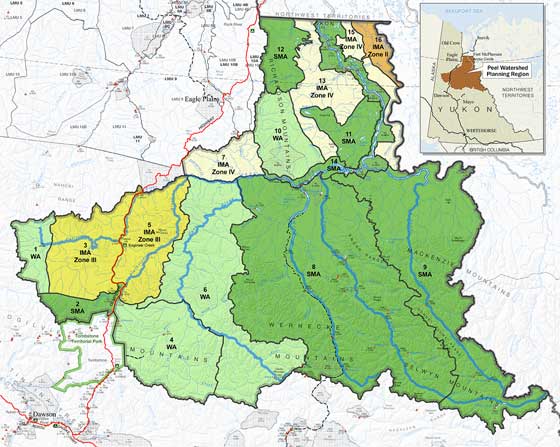
The final blueprint, which the commission has been working on for four months, recommends that 80 per cent of the watershed be protected under a Conservation Area.
This is roughly same number the commission recommended in the plan it submitted – which was later rejected – to the government in 2009. Affected First Nations have been clear that they want 100 per cent of the watershed protected.
The difference with the new plan, though, is that the chunk of protected land is divided into two regions: one which is to have permanent protection and one that can be reviewed periodically and altered if need be.
The remaining 20 per cent is classified as "the working landscape”, where the industrial development would occur.
"It is a conservative approach,” David Loeks, the commission's chair, told the Star this morning.
"When you're asked to serve the public interest and this public is divided, the responsible approach is to provide as many options for the future as you can.”
This, said Loeks, is the same logic the commission has been using since it began working on the plan six years ago.
Loeks said the areas with interim protection, or what the commission calls a "Wilderness Area”, allow for more flexibility should "something change” in the area.
"Imagine someone found the mother of all goodness in Kluane Park,” said Loeks. "Well, you could access it if you change the legislation, but it would be quite the uphill climb.”
A Wilderness Area should not be developed based on our current knowledge, Loeks said. Rather, it allows for a periodic review to ensure the balance between protecting the environment and ensuring sustainable development is where it should be.
Loeks said the permanently protected areas are regions Yukoners have most closely attached their wilderness values to.
"More is less, these are the places people have identified as the core of what is important to them,” said Loeks.
This includes the Snake, Wind and Bonnet Plume rivers, as well as the base of the Peel River. Two proposed National Historic Sites – Tshuu tr'adaojiich'uu and Teetl'it njik – are also within the area to be permanently protected through legislation.
Although issuing new rights and building new roads in the Conservation Area is not allowed, existing mineral claims and leases could be developed.
When the commission was created in 2005, there were 2,400 claims staked. One year ago, that number had jumped to 10,000.
"It's important to note that a lot of this happened after the planning process was initiated,” said Loeks. "A large portion of them seemed to be hurrying in.”
The number of existing mineral claims has now lowered slightly to around 8,420.
As for new roads in the "working landscape”, or what is know as the Integrated Management Area, the Commission still recommends they be temporary and public use should not be allowed.
Loeks said complete reclamation of road after it's constructed is possible.
"It's quite realistic if taken seriously, but you have to have the budget for it,” he said. "If you do build a road, we're saying, ‘Reduce the impacts much as you possibly can.'”
The commission also recommended that a sub-regional management plan for the Dempster Highway Corridor be completed and any wheeled off-road vehicle use should be limited to specific locations within the region.
Loeks said the commission did respond to the government's request to provide more clarity and is more streamlined and user-friendly. Where it became increasingly difficult, he said, was dealing with the government's request to conserve less land.
"We weren't given enough reason as to where and why,” said Loeks. The comission, under restrictions around budget and what they are mandated to do under the Umbrella Final Agreement (UFA), were not given the option to go "way back to the drawing board” with this Final Plan, said Loeks.
"We were left with a rude choice at the time when the division was getting even more stark,” he said. "You can't please everyone, you just can't.”
Loeks believes the commission dealt with the First Nations' request for 100 per cent protection of the Peel watershed as best as it could in the forward of the Final Plan.
It reads that the ecological integrity of the Integrated Management Areas are capable of accommodating responsible resource development, as long as best management practices and full restoration of disturbed sites and roads are carried out.
Loeks also emphasized that under the UFA, the commission's overall direction was to foster sustainable development.
The Peel Watershed Planning Commission submitted the Final Recommended Land Use Plan to the Yukon government and the First Nation of Na-Cho Nyak Dun and the Vuntut Gwitchin, Tr'ondek Hwech'in and Gwich'in Tribal Council Monday morning. The plan went live on the commission's website late in the afternoon.
The commission's work is now done, but Loeks has high hopes for the government's next steps.
"I hope the government accepts it, and accepts it entirely,” he said.
"This plan meets the objectives, and I would challenge anyone to come up with a position they say is more responsible. Any place you take a stance, someone is going to argue against you.”
Neither Premier Darrell Pasloski nor Patrick Rouble, the Minister of Energy, Mines and Resources, were made available to comment on the Final Plan before press time this afternoon.
See tomorrow's Star for reaction and more details from a commission news conference set for later this afternoon.
Comments (2)
Up 0 Down 0
bobby bitman on Jul 27, 2011 at 6:00 am
This is an extremely important issue to me. More important than the 'housing crisis' and I wish the media would focus more on it. We are in the midst of a gold rush, and a frenzy for other minerals as well. The public needs to see photographs of current mining practices and real evidence of what is going on behind the mountains, out of view. Who the benefits are going to? Where do those people normally reside? How much is the Yukon getting in royalties per ounce of gold, per ton of ore? What is the track record on reclamation and costs associated with cleaning up after the mining industry in the Yukon?
I am hoping to see the complete preservation of this area for the sake of the ecosystem itself, for the enjoyment of humans in the future, and for resource extraction jobs in the future at a time when royalties are in place that benefit Yukoners, while technologies and laws protect the ecosystem more effectively.
Save something for the future! Stop being so selfish and greedy, there is NO NEED to ramp up our economy even more, while in reality the vast majority of the wealth being permanently removed from our lands is heading right out of the territory.
The Yukon is boom town enough already. We have no right to take everything in one generation, leaving ugliness and destruction behind. I feel that things are out of control and that we need a big breather.
Prove me wrong. I would love to actually see what is going on out there but unfortunately do not have the resources to go out myself and look. This is how I feel however.
I fully support the recommendations of the commission, even though I do not feel they go far enough to protect the environment and our future.
Up 1 Down 0
Josey Wales on Jul 26, 2011 at 8:36 am
Why stop at just this mere wee piece of THE Yukon? Why not just put park gates up at all roads in to this welfare state?
We could call it...Land's of first migrants park...HippyLand...Leftyland.
The hell with jobs...for a few, as other jobs are awarded based on race..to babysit the land.
Really we could be world leaders in making dream catchers for German tourists.
All of us can sit around in some new mega building just rejoicing on all of our collective cultures...group hugs and swilling swank lattes in S.S. travel mugs.
With S.S. that came from a mine outside of Canada...far from any sacred lands.
The parkification of this place re-defines the NIMBY stereo-type.
When (not if) when this "park" is created, ALL HUMAN activities should cease in said park of the future (soon too).
I see this as a lobby effort from "some" outdoor tourist types that wish to have only their kind enjoying this area.
NO planes flying in to this region...
No hippy love-ins...
No Helicopters...
No miners...
No "traditional" healing camps with ANY permanent buildings, unless it is on lands established as F/N's...and with ZIP of the colonial dollars spent.
see where this quagmire is headed?
Never-mind..it has already been here for awhile.
The Us & them battle...with some of "us" being more equal than others? ....then the hippies/socialists factored in.
I really think this territory is going to get far more divided, before we ever get "united".
I see the gap widen daily here, with those whom fund it all...falling in the cracks.