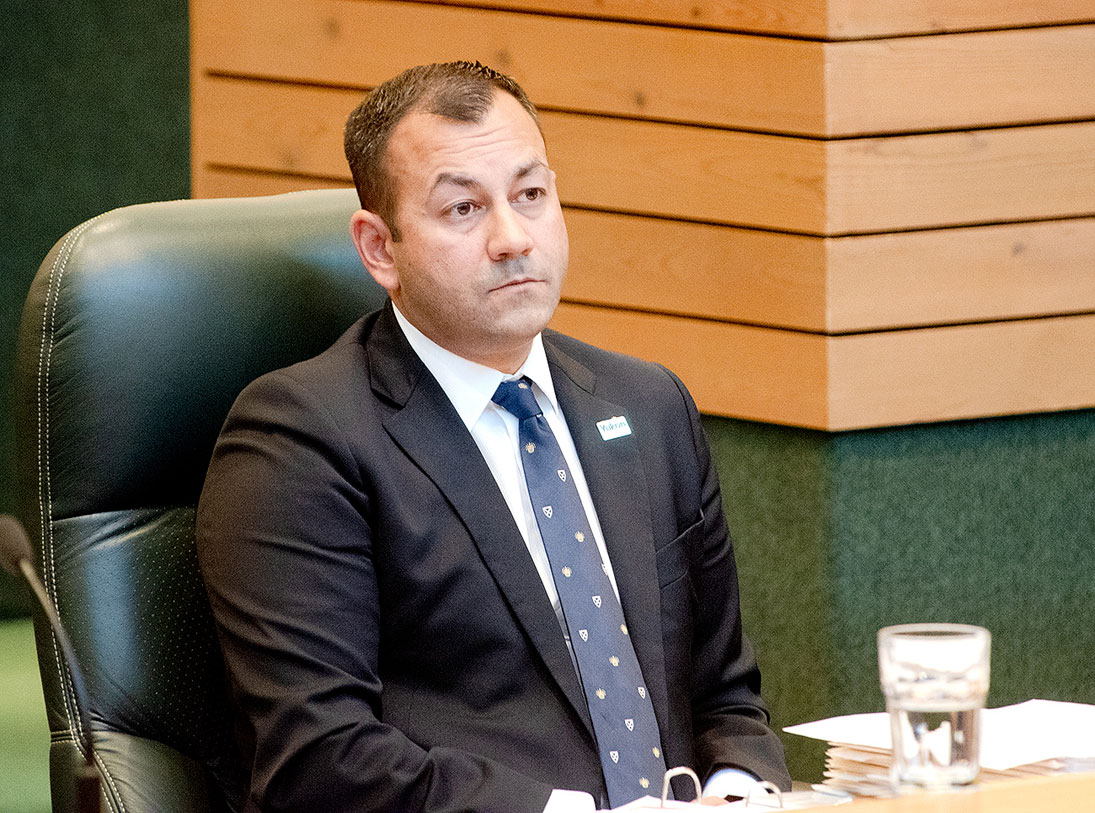
Photo by Whitehorse Star
Energy, Mines and Resources Minister Ranj Pillai
Photo by Whitehorse Star
Energy, Mines and Resources Minister Ranj Pillai
The Yukon government has put the possibility of tying into B.C.’s electrical grid to bed.
The Yukon government has put the possibility of tying into B.C.’s electrical grid to bed.
Instead, it will turn its attention to options closer at home in the territory, it said Wednesday.
Energy, Mines and Resources Minister Ranj Pillai told the legislature the choice is off the table. He spoke after the Yukon Party’s Wade Istchenko asked for an update on the project around energy supply and demand.
“At this particular time in our discussions with the B.C. government, there is not an interest for large investment,” Pillai said.
The territory does not tie into the bigger North American grid, so all energy used must be generated within the Yukon.
The previous Yukon Party government had considered tying into the larger grid for years. Pillai explained last summer that option may have been met with limited success.
That’s because there were no takers and few partners (like BC Hydro) willing to put skin in the game – a game which the Yukon Party government projected could cost $1.7 billion.
As Istchenko pointed out Wednesday, that could be a costly endeavour, as it surpasses the Yukon’s entire budget, which sits at $1.5 billion for the 2019-20 year, by $200 million.
As detailed in the Star last July, the Canadian Electricity Association recommended the federal government at least look into connecting provinces and territories with transmission lines – so linking northern areas to the bigger North American grid.
That tie-in could have seen the export of energy from the North to southern neighbours, in a move that Pillai likened at one point to a nation-building exercise.
He added Wednesday the business community also suggested that YG look at domestic options instead, “and we think that’s some good advice and direction.”
Yukon Energy had studied the feasibility of tying into the B.C. grid in early 2018, retaining Midgaard Consulting for $70,000, with a number of other works showing the territory needs to have greater generating capacity, especially during the winter months.
Ditching plans for the B.C. option, the government has now instead opted to apply for a large battery through the Natural Sciences and Engineering Research Council of Canada (NSERC).
“I believe that our request is for about $11 million, so instead of having two competing proposals, we thought that storage — which can help us in complementing infrastructure that comes on line from our independent power production — was the best route, and that’s what Yukoners wanted,” Pillai told MLAs.
The minister expected further discussions to take place when the Yukon Development and Yukon Energy corporation appear in the House.
Pillai’s remarks came just over two months after YG unveiled its Independent Power Production policy in late January.
Those rules are to help guide the purchase of electricity from independent power producers (that is, non-utility entities like homeowners) who generate power that could be used to supply electricity back into the grid.
“We still think that some of that work that we have done could be helpful to look at what we can do domestically,” Pillai said, “but at this time, we continue to look at other renewable energy sources.”
Those may include the Haeckel Hill wind project, which, as the Star reported in February, is not expecting to stand up any of its four wind turbines by year’s end.
In order to encourage thoughtful and responsible discussion, website comments will not be visible until a moderator approves them. Please add comments judiciously and refrain from maligning any individual or institution. Read about our user comment and privacy policies.
Your name and email address are required before your comment is posted. Otherwise, your comment will not be posted.
Comments (5)
Up 4 Down 8
Sally Wright on Apr 9, 2019 at 11:49 am
It is about time YDC dropped this idea. YTG has spent way more than 2018's $70,000 contract, to yet again a big outside corporation to discover what we discovered when I was on the YDC board in the late 1990's. Way too expensive to build the line and all other renewable energy projects would have to be dropped to pay for it. Much better we develop an Indigenous Renewable Energy Economy up here. Solar, wind, hydro and biomass can meet all of our needs, they must if we are to reduce our GHGs. Continuing down the oil road is no longer a safe option. The risks to our food, water, homes and health have been laid out by the IPCC over and over. The latest report says the North is warming at twice the rate as the rest of Canada ... and Canada is really not doing well.
Time to use our energy planning resources more wisely. My challenge to Minister Pillai is ; where is the plan? Where is the Green Economy that the YG promised to the Auditor General in Dec. 2017 when an Audit found that YTG did no emissions reductions from 2006 to 2015? The IPP Policy is a pittance towards what we really need, nothing short of a transformation in the way we do business in the North.
Up 8 Down 3
Powerless on Apr 8, 2019 at 6:37 pm
So that’s the only answer the government has. Buy a 11 million dollar battery? And then what, buy excess power from renewable wind and solar systems, most paid for by tax payers dollars. Exactly how reliable will they be and how expensive will it be to tie them all in to the grid. If the government wants to go the renewable route, why are they not investing in a solar or wind farm. At least then it’s controlled by a reputable and controlled supplier. We are told our population and economy is growing rapidly and our power system cannot keep up as is. We already have one of our major hydro facilities under attack to have it removed and the best we can come up with is an oversized Duracell.
Up 8 Down 3
My Opinion on Apr 8, 2019 at 1:08 pm
They speak of all this independently generated electricity from roof top panels and the like. Well it doesn't work. We need massive amounts of power in the winter and none in the summer. Solar is the polar opposite. An 11,000,000.00 Battery? Now that is environmentally friendly. Where do you recycle that? Besides it will need replacing long before it has been paid for, as with all renewable mechanized sources.
Up 11 Down 9
Josey Wales on Apr 5, 2019 at 1:31 pm
Hey Max...indeed to your points, although inferred you failed to illustrate the extra debt load. The chicken little industry is very lucrative for those holding the purse strings, padding fiefdoms. Really just a byproduct of social engineering we seem to hold as a Canadian value, when really is mere pathetic (sorry for the redundancy) Liberal ideology.
It aids very well in polarizing our citizens, keeping us as obedient subjects.
Thanks for your participation Max, and use every opportunity to get thee message out.
Soon to disregard the CL zealots...will be deemed a hate crime.
Keep the rats in the cage fighting amongst each other, and many not able to multitask? Will be blown away when Canada becomes 3rd world...more than currently.
Up 16 Down 12
Max Mack on Apr 4, 2019 at 6:03 pm
Of course the business community wants local "solutions", aka wealth transfers from you and me to them. All of this so-called "green" nonsense is about feeding the trough, and the local monied players and the First Nations are lining up to get theirs.
The amount of energy generated from this looming feeding frenzy is and will be insignificant, along with the negligible reduction in the Yukon's "carbon contribution".
But, the price of everything will go up, up, up while the politicians and their paid-off cronies entrench us ever deeper into the miasma of authoritarianism and the climate change cult.