Photo by Whitehorse Star
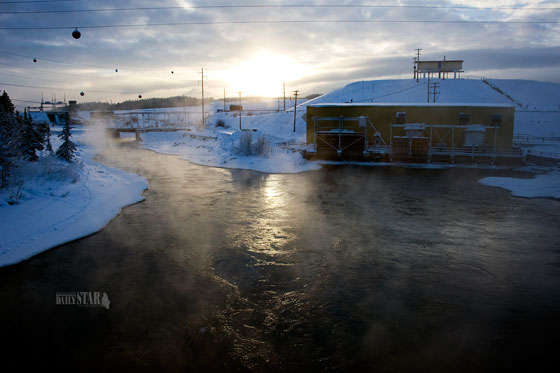
NEW HYDRO ON THE HORIZON – Above is a picture of the Whitehorse Rapids Dam facility. The government announced Thursday itsʼ beginning to look for a location to build a new hydro- generating facility.
Photo by Whitehorse Star
NEW HYDRO ON THE HORIZON – Above is a picture of the Whitehorse Rapids Dam facility. The government announced Thursday itsʼ beginning to look for a location to build a new hydro- generating facility.
The Yukon government has kicked off its pursuit of new hydroelectric energy projects.
The Yukon government has kicked off its pursuit of new hydroelectric energy projects.
Energy, Mines and Resources Minister Scott Kent made the announcement Thursday.
The minister insisted in an interview this morning this is not a planning exercise that will end up on the shelf.
"A substantial increase in Yukon's power supply will be necessary over time to foster responsible and sustainable economic development in the territory,” Kent said in Thursday's press release.
"Hydroelectric power will meet this demand and ensure Yukon's power supply is from a clean, affordable source.”
Kent has directed the Yukon Development Corp. – Yukon Energy's parent company – to plan one or more hydroelectric projects that will meet the Yukon's anticipated growth in demand.
The Crown corporation has been instructed to report back to Kent in 90 days with a work plan to achieve its mandate along with the estimated cost of doing work, the minister said.
Until the development corporation provides the work plan and the cost estimate, he added, he won't be sure what the exercise will cost, and what will be involved in terms of human resources.
The government will foot the bill, and the cost will not be passed on to Yukon Energy or its ratepayers, he said.
Kent said he would expect to have the results by next fall.
From there, he said, the government would begin searching for funding partners, which essentially boils down to the federal government and Yukon First Nations.
It's his intent, he said, to carry the project on through the permitting stage and into operation.
"Realistically, we are probably looking at 10- or 15-year time horizon on this before we can turn the lights on,” he said.
Premier Darrell Pasloski, the minister noted, has committed to making new hydroelectric generation a part of the territory's energy future.
Kent said simply the government is asking the development corporation to match the best project with the anticipated growth in demand while considering cost and location.
The exercise will likely involve looking at options already identified for new dams and others that haven't been, he said.
The government has already identified 10 potential sites that it set aside years ago during the negotiations of aboriginal land claim settlements.
Yukon Energy has identified 23 different options for future hydro generation, from small projects to the very large.
On the smaller scale, for instance, Yukon Energy has identified the option of installing a hydro dam on the Tutshi River at the south end of Windy Arm for an estimated cost of $165 million (2009 dollars) for six megawatts of generating capacity.
Among the proposals in the medium category is a power dam at the Hoole Canyon on the Pelly River, at a cost of $460 million for 40 megawatts of generating capacity, or the same amount of hydro capacity available at the Whitehorse Rapids Dam.
Among the larger projects identified in Yukon Energy's 20-resource plan is damming Fraser Falls on the Stewart River at a cost of $2.5 billion for 300 megawatts of generating capacity.
Anne Middler of the Yukon Conservation Society said this morning while some hydro-generation is good, not all of it is.
"We support low-impact projects that will give us incremental increases of hydro over time and generally that means not large projects but small projects,” she said.
Middler said the society doesn't yet have details about what the government is proposing.
Large hydro projects, she said, have a significant environmental cost.
The society would not be favour of flooding large valleys to provide huge amounts of power, she added, particularly if the demand is coming from industrial pursuits like large mines.
Middler said good examples of low-impact, effective hydro projects can be found in Skagway's Goat Lake hydro project, which produces four megawatts of generating capacity, and Altin's Pine Creek project, which produces 2.1 megawatts of capacity.
In order to encourage thoughtful and responsible discussion, website comments will not be visible until a moderator approves them. Please add comments judiciously and refrain from maligning any individual or institution. Read about our user comment and privacy policies.
Your name and email address are required before your comment is posted. Otherwise, your comment will not be posted.
Comments (12)
Up 0 Down 1
north of 60 on Nov 27, 2013 at 10:14 am
" the fact that it was packed to the rafters with spent fuel rods." posted by Brett Cross
That is misinformed hyperbole not fact.
Such unsupported nukophobe opinions have no credibility.
Up 5 Down 2
BnR on Nov 27, 2013 at 1:59 am
Brett
Spent fuel rod storage is just that, not a big deal in the big scheme of things. All power generation has issues: coal has big holes in the ground and emissions, oil has its own problems, hydro has loss of habitat etc. Nothing is perfect.
And irregardless is not a word.
Up 4 Down 7
woodcutter on Nov 26, 2013 at 7:19 am
The demand for electrical power is being driven by the industrial expansion of proposed mine's. They are intensive users of power and once the mine is shut down, there is then surplus power.
Many of the FN settlement agreements have already taken into consideration the potential for mega projects. The specific agreements are already listed in each FN Self government agreements, and have compensation formulas agreed upon.
Nuclear is about as likely to be here as Coconut trees.
Up 9 Down 2
north of 60 on Nov 26, 2013 at 6:53 am
Modern small scale nuclear reactors do not have the problems inherent in the obsolete Fukushima design.
The car you buy today isn't an obsolete, unsafe, gas-guzzler from the 70s is it?
Up 12 Down 1
lol on Nov 26, 2013 at 5:45 am
This is the same government who seems incapable of building a high school. How many false starts and millions wasted on plans and consultations and not a stitch of work done.
What makes anyone think they can pull something like this off.
Up 10 Down 2
Joel on Nov 26, 2013 at 2:49 am
Did anyone happen to notice that we are coming close to our limits for renewable power without all the mines running currently? It isn't the mines that are using all the power, it is everyone.
Nuclear is simply shifting from fossil fuels to another mined resource that needs to be constantly fed.
Up 7 Down 6
Brett Cross on Nov 25, 2013 at 12:56 pm
BnR, could you explain your statement, "In the big scheme of things, dealing with spent fuel rods is not that big a deal."? Irregardless of Fukushima's design, the fact that it was packed to the rafters with spent fuel rods would suggest otherwise. Almost all spent fuel is "temporarily" stored on-site at nuclear reactors all over the world, exactly because long term disposal is a problem that has not yet been solved. Your faith in humanities ability to manage a hazard of this scale is admirable, but I believe unfounded.
Up 16 Down 1
BnR on Nov 25, 2013 at 9:43 am
Many good points Sam. Location would be the big issue with a NP.
As far as mega hydro project location, you are correct of course, negotiating a fair package with whichever FN would affected would take years, if it could be complete all, who would want to lose so much territory?
While I fully support micro hydro style projects (and a few of these could be all we need to sustain us IF proposed mines take care of their own power needs), I don't think we should even start down the mega project road.
Interestingly, Alberta is working towards a small Toshiba reactor to be on line by 2020.
Up 21 Down 6
Sam Fidler on Nov 24, 2013 at 1:41 pm
Its time to think outside the box.
What FN is going to support a major dam near their traditional territory- none.
Nuclear energy if installed correctly is safe and reliable.
With Yukon transmission lines we can put small briefcase style nuclear generators in the central Yukon near Mayo or Ross River. They can provide fuel to all the proposed mines and tie into existing infrastructure. Nuclear is not wind or water but it has taken a bad rap and it's almost green- even David Suzuki says so.
Lets forget about dams and lakes and all the local approvals for them- time to move forward with nuclear power generation.
Up 26 Down 3
north of 60 on Nov 23, 2013 at 11:10 am
"support low-impact projects that will give us incremental increases of hydro over time and generally that means not large projects but small projects,”
Yes. This makes the most sense. Small projects employ locals, are quicker to build, and are less likely to have the management misadventures that seem to plague so many large projects recently.
Atlin's new hydro facility is a good example of appropriate technology application.
New mines should be expected to either generate their own power or contribute to developing more hydro if they want to tie into the grid.
Up 22 Down 11
translation on Nov 22, 2013 at 1:59 pm
'The government will foot the bill' for the study, 'not the ratepayers'. Who's money does Scott Kent think 'the government' is spending?! Ya, ours. The taxpayers, who happen to also be the ratepayers.
"A substantial increase in Yukon's power supply will be necessary to foster economic development in the territory,” Kent said.
Read: 'To provide mining companies with remote, cheap energy so they can have higher profits by not having to supply their own energy infrastructure. And should they fail and close (as they almost always do), Yukoners will just suck it up.'
Up 19 Down 5
BnR on Nov 22, 2013 at 11:09 am
It seems to me that if we are going to go down the mega project road, lets do it right.
Fraser Falls on the Stewart would appear to be the best option. The river above Fraser Falls is seldom used and seldom seen, and we have the infrastructure already in place, that is the transmission lines to Mayo B, from the Southern grid to the Northern grid.
But large hydro projects are going the way of the Dodo. In all seriousness, why are we not taking a long hard look at a small nuclear power generation facility. All power generation modes have drawbacks. Burning fossil fuels have emissions and the issues involved with extracting those fossil fuels. Hydro projects have their own pitfalls. In the big scheme of things, dealing with spent fuel rods is not that big a deal.
And please don't use Fukushima as an example of energy gone bad. Comparing the Fukushima plant design to modern designs is like comparing 1960s era automobiles to a Honda FIT.