Photo by Vince Fedoroff
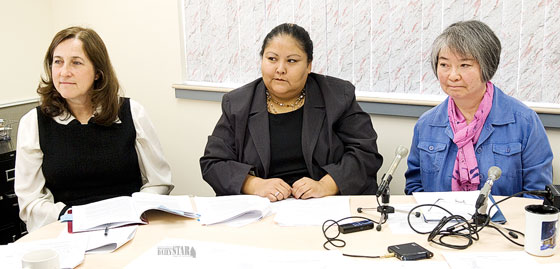
THE PROBLEMS REMAIN - The Yukon Human Rights Commission's Heather MacFadgen, Melissa Atkinson and Lillian Nakamura Maguire discuss the report and possible remedies at this morning's news conference in Whitehorse.
Photo by Vince Fedoroff
THE PROBLEMS REMAIN - The Yukon Human Rights Commission's Heather MacFadgen, Melissa Atkinson and Lillian Nakamura Maguire discuss the report and possible remedies at this morning's news conference in Whitehorse.
The Yukon Human Rights Commission has proposed four recommendations coming out of a report showing women in the territory are discriminated against in a number of aspects of life, ranging from employment to accommodation.
The Yukon Human Rights Commission has proposed four recommendations coming out of a report showing women in the territory are discriminated against in a number of aspects of life, ranging from employment to accommodation.
The Report Of Human Rights of Women and Girls was released this morning at the commission's offices.
"It's a really good start," Heather MacFadgen, the commission's executive director, told a news conference.
She pointed to the review underway of the territory's human rights legislation.
The report found that of the 255 women and girls (138 women and 64 female students) interviewed through focus groups or individual sessions, 55 per cent of women and 39 per cent of female students said they experienced discrimination.
A total of 19 per cent of those women and five per cent of those girls said they had used the commission's services at some point.
It was a combination of factors that made the commission focus on women for the report, MacFadgen said.
Women make up more than half the population in the territory, haven't achieved full equality and continue to face challenges, she said.
Funding in the amount of $20,000 from the Women's Equality Fund also meant the commission could hire someone to do research: looking at the inquiry (for the past three years) and complaint records of the commission (from 1987 to 2007) and conducting the focus groups and interviews throughout the territory, it was noted.
Among the major findings, it was learned the six-month time limit was thought to be too short and there is a need for support in accessing services.
There were complaints of discrimination related to work around the duty to accommodate not being well understood by employers as well as complaints of harassment.
There were service complaints as well based on ancestry and the failure to accommodate disabilities at schools, government and non-government agencies, banks and the RCMP.
There are also complaints around pay equity for women and discussion around gaps in human rights protection for people working for non-self-governing first nations among a
number of other issues.
Based on the findings of the report, the commission is proposing:
Under protected areas in legislation, it's proposed pay equity be applied to all employers, there be protection against hatred, there be clearer definitions to replace outdated language, and that a two-year time frame for complaints replace the current six-month limit;
Further research and consultation with first nation governments and collaboration with aboriginal women's groups is required;
Action be taken on the human rights process with education and awareness initiatives, community outreach along with culturally appropriate programs, resources and initiatives; and
Further research areas be identified as well as specific research being concentrated on women and girls that would include more consultation, research and follow-up to get a comprehensive and Yukon-based approach to human rights.
Lillian Nakamura Maguire, the commission's public education specialist, noted the results show a need for human rights education in the public school system, with most women reporting some knowledge of the commission while most female students reported knowing "a little bit".
"We believe it needs to be done at the curriculum level," she said.
More education on all fronts could lead to preventing more human rights violations, as people like employers become aware of their obligations to accommodate and more people learn how to deal with situations where there is a problem.
"I don't want to see people coming through the door," she said, adding she would rather have situations prevented then have to see them go through a complaint process.
Raising awareness is key, said commission chair Melissa Atkinson.
The legislative review means there's an opportunity for the Yukon's legislation to become the best in Canada through looking at what other jurisdictions are doing and with reports like this one, she said.
"We have a wealth of knowledge," Atkinson said.
In order to encourage thoughtful and responsible discussion, website comments will not be visible until a moderator approves them. Please add comments judiciously and refrain from maligning any individual or institution. Read about our user comment and privacy policies.
Your name and email address are required before your comment is posted. Otherwise, your comment will not be posted.
Be the first to comment