Wolverine moves toward production by middle of 2010
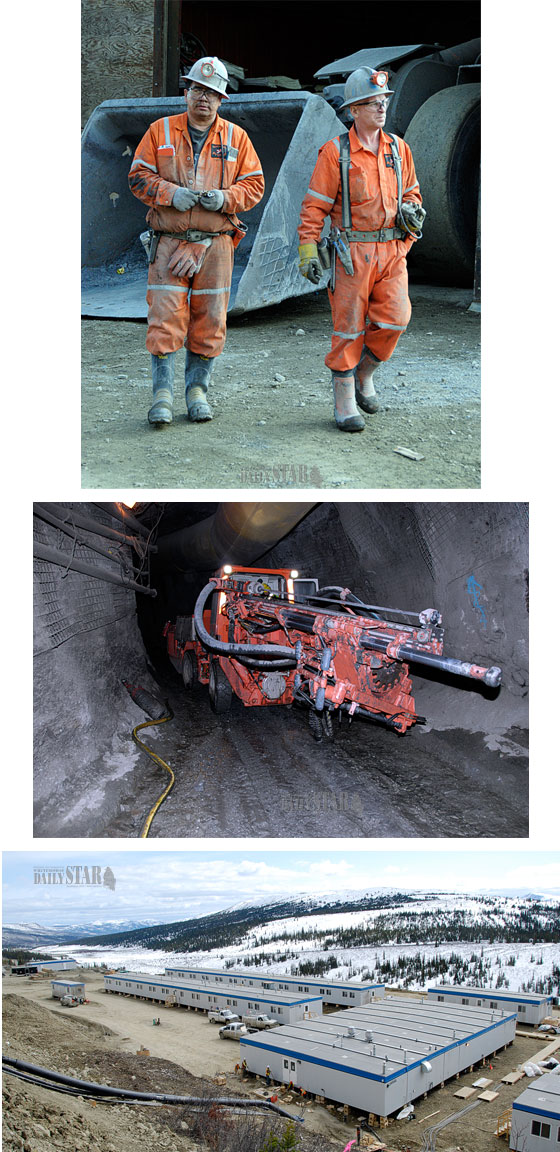
WOLVERINE MINE - Clive Creaney pokes fun at himself on the way from the airstrip to the bustling construction camp for the Wolverine mine southeast of Ross River.
By Chuck Tobin on May 8, 2009
WOLVERINE MINE - Clive Creaney pokes fun at himself on the way from the airstrip to the bustling construction camp for the Wolverine mine southeast of Ross River.
Being from Vancouver, says the project manager, he wasn't so familiar last winter with the frost heaves of the North when it he situated the 40 or trailers that will make up the main camp.
"Seriously, if you put a marble on the floor it will roll right down to the other end," he jokes.
Creaney's the man out at Wolverine right now.
It's Creaney who will oversee construction of the entire site; not just the main camp, but the large processing plant, fresh water supply, tailings area, relocation of the airstrip....
The project manager points to the site of his future batch plant for concrete. All the concrete for construction will be mixed on site.
Might as well, Creaney tells a bus load of media on tour Thursday.
All the material they need - the gravel, sand - is right there, and they want to be pouring next month, he added.
It seems like a few marbles rolling down the floor isn't all that high on his to-do list, though there's a crew working at levelling the trailers as the bus drives by.
But there's also a bulldozer pushing dirt, a couple of rock trucks hauling and a hoe or two doing their thing.
A crew is drilling off a rock face that needs to be blasted out.
Creaney says he basically has to relocate a big section of hillside, to level out the site for the processing plant and such.
The Wolverine deposit was first discovered during the wildly busy staking rush of the mid-1990s, which was sparked by Cominco's 1993 Kudz Ze Kayah find.
In geology terms, a volcanogenic massive sulphide deposit typically has lots of brothers and sisters in the same neighbourhood, and as news of Kudz Ze Kayah spread, the rush was on.
Wolverine was among several promising targets unearthed.
The Yukon Zinc Corporation, under the direction of founding president Harlan Meade, pulled the property through the downturn in world mineral prices in the late 1990s and early 2000s, and onward.
The mining executive guided Wolverine through the perennial task of raising financing to continue moving forward, including the completion of a full feasibility study, securing major permits and completing a 26-kilometre, all-weather haul road.
But last spring the junior Yukon Zinc Corporation announced a private Chinese partnership was interested in buying the property. The deal was sealed by July, and on-the-ground mobilization began this winter to get the Wolverine deposit into production by the middle of next year.
The effort was evident at the mine site Thursday during a media tour sponsored by the Yukon government.
As Creaney's crew was moving mountains and levelling trailers, a freshly blasted section of the main underground tunnel was being roof bolted by miners working for Procon, an international contract mining firm.
Two metres of new tunnel a day - that's the target.
It is fortunate in these tough market conditions to have an owner with the money to bring the mine into production, Ray Mah, Yukon Zinc's chief operating officer, explains during an interview at the site.
"If you have the financing, it is a perfect strategy to be building while the market is down, and be ready when the market is up."
The 2006 feasibility study estimated it would cost $207 million to get Wolverine into production for a mine life currently pegged between 11-13 years.
"I think we will come in about 10 or 15 per cent higher," says Mah.
He says there are currently 105 staff working at the site - not including those out on shift change.
Approximately 70 are Yukoners, of which 26 are members of the Kaska Nation. The mine site is in the heartland of Kaska territory.
Creaney points out he is making every attempt to keep contract work down to the size where local companies are able to compete.
Currently, he says, the electrical work for the camp is being done by a Whitehorse company, as is the plumbing work.
Employment is expected to jump to 205 during peak construction this summer.
When Wolverine is in production next year, the full roster of staff - on site and on days off - will be in the neighbourhood of 250, Mah says.
"We have every expectation, and every desire to be earlier than that, but that is the best target," Mah says of the production target of mid-2010.
He says the schedule is to have the processing plant up and closed to weather by the end of this October, with the mechanical work completed before the end of next March, in time for testing and tweaking prior to production.
Once in production, the Wolverine mine will chew through 1,700 hundred tonnes of raw ore per day.
Nine truck loads of concentrate will head out every day, south along the Robert Campbell Highway, and then down the Stewart-Cassiar to the B.C. port of Stewart for shipment overseas.
Mah said operation and maintenance of the Wolverine mine is expected to run around $60 million a year, with annual revenue from sales running at $120 million, depending on the price of ore.
Mah estimated Wolverine's break-even price for zinc is between 50 and 60 cents a pound. It was above 70 cents yesterday, and while it was swept to a low of 50 cents a pound in last year's market crash, two years ago it was selling for just over $2 a pound.
Carl Schulze, president of the Yukon Chamber of Mines, was on the mine tour, and said there's no question if Wolverine will be a mine next year, and will be a somewhat larger employer than the Minto Mine, currently the territory's only operational hardrock mine.
"It's all permitted," Schulze said of the Wolverine project. "It's just a matter of how long it takes for them to put in their infrastructure and get everything up and running."
Comments (3)
Up 0 Down 0
Bill Munroe on May 16, 2009 at 4:15 am
i know this Is a good mine For the yukon & china,,but i a mans wife Should not be taken from her home and family to benifit the mine that has caused marrige and stress because of the money and freedom from her home and family from My opinion ,,,What will The compney do to correct The Damage When Some people are Easy led by big short term money and no Future with the Mine and loss of their family,,another Yukon Loss for the people.
Up 0 Down 0
Francias Pillman on May 11, 2009 at 10:15 am
You meant to say, "will benefit china"
Up 0 Down 0
Daniel M. Opper on May 9, 2009 at 3:11 am
This is a viable, economic project that will benefit all Yukoners for years to come. Congratulations to the development team of Yukon Zinc.