Photo by Vince Fedoroff
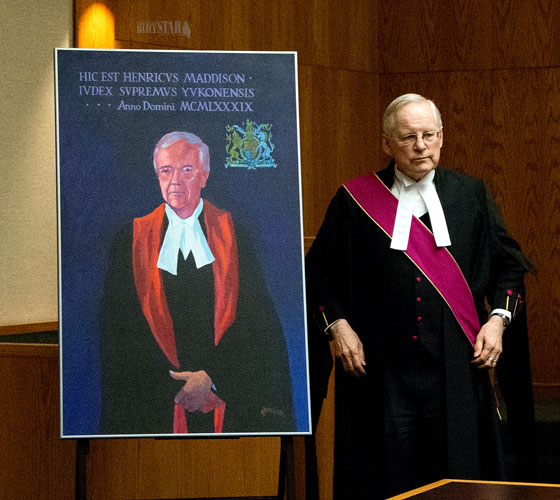
JUSTICE COMMITTED TO CANVAS – A portrait of the late Harry Maddison was unveiled Friday afternoon at the Supreme Court of the Yukon. Here, Supreme Court Justice Ron Veale is seen with the portrait.
Photo by Vince Fedoroff
JUSTICE COMMITTED TO CANVAS – A portrait of the late Harry Maddison was unveiled Friday afternoon at the Supreme Court of the Yukon. Here, Supreme Court Justice Ron Veale is seen with the portrait.
In the first-ever special memorial sitting of the Yukon Supreme Court,
In the first-ever special memorial sitting of the Yukon Supreme Court, judges, lawyers friends and family members came together Friday afternoon to remember the life and career of the late Harry Maddison, the territory's longest-serving justice.
Maddison died Dec. 26, 2013, at age 89 in Vancouver.
The mock courtroom setup saw jurists from the Yukon and beyond sharing their memories of a man held in near-universal esteem across the North.
"Judge Maddison took his responsibilities as a judge extremely seriously. He demanded the highest standards of himself and those who stood before him,” said Lesley McCullough, a lawyer and current assistant deputy minister of justice.
"He also had a wonderful sense of humour.”
McCullough recalled having to request extensions on court proceedings several times in a row after being unable to serve papers to a particularly elusive defendant. Maddison asked why.
"‘Well, my Lord, a good man is hard to find,'” she responded.
"And he replied that if I was holding out for a man in the Yukon, I would undoubtedly be back before his court several more times.”
Another time, shortly after he underwent eye surgery, Maddison appeared in court sporting dark, wraparound sunglasses over his prescription spectacles.
"They were cool. And he knew it. He got a big kick out of wearing them,” McCullough said, smiling.
When an accused came before the court, he said: "I know this show. I've watched this show. And finally I'm in the show.
"Beam me up, Scottie!”
McCullough added that the individual was saddened to learn there was little to no connection between Maddison and Star Trek.
She also remarked on how the judge's decisions over his 30 years on the bench impacted policy and precedents in areas ranging from judicial independence to First Nations justice.
"Cumulatively, they made a huge difference for our territory.”
Roughly 50 people crowded Courtroom No. 1 for the remembrance Friday, including territorial court Judge Peter Chisholm and Supreme Court Justices Leigh Gower and Ron Veale, who "presided” over the "hearing.”
Maddison's judicial robe lay draped over a portrait dating back to 1989, painted in acrylic by the territory's most famous artist, Ted Harrison, a good friend of the judge.
The canvas was unveiled publicly at around 4:30 p.m. Friday, with family and public figures like Justice Minister Mike Nixon and deputy justice minister Tom Ullyet in attendance.
Matthew Good, the Maddisons' grandson and a junior barrister himself, addressed the five-judge "panel,” recalling how he played in the courthouse as a child.
Good thought that the commemoration, which leavened the usually solemn atmosphere of the courtroom with humour and fond recollections, carried "just the right mix of pomp and good nature” to have earned Maddison's approval.
"I never met anyone with as many loyal friends as this judicial juggernaut,” Good said.
He noted his grandfather carried on an affectionate and "cheeky” correspondence with the Lord Chief Justice of England and Whales — impressive for a man "whose jurisdiction encompassed more caribou than people,” Good added.
He also noted a quip by British satirist Peter Cook that Maddison was fond of: "It's better to be a judge than a miner.
Being a miner, as soon as you're too old and tired and sick and stupid to do the job properly, you have to go.
"Well, the very opposite applies to judges.”
Good, who served as a law clerk to Supreme Court of Canada Chief Justice Beverley McLachlan, passed on remarks from the head of the country's highest court.
"I remember him with great fondness,” McLachlin said.
One deputy judge said, through Good, that his grandfather was "wise and compassionate.” Another legal professional recalled wryly that "Hank was a stickler for professional conduct.”
A third remembered how, decades ago — when the Yukon law community was small enough "to fit around a large dining table” — Maddison would invite sparring lawyers into his chambers for a cup of tea while a jury deliberated on a verdict.
That simple act reminded all parties that at they end of the day, they were all colleagues, worthy of mutual respect and affection.
"Justice Maddison was honoured and deeply proud for being able to serve,” Good said.
Local lawyer Shayne Fairman recalled clerking with the judge years ago.
"I think that Justice Maddison made me a better lawyer, but also a better person,” he said.
The judge reminded him of the importance of "helping the little guy” and "contributing to society.”
"I think he thought the role lawyers play was important because you could help people in trouble.”
Professionally, Maddison "expected a higher standard, and ethically, he lived up to the idea that "your word is your bond,” Fairman said.
Maddison's creativity in gifts, however, may not have matched his other qualities. He presented Fairman, at the end of his clerkship, with The Canadian Guide to Uniform Legal Citation.
"I don't know if that meant my legal citations were particularly poor at that point,” Fairman mused.
He still wears the legal tabs — courtroom attire equivalent to a tie — to this day.
"The same could not be said of my pants,” Fairman added.
A celebration of life was held at the Yukon Arts Centre Saturday afternoon.
Veale, who took over for Maddison in 2000, argued cases before him for years and got to know him well as a friend in Maddison's retirement.
"I think he did a very masterful job,” Veale said in an interview after Maddison's death. "He was the sole judge for 20 years. He had a huge task in terms of running the court.”
There are currently two judges on the Supreme Court, including Veale.
"As a single judge, you've got nobody in the office next door to talk to. It was very tough.”
Maddison's formal demeanour on the bench belied a robust sense of humour outside the courthouse, Veale said.
"You saw the friendlier guy, the guy with the great sense of humour, which was quite different from the guy you saw in court.”
Veale noted Maddison's support of the local arts scene.
"He was very active in the community. For example, he was very active in one of the drama societies, which wouldn't happen today.”
A debate over park benches flared one year at city hall, where some fretted their installation would attract derelicts.
"Two days later, there was a photograph in the Whitehorse Star of Judge Maddison sitting all alone on a bench,” Veale recalled.
"That was kind of his quiet statement about the issue and whoever the counsellor was.”
Veale had fond recollections from when he first arrived in the territory as a young lawyer in 1973.
"One of the lovely stories I remember is when I first came up ... and had my first big trial with him. I was all excited and waiting for the judgment, not realizing that it takes more than a few days to think about the issue and write it up.”
Growing antsy, a 28-year-old Veale called the court registry, then adjacent to the judges' chambers, to ask how the ruling was coming along.
"‘Tell him he lost!'” came the joking reply from the other end.
"He could have been very short and curt with me. You don't call a judge and ask him about his ruling. You wait for it.”
Beyond his affectionate personal side, Maddison strove to preserve the independence of the courts, even on apparently superficial levels.
In the early 1980s, he fought to keep the state from from hanging the royal coat of arms, or crest, on Yukon Supreme Court walls.
At one point during the "crest affair,” Maddison took matters into his own hands: "I remember the day the crest was put in. He had a black lawyer's robe thrown right over it,” Veale said, laughing.
Though Maddison softened up a bit, conceding to the coat of arms in both of the Yukon Supreme Court's courtrooms, for example, he otherwise maintained a bare public workplace.
"At the end of the day, he was establishing judicial independence, and that is an extremely important marker for us today,” Veale said.
Born in 1924, Maddison piloted a bomber plane in the Second World War and went on to receive his bachelor and law degrees from the University of Alberta, practising real estate law in Edmonton in the 1950s.
He worked for four years in "a special service to the oil patch,” according to ADR Chambers International, a Canadian legal organization. He then spent 10 years in general practice in Peace River, Alta.
Called to the bench in 1969, Maddison served for the next 30 years as a Yukon Supreme Court justice, retiring in 1999 and residing in Whitehorse until his death.
Steering the Supreme Court as its sole judge for two decades, Maddison sought to expand accessibility to the justice system through proceedings in the communities and also in the Northwest Territories.
"In his capacity as one of the trial judges of the Supreme Court of the Northwest Territories, he sat in almost every community in the N.W.T., usually hearing criminal matters in the smaller communities, civil matters in Yellowknife,” ADR states.
Maddison also integrated traditional forms of dispute resolution into his decisions, including circle sentencing, which draws on First Nations customs to find appropriate punishment, denunciation and deterrence.
The publisher of Maddison's collected lectures – co-edited by Veale – describes him as "a traditionalist and a reformer.
"He embraced mediation while many courts were still questioning its value.”
Yukon College recently established a permanent chair in his name to recognize the judge's contribution to northern justice.
Late last week, that fund brought internationally renowned Justice Juan Guzman to the territory to speak about his experience investigating the human rights abuses of Chilean dictator Augusto Pinochet.
The late jurist's longtime wife, Jeannie, died several years ago.
In order to encourage thoughtful and responsible discussion, website comments will not be visible until a moderator approves them. Please add comments judiciously and refrain from maligning any individual or institution. Read about our user comment and privacy policies.
Your name and email address are required before your comment is posted. Otherwise, your comment will not be posted.
Be the first to comment