Photo by Whitehorse Star
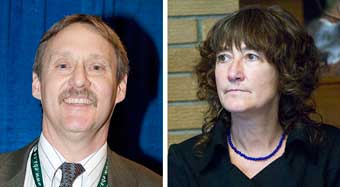
Carl Schulze and Karen Baltgailis
Photo by Whitehorse Star
Carl Schulze and Karen Baltgailis
The Peel Watershed Planning Commission is recommending maximum protection for 80 per cent of the watershed.
The Peel Watershed Planning Commission is recommending maximum protection for 80 per cent of the watershed.
The Yukon Conservation Society is pleased, while the Yukon Chamber of Mines is disappointed, "very disappointed.”
The commission released its plan last night, and delivered it today to the Yukon government, the First Nation of Nacho Nyak Dun of Mayo, the Tr'ondek Hwech'in First Nation of Dawson City and Old Crow's Vuntut Gwitchin First Nation.
Accepting, rejecting or altering the plan will be almost entirely up to the Yukon government at the end of the day, as 97 per cent of the planning area is territorial Crown land.
The Peel plan has been a hotly debated issue between those favouring wilderness protection and those wanting to maintain access for exploration and development of mineral and oil and gas resources.
The wilderness lobby argued the Peel watershed was a world-class jewel that could not maintain its pristine values with all kinds of roads running through it.
Support of continued industrial access said the region's resources are significant on a worldwide scale and far too valuable to be locked away.
In a brief glance at the 200-plus page documents, it is evident the commission agreed with the wilderness lobby.
In its forward to the document, an excerpt from the message written by the six commissioners reads:
"We heard that the Peel Watershed is unusual. Not just in the Yukon, but in Canada and in the world. Other places are beautiful, other places have animals, and other places have rivers and wetlands and mountains and tundra. Our planning area has these assets in abundance, but that's not what makes it so unique. The really important asset of the Peel country is that it is extensive, undeveloped, and largely devoid of roads. In short, it is beautiful, rich, and wild, and therefore both unusual and unusually valuable – as it is.
"We also heard that the Peel country holds potential reserves of minerals, uranium, oil, and gas. And that developing these resources depends on open staking with the option to build roads to claims and leases. The stated belief is that industrial
development and ‘opening the country' is best for society.
Underlying this assumption is another, that economic worth (measured by dollars) is how lands and resources should be valued by society.
"... As we were charged to do, this Plan focuses on ‘Sustainable Development'. The UFA definition is clear that it is ecosystems and social systems that are to be sustained, and development is fostered insofar as it doesn't undermine them.”
The commissioners also noted that it is simply not possible to solve some conflicting land uses, and that their work was guided the Umbrella Final Agreement and its requirement the planning exercise recognizes the values of society as a whole.
Among the many recommendations are:
• That mineral staking be prohibited in 80 per cent of the Peel that is under the designation of special management areas.
• That no roads, winter or all-season, be allowed in those areas.
• That the existing designation of the Wind River as a travel corridor and winter road access route be forever removed.
• That no more airstrips be allowed anywhere in the 68,042 kilometres making up the Peel planning area.
• That new management guidelines be prepared to govern the use of snowmachines, ATVs and other off-road-vehicles in the Peel watershed, as volunteer efforts are proving not to be enough to off-set the impact of off-road vehicles.
• That a comprehensive plan be developed to monitor and manage water resources throughout the planning area.
• That initiatives be undertaken to enhance tourism-related opportunities in the region.
• That plans be developed to avoid having large concentrations of people, either from industry or tourism, congregating in one place at one time.
Among what the commissioners found in their deliberations was that:
"Large segments of the Yukon public have identified values and interests that are congruent with those of the affected First Nations, namely that ecosystem integrity and intact landscapes are the priority land-use management consideration in the planning region.”
Karen Baltgailis, executive director for the conservation society, said this morning that in her initial glance at the substantial document, she feels the planning commission has listened to what the majority of Yukoners were saying.
"Recognizing we have not explored the details yet, at this point in time as far as we can tell, it really does seem like the commission has really listened to the majority of first nations and the Yukon public.”
The recommended plan is much closer than last spring's draft plan to achieving the level of protection the majority of Yukoners were seeking, she said.
Baltgailis said because it will likely take the Yukon and the first nation governments some months to negotiate and respond to the document, she hopes in the spirit of good faith the Yukon government will right away implement a moratorium on mineral staking.
"We do not want to see a flurry of nuisance mineral staking happing over the next summer to further complicate things,” she said.
Carl Schulze, president of the Yukon Chamber of Mines, said this morning he only had time to read a brief summary of the document provided by the commission.
"I am very disappointed,” he said of what he did read.
Schulze pointed out last spring's draft plan called for protection across 59 per cent of the planning area, an amount which was stringently opposed by industry.
The commission has now gone even further and increased the amount to 80 per cent, he said, sounding somewhat as though he'd been broadsided.
Schulze said the commission's recommendation to allow existing mineral claims to stand in special management areas is meaningless, because without road access, the claims have no value.
In the draft plan, he pointed out, the world class iron ore deposit near the Snake River was left open as a zone that allowed for future development of the deposit, which has been on the books for decades, he noted.
Not anymore, Schulze said, noting the deposit now sits under a special management designation, which means no roads. With no roads, there's essentially no deposit, he said.
Just last week during the Yukon Geoscience Forum, the chamber president warned industry delegates that a pro-wilderness victory in the Peel could set the precedent for the next six regional planning exercises across the Yukon.
The planning exercise for the Dawson region is about to begin, and while the wilderness lobby may not go in with a goal of protecting 80 per cent of the area, it could be 50 per cent, he said.
He told delegates the Yukon is currently looked upon quite favourably as a place to invest, not only for its mineral resource but also because of its favourable regulatory regime.
Losing the Peel struggle, he told delegates, could erode that image.
This morning, Schulze reiterated that concern.
He would not say if the chamber will immeidiately begin lobbying the Yukon government, which has the final say.
He did say the chamber is indeed a lobby organization.
Baltgailis said while she recognizes the Yukon Party government is a pro-development government, she also points the government has said several times recently it is respecting the planning process established under the Umbrella Final Agreement, and the work of the commission.
"I am hoping that will continue,” she said.
In order to encourage thoughtful and responsible discussion, website comments will not be visible until a moderator approves them. Please add comments judiciously and refrain from maligning any individual or institution. Read about our user comment and privacy policies.
Your name and email address are required before your comment is posted. Otherwise, your comment will not be posted.
Be the first to comment