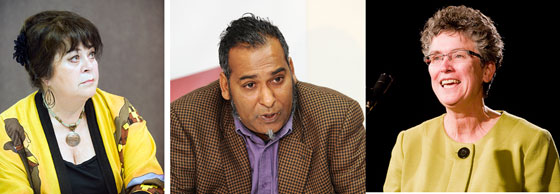
Photo by Whitehorse Star
Marian Horne, Patrick Singh, and Liz Hanson
Photo by Whitehorse Star
Marian Horne, Patrick Singh, and Liz Hanson
Ed. note: this is one of a series of riding profiles the Star will publish leading up to the Oct. 11 territorial election.
Ed. note: this is one of a series of riding profiles the Star will publish leading up to the Oct. 11 territorial election.
Whitehorse Centre is a community in flux. Its boundaries encompass all of the downtown area and extend roughly from the Yukon River in the east and the escarpment in the west, and from the Marwell industrial district in the riding's north end to the roundabout on Robert Service Way.
One of the city's oldest areas, the riding is home to many small businesses as well as the Yukon Legislative Assembly and several territorial government agencies and First Nations offices.
Development along the waterfront and the construction of several condominiums have made the area an increasingly desirable one for newcomers.
But with sparse housing availability and high rents, the riding has also found itself at the very epicenter of the territory's housing crisis, and struggles with a relatively high number of residents living with alcohol and drug addictions.
All three major parties have fielded candidates in Whitehorse Centre, who include NDP Leader and incumbent Liz Hanson.
Originally from Calgary, Hanson studied political science and social work at the University of Calgary.
As a social worker, Hanson worked in Prince Edward Island and in street-based programs helping the homeless in Calgary.
She took a job with the Department of Indian and Northern Affairs in Whitehorse in 1978. While working with the department, Hanson helped create various social work training programs. She was responsible for a territory that extended from Old Crow to Good Hope Lake, B.C.
She also assisted with the 11 successful First Nations self-governing agreements in the territory. Hanson, who has been with the territorial NDP since she retired from the federal government in 2007, was acclaimed as party leader in 2009.
As both the NDP leader and MLA for the riding, Hanson has a unique role to play, but says she is committed to balancing her responsibilities to the party, the territory and riding.
"An MLA's job is to work on behalf of the citizens, regardless of who they vote for,” she says.
"Going for the premier's office will be a balancing act for me. Not only will I be representing Yukoners as premier, but also my constituents. But I will always make sure I have the time I need to touch base with them; it is very important to me not to lose touch with my riding.”
A major concern for Hanson is the at-risk populations living in Whitehorse Centre, including youth. She also believes in greater investment in employment, improving relationships with First Nations governments, investment in communication technology for small business, addictions treatment, transit and providing both social and affordable housing, she says.
Patrick Singh is the Liberal candidate for Whitehorse Centre. This is his first time running for political office.
What he lacks in political experience, he makes up for with 20 years of working at the street level within the riding. Singh has been a small business owner in Whitehorse Centre for the last two decades, first as owner of Paddy's Place, a local pub and live music venue, and most recently as the owner of Mark and Paddy's Wondrous Music Emporium on Fifth Avenue and a hot dog stand on Main Street.
He believes his "intimate knowledge of the downtown cultural and artistic community” and his experience in business, working alongside various levels of government and NGOs, gives him a newcomer's advantage and the opportunity to provide a new approach to leadership for the revitalizing community.
A priority for Singh is investment in small businesses downtown, particularly those servicing the arts.
"Downtowns are traditionally centres of arts and culture,” he says.
" Downtown Whitehorse is just that and can be even more so. Downtown should be an expression of the unique culture of the city, of the territory.”
Singh favours creating more downtown street festivals and events, a part-time pedestrian walkway on Main Street between Third and Fourth Avenues, and a downtown art school.
Marian Horne is the Yukon Party's candidate in Whitehorse Centre. The current Minister of Justice, Horne has served as the MLA for Pelly-Nisutlin and is responsible for the Women's Directorate. Much to her displeasure, which she made public, she lost the Yukon Party's Pelly-Nisutlin nomination to Stacey Hassard for this election.
A member of the Tlingit First Nation, she also served on the Teslin-Tlingit council. Her background is in business accounting, and she has worked for several multinational corporations, including Antel, ATCO, Trimac and Phizer.
Horne received a scholarship to the Banff School of Fine Art, and studied business at the McTavish Business School and the New York School of Interior Design.
One of her primary concerns is substance abuse, particularly its systemic effects on women, children and families, as well as bringing the effects of FASD to the territorial forefront. She also supports arts and extra-curricular programming for youth at risk and improving care to seniors, she says.
The housing debate is at the forefront of all three candidates' platforms.
"We need multi-use housing,” says Singh. "We need to make sure that the people who need housing immediately have it.
"I am in support of the Northern Housing Initiative 100 per cent, because once we help people help themselves, we'll have a healthier community. We also have to ensure that there is investment for housing for the middle class, because everyone is in this situation.”
Says Horne: "We need creative thinking to get more housing on the market.”
She wants to work closely with the City of Whitehorse to bring forward some of the rezoning issues and with the Yukon Housing Corp. to get a public housing initiative going to give people access to adequate, affordable housing.
Hanson also favours rezoning land to provide for more housing, but also supports temporary and long-term housing solutions for at-risk population.
"There are also youth at risk, and we have talked until we are blue in the face about helping kids without a safe environment because there is a lot going on; maybe it's abuse, violence, addictions issues.
"There is a very immediate need for more appropriate youth shelters and programs in the short and long term, because we cannot have our kids out on the street involved in crime, or selling their bodies for a place to stay,” she says.
Finding a solution to chronic drug and alcohol abuse is another key issue in the riding.
"There are a lot of at-risk people that gravitate to Whitehorse Centre,” says Hanson
"We need to move toward a harm reduction model, as outlined in the Beaton-Allen report. It's been all but ignored by the previous government, and now we are faced with the very serious social challenge of finding these people an appropriate place to stay, for treatment and also in terms of permanent, affordable housing.”
"Substance abuse is the biggest generator of crime in the Yukon, and that is so evident here in Whitehorse,” says Horne.
"Violence against women is three times the national average here. The kids see the women treated this way and it is passed on. Healthy communities make healthy families and a healthy Yukon. As Minister of Justice, I created programs and services to address that and I would do the same in Whitehorse Centre.”
"We need to take care of chronic alcoholism downtown,” says Singh. "It's going to take proper management, but can start with the creation of a downtown treatment centre.”
All three candidates agree that Whitehorse Centre plays a vital role in the territory – culturally, politically and economically.
"Whitehorse Centre is the pulse of the Yukon. It's the place everyone drives through, it's a place to do business, and whatever we do to improve Whitehorse Centre will improve the Yukon,” says Horne.
"Whitehorse is the first place visitors come to see, and it should be a gem,” says Singh.
"Yukoners are great people, and we don't need people to come and tell us how to do things right; we should set the example and we can start in Whitehorse.”
Says Hanson: "Whitehorse Centre has a real ‘pride of place.' People love living here and you can tell by the care they put into their homes and gardens; it's just got a nicer feel to it,” says Hanson.
"With the combination of arts, business, the heads of the mining companies, First Nations and government, it's a cross-section, from families that ‘came over the pass' to those new to town, new to Canada. Whitehorse Centre really is the heart of the Yukon.”
The riding has been held by both the NDP and the Liberals since 1996.
Former NDP leader Todd Hardy won it in 2006 with 47 per cent of the vote. Voter turnout was 66 per cent out of 1,167 registered voters.
Hanson won the riding in a December 2010 byelection called after Hardy's death from leukemia the previous July.
In order to encourage thoughtful and responsible discussion, website comments will not be visible until a moderator approves them. Please add comments judiciously and refrain from maligning any individual or institution. Read about our user comment and privacy policies.
Your name and email address are required before your comment is posted. Otherwise, your comment will not be posted.
Be the first to comment