Whistle Bend planners face forest of critics
It was supposed to be an eco-friendly, sustainable community.
By Stephanie Waddell on January 15, 2010
It was supposed to be an eco-friendly, sustainable community.
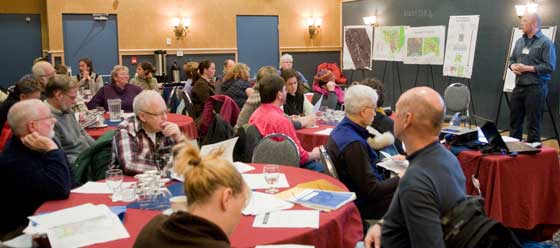
Instead, it seems Whistle Bend will be just like any other neighbourhood in Whitehorse, at least to many who spoke out at a public meeting on the proposed subdivision held Thursday evening.
"There's nothing sustainable from what we're hearing tonight,” one of 30 or so people argued to officials with the city and the Yukon Environmental and Socio-economic Assessment Board (YESAB).
The first two phases of the subdivision, to see 295 new lots constructed in the lower bench of Porter Creek, is now being considered by the YESAB after the city approved the zoning and subdivision of the land last year.
It wasn't those first two phases of the project that dominated the conversation last night though. Instead, city planners came under fire for a plan in the later phases that would see a road connecting the new subdivision with the Alaska Highway crossing at McIntyre Creek.
The public arguments last came after Karen Baltgailis, the executive director of the Yukon Conservation Society, publicly called on the assessment to be halted until there could be consultation on the proposed road extension from Pine Street to the highway.
She argued the new crossing should have been included in the first two phases of Whistle Bend, rather than as a piece of background information included in the YESAB submission.
"Is the city trying to sneak the connector road in by putting the environmental assessment of it off until future phases of Whistle Bend?” Baltgailis asked in a statement this week.
"The City of Whitehorse Whistle Bend Transportation Network Impact Study says that a road link to the Alaska Highway is needed at a Whistle Bend population of 1,000 people, which is the target of phase one and two, so why hasn't the city included it in the current assessment?
"Once phases one and two are built, is the city going to come back to YESAB and say they've spent so much money on phases one and two and now they're built, so a connector road must be built?”
Those sentiments were expressed by many at last night's meeting. They argued the initial pieces of the subdivision will create the need for the roadway.
"Once you do phases one and two, you will have demand,” said one person, who went on to add that while there's been a great deal of consultation on the Whistle Bend subdivision, little has been said about the crossing at McIntyre Creek or the Pine Street extension.
Too often, Baltgailis said in an interview, a project will come before the YESAB in phases. By the time it gets to the later stages, the proponent will tell the YESAB there has already been so much spent on the previous phases that now the need is there to go ahead with the later ones.
"Things happen quicker than you expect,” she said, arguing the YESAB rarely recommends against something being done piecemeal because it's difficult to see the full impact that way.
"The assessment report submitted to YESAB states that the entire McIntyre Creek corridor is considered a significant wildlife area and it is environmentally sensitive,” said Friends of McIntyre Creek president Dorothy Bradley. "A road and bridge are entirely incompatible with this designation.”
While both Montainview Drive and Range Road cross McIntyre Creek, Baltgailis said the proposed crossing that would link to Pine Street would be in the middle of a large area of wildlife habitat and through a site that's heavily used by people for recreational activities.
It was at a Dec. 17 council and senior management meeting about the city's review of the Official Community Plan that Baltgailis said she heard planning manager Mike Gau say the crossing would be a necessary part of Whistle Bend.
At last night's meeting though, Gau argued it will be a decision left up to council. The need for the road is based on current transportation trends and comes purely from a technical sense without yet looking at the environmental and other impacts, he added.
If people start taking transit, for example, that could take pressure off roads like Mountainview Drive, possibly alleviating the need for the connector.
"Council can make that decision,” he said.
Baltgailis countered his argument by asking that he write a letter to the YESAB that would then be copied to council stating at the December meeting he misspoke himself about the road being an integral part of Whistle Bend.
She also argued that rather than spending millions on new roads, the city would be better off to spend that money on creating a more effective transit system.
As the city continued to defend what it's put before the YESAB, stating there would be public consultation and more research into the possibility of the route if the city opted to pursue it, residents at the meeting continued to slam the city, saying the entire Whistle Bend project should be assessed all at once.
YESAB assessment officer Keith Maguire pointed out that to assess the whole project, the YESAB would need the same level of the information it has now on the first two phases for the entire project.
As both he and Gau explained, in a subdivision that's expected to grow over decades, it's impossible to get to that level of detail needed for a YESAB submission on sections that are many years away.
"We're not assessing the master plan,” Maguire said. Pieces like the transportation study detailing the crossing help the board consider what the longer-term impacts of the development would be, he added.
If the decision is made to go ahead with the crossing, he said, it would be subject to an assessment review, similar to what is being done now on the first two phases.
Maguire went on to note the issue is something the board could be looking at more as it considers the public interest in the situation.
"It's something we're definitely aware of,” he said.
The city also came under fire for its plans as residents wondered about the previously talked about district heating system for the neighbourhood, only to learn it's now something being looked at for later phases.
While a geo-exchange study was done, Gau noted, it wasn't a detailed piece, and there are still questions about who would run the new utility and how the capital work would be funded. It's fairly easy to get money to study the possibilities, but funding to actually make it happen is difficult, Gau said.
"It's something we really want to do,” he said.
Others, meanwhile, took issue with the city cutting back on the greenspace that was originally envisioned for the community.
Gau argued that as the plans became more detailed for the area, some "trade-offs” had to be made to meet all the goals for the neighbourhood.
"It's a trade-off between development and green space,” he said.
Many continued to argue the neighbourhood will not be the sustainable community planners initially suggested it would be, and should perhaps be halted for now.
City planner Kindon Kosick, who's managing the Whistle Bend project, argued that it goes much further than any other neighbourhood has in sustainability.
All residents will be within five minutes of a bus stop, he said, and the higher density will help prevent urban sprawl. Though some of the green space has been reduced from what was initially proposed, he conceded, there are still the "green fingers” throughout the neighbourhood.
While YESAB officials listened to the range of comments, residents have until next Friday to let officials know their thoughts on the project.
The YESAB will then come up with a report with possible recommendations.
Comments (8)
Up 0 Down 0
Jerimiah on Jan 23, 2010 at 1:55 am
footprints
The multilane roads are more about progressive planning. Recall Whitehorse of 50 years ago, Whitehorse now and imagine Whitehorse in 50 or 100 years. Without large arteries running into downtown the city centre is doomed for failure....look and any city today. Cities tend to rot from the inside out. This is already happening with the big box developments sucking business away from downtown merchants. While Main Street is only 5 minutes from Walmart people will opt for the former with free parking and no congestion.
And while pedestrian and traffic safety is an issue accidents will happen. We saw yesterday a child getting hit in a parking lot. Enforcement of speed limits and other rules of the road in addition to arresting public drunkards and jaywalkers would go a long way to protect people from themselves.
Some gentrification of downtown is happening with new condos and while having more people living downtown is positive the people they've displaced are generally on the margins of society. ie the poor and elderly.
Arn, you grumpy, lonely old man: English is not my first language, in fact my third but my points are still valid. You and 'francias' contribute nothing more than snide remarks to the dialog here.
Up 0 Down 0
Brett Chandler on Jan 22, 2010 at 8:34 am
More small buses won't help transit.
The size of the bus has almost no impact on transit costs. All told, it probably costs in the neighborhood of $50 an hour to run a bus in this city. Switching to a smaller bus will save maybe $2 of that.
The bulk of that cost--close to $40--comes from labor. The driver to drive, the mechanics to maintain. No, CoW transit drivers don't actually get paid that much, but when you include benefits, CPP & EI, and WCB, you get the idea.
What we need, is higher density, or at least what I'd call "pockets of density" in all communities. A 100-unit multi-family development will likely have several transit users, and the bus has less distance to travel to reach them all. That one high-density development can make transit viable for a whole neighborhood. Trash collection and water and sewer connections get cheaper and easier, too.
Whistle Bend IS more sustainable than previous communities, though not by that much unless features like geo-exchange heating make the cut. It's also the only game in town right now.
It's really nice to hear Karen Baltgailis complain about how much environmental risk this project entails, but what of the social risk if it doesn't proceed? We're out of lots again after this year, just as mining and pipelines in the region stand to take off. As housing costs go out of sight, how do we address the problem of homelessness? How do we encourage workers to move to the Yukon, instead of flying in for their mine stints?
Up 0 Down 0
footprints on Jan 22, 2010 at 6:30 am
Jerimiah: I have to question the idea of multi lane roads. High traffic crash rates (especially pedestrian deaths along 2nd Avenue) are associated with multi lane roads. Multi lane roads allow for hyperactive driving habits, some drivers recklessly changing lanes continuously in an effort to arrive at their destination a mere half minute before the very cars they pass, all at the expense of public safety. 4th Avenue, which has one single lane each direction straight through, with left and right turning lanes does not have anywhere near the same incidences of carnage. But I do agree that traffic circles are ridiculous.
Up 0 Down 0
Arn Anderson on Jan 20, 2010 at 9:55 am
Barron is the exact attitude I called forth.
Get a grip and quit your whining about the CoW. Bev Buckway won and you cant let it go.
Up 0 Down 0
Barron on Jan 19, 2010 at 11:13 am
Quit your whining Arn, Jerimiah made some valid points which is something that escapes you.
I think Gau is trying to compensate for having half the hair and twice the waist size he had in high school.
COW will 'consult' and then ignore the public like it always has right Buckway? Remember the petition you threw into the landfill?
Up 0 Down 0
Arn Anderson on Jan 19, 2010 at 3:00 am
Wonders where are all the grammar nazis for Jerimiah's comment? Oh I forgot, it doesnt say Arn Anderson beside it, typical.
Up 0 Down 0
francias pillman on Jan 18, 2010 at 9:46 am
Saying one thing and doing the other? This town voted for its own incompetence, you reap what you sow.
Up 0 Down 0
Jerimiah on Jan 17, 2010 at 2:57 am
Gau is simply playing a shell game.
Of course the road will plow through the park once the development happens....once you get a few thousand people living there how will they get out? Look at Copper Ridge, for years it was 2 lanes in, one lane out and while the Hamilton Extension did alleviate much of the traffic issues but transit has never been addressed. Currently the southernmost streets are more than 1.5 kilometers away from the nearest bus stop. With virtually no services up here the spoke and hub layout of the city, inadequact transit make owning a vehicle essential. Whistelbend will be no different. COW needs to look beyond10-15 years out and have large, multi lane roads (sans traffic circles)that connect the 'burbs to the city centre. Additionally they need to fix transit; Smaller buses, more often and covering more of the city. The large buses are fine for paeak times and busy routes.