Photo by Stephanie Waddell
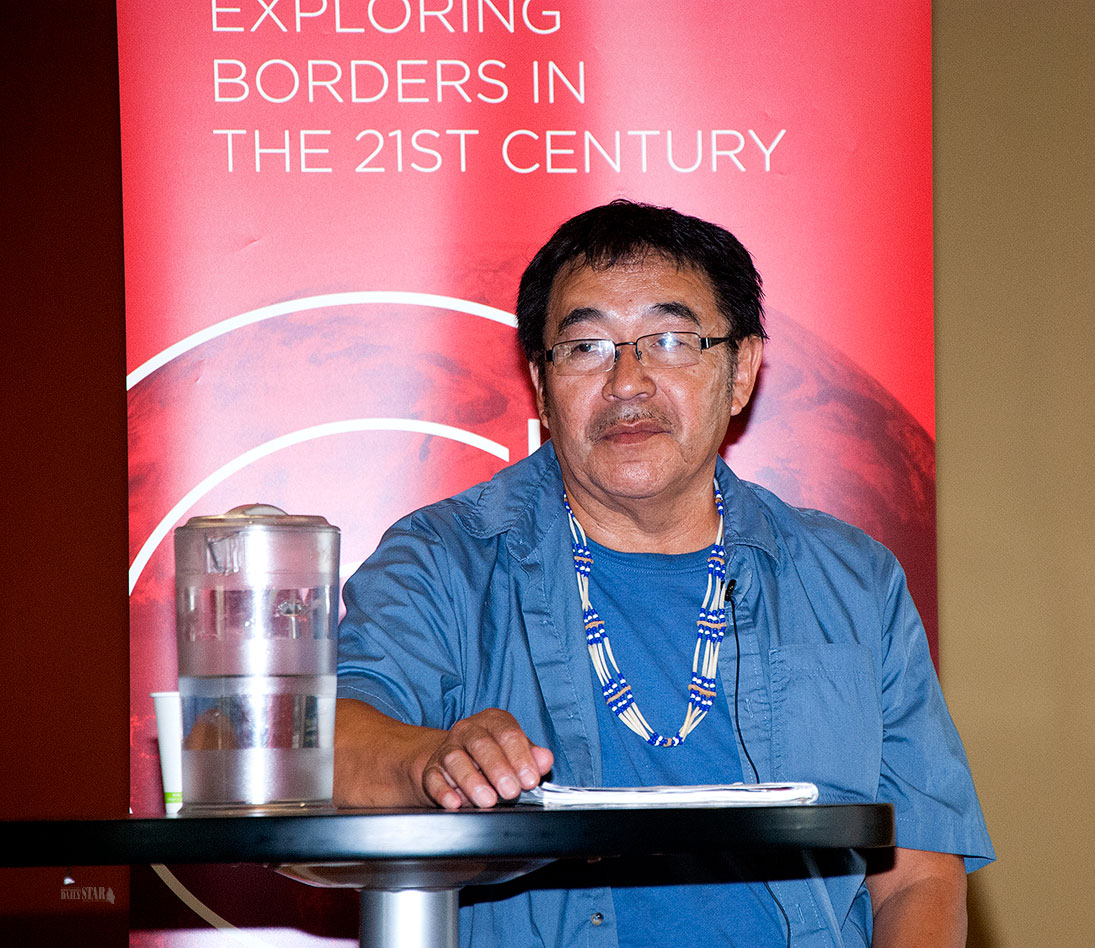
RECALLING A TENSE TIME – When officials arrived in the 1950s to take David Johnny (above) and his siblings back to residential school, Johnny’s father pulled out a gun and told them his children were not going back.
Photo by Stephanie Waddell
RECALLING A TENSE TIME – When officials arrived in the 1950s to take David Johnny (above) and his siblings back to residential school, Johnny’s father pulled out a gun and told them his children were not going back.
A line drawn on a map more than a century ago continues to have a major impact on members of the White River First Nation.
A line drawn on a map more than a century ago continues to have a major impact on members of the White River First Nation.
“When that line came through, it changed everything,” David Johnny, the First Nation’s deputy chief, told those attending the Borders In The North conference during his keynote address Wednesday afternoon.
The two-day conference, focused on border issues and being held at Yukon College, will wrap up later today.
Johnny, who’s also served three terms as chief for his First Nation, focused his presentation on the more personal border experience going back to the early 1900s.
That’s when the international boundary line between Alaska and the Yukon was drawn in his First Nation’s traditional territory around Beaver Creek.
As he told the lunch time crowd that gathered to hear him, before the boundary with Alaska was drawn, First Nations hunted, trapped and fished between what are now two jurisdictions.
Before contact with non-First Nations, “we had our own government, we had our own laws,” Johnny said.
Through a council of chief and elders, issues were dealt with in a system that governed First Nations, he said.
He went on to describe it as a time when the First Nations had the freedom to hunt, fish and trap where they wanted.
When the border was drawn, everything that First Nations had spent thousands of years building was misplaced.
Many older people got into trouble with the law in thinking they still had the freedom to move freely. Nobody was thinking about the impact on First Nations, Johnny said.
“It’s just like displacing people,” he said, adding that it was as though families weren’t families anymore.
Where once was a fishing camp, now stands a U.S. customs station, he pointed out.
While Johnny’s been told he’s Canadian, in the 1950s, he was growing up in his family home on the Alaska side of the border.
One day, the RCMP and other officials showed up telling the family they had to come back to Canada because they were Canadian. If they didn’t do so, they were warned Johnny’s father would go to jail.
Johnny said he can remember being six years old, hardly able to speak English and being put on the back of a flatbed with his brother and driven off to the Lower Post Residential School in northern B.C.
Back with their parents in the summer, they told them about the abuse happening at the school.
When officials arrived again to take the kids back to the residential school, Johnny’s dad pulled out a gun and told the officials the kids were not going back.
The impact of the border being established continues to be felt by the First Nations, he said.
He pointed out that it is in the White River First Nation tradition to bring items – like guns, blankets, snowshoes and others – to honour a deceased person being put to rest.
When his grandmother died, he said, family in Alaska brought guns, blankets and the like only to have them all seized at the border.
Similarly, because his son and son-in-law have run into trouble in the past, they cannot cross the Alaska/Yukon border to come to Johnny’s upcoming retirement party this weekend.
“It just doesn’t seem right,” he said.
Johnny argued there should be an agreement in place that would allow First Nations to cross the border and, provided they have proper paperwork, bring items across more easily.
“It’s a really big issue,” he said, stressing that the boundary line drawn on the map took away part of the identity of the First Nations people.
In order to encourage thoughtful and responsible discussion, website comments will not be visible until a moderator approves them. Please add comments judiciously and refrain from maligning any individual or institution. Read about our user comment and privacy policies.
Your name and email address are required before your comment is posted. Otherwise, your comment will not be posted.
Be the first to comment