
Photo by Star Photo By Vince Fedoroff
LARGER PREMISES NEEDED – Marc Champagne, principal of École Émilie-Tremblay, talks to the media in the school's library, which falls below secondary school calibre.
Photo by Star Photo By Vince Fedoroff
LARGER PREMISES NEEDED – Marc Champagne, principal of École Émilie-Tremblay, talks to the media in the school's library, which falls below secondary school calibre.

Photo by Star Photo By Vince Fedoroff
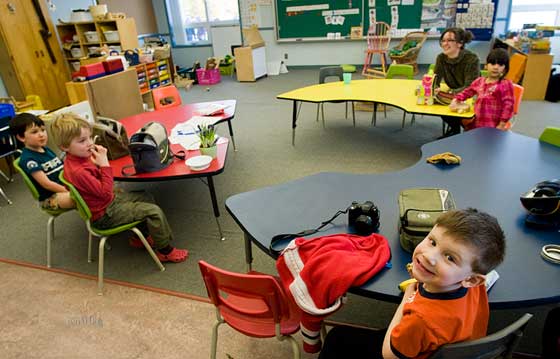
Photo by Star Photo By Vince Fedoroff

Photo by Star Photo By Vince Fedoroff

Photo by Star Photo By Vince Fedoroff
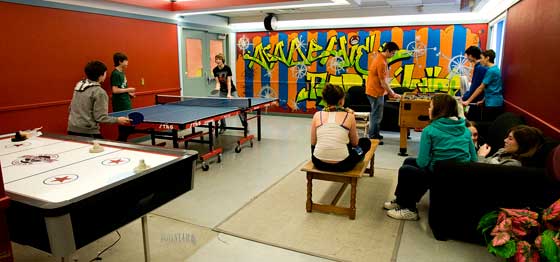
Photo by Star Photo By Vince Fedoroff
École Émilie-Tremblay's principal Marc Champagne offered local media a tour of his school Tuesday to present the francophone school board's side in its lawsuit against the Yukon government.
École Émilie-Tremblay's principal Marc Champagne offered local media a tour of his school Tuesday to present the francophone school board's side in its lawsuit against the Yukon government.
While media attention has focused on the government's appeal to have Justice Vital Ouellette removed from the case for alleged bias, and the francophone board's healthy $4 million-plus annual budget, Champagne said what the board is asking for is reasonable.
Filed in February 2009 and currently under deliberation by the Yukon Supreme Court, the Commission scholaire francophone du Yukon's lawsuit cites section 23 of the Charter of Rights and Freedoms – a constitutional guarantee for minority language rights – and seeks sole control of the school's annual funding.
The board also wants the government to build it a dedicated high school as École Émilie-Tremblay, opened in 1996 and originally intended as an elementary school, is overcrowded, said Champagne.
The Education department lists maximum capacity for the 3,470-square-metre École Émilie-Tremblay at 288 students.
But Champagne said student/teacher ratio requirements as well as providing curricula for Kindergarten to Grade 12 makes accommodating the school's current enrolment of 184 students a stretch.
A sound-proof music room, for example, has been converted to a regular elementary classroom, and the piano and other musical instruments now crowd a corner of the school's library.
On the high school side of the building, a science lab also serves as the industrial arts classroom and a collection of large power tools competes with sinks and gas-equipped desks.
Tutorial sessions and special needs classes have also spilled into École Émilie-Tremblay's hallways and in some instances are divided by makeshift curtains strung between the walls.
"We're definitely challenged for space and we're using every nook and cranny,” said Champagne.
With only 41 students at École Émilie-Tremblay enrolled in Académie Parhélie, the school's secondary school program for Grades 7 through 12, making the case for a $15-million high school addition – based on a Zedda and Kobayashi Architects' design commissioned two years ago – has been difficult for the board; hence the lawsuit.
Both Champagne and the board's director, Lorraine Taillefer, believe a dedicated high school would keep more secondary students; two-thirds of whom are lost to mainstream English programs.
"It's difficult to retain high school students,” said Champagne, noting the attrition begins when students reach Grade 8.
"Because it's difficult to compete with other schools that have incredible infrastructure.”
Asked if the francophone board would entertain sharing existing facilities' infrastructure, Taillefer and Champagne said there were talks with the Education department on a dedicated francophone wing that could be included in the replacement for F.H. Collins Secondary School, but those went nowhere.
Champagne also questioned the rationale that high school students leaving École Émilie-Tremblay did so because they desired to be around more kids of a similar age.
"I'm not convinced that having students attend a school with 700 students is a great thing,” he said.
However, the reverse – mixing Grades 7 through 12 to maximize teaching resources and learning
opportunities – is an imperfect situation as well.
But Champagne and Taillefer argue that only with a dedicated high school can the francophone board retain and attract more students and normalize its secondary education programming.
The Zedda and Kobayashi design is for a facility to accommodate up to 150 high school students and would share the current gymnasium at École Émilie-Tremblay.
This week, lawyers for the francophone school board and the Yukon government wrapped up their submissions to the court. A decision in the case is not expected for at least a month. If the government loses, it is very likely it would appeal.
Last year, the government tried to have Ouellette – an advocate of French language rights prior to being called to the bench in 2002 – replaced, but in his Jan. 7 decision, Ouellette quashed the appeal.
In order to encourage thoughtful and responsible discussion, website comments will not be visible until a moderator approves them. Please add comments judiciously and refrain from maligning any individual or institution. Read about our user comment and privacy policies.
Your name and email address are required before your comment is posted. Otherwise, your comment will not be posted.
Comments (3)
Up 0 Down 0
Brent Allan on Feb 4, 2011 at 2:00 am
Interesting article and responses.
Perhaps some of these people wanting to extend french ESL in the Yukon and in other parts of Canada should check into what is really happening in Quebec with the english language. Bill 101 specifically restricts english language schooling to those with parents who were schooled in an english school in Canada. In other words an immigrant from the US or British Isles cannot enroll their children in the english school system. Other imperatives include French being pre-eminent on commercial signage and they in fact have a whole department known as the OQLF (language police) to maintain the discriminatory policies of 101. The PQ opposition (if elected) now wants to extend the provisions of 101 to secondary schools and also universities by restricting funding to anglo institutions. So, outright discrimination against anglos goes on in Quebec and we are supposed to support the French factor elsewhere in Canada. Sounds like the door swings only one way. I note that the official language commissioner keeps his mouth shut on anything in Quebec but has no problems condemning the rest of Canada for such things as the lack of French at the last Vancouver Olympics.
Wake up people, you're being had.
Up 0 Down 0
Francias pillman on Feb 2, 2011 at 10:33 am
It's funny how French people consider themselves separate from Canada, such as Quebec separating, but who cries the blues when they want some money from English speaking Canada? Please build your own school, with your own money. And not wanting to integrate with other schools purely based on being French is hurtful to Canada, and proves my above point perfectly. You want nothing to do with Canada, but want all of it's money. Sorry it doesn't work that way.
Up 0 Down 0
Yukon Billy on Feb 2, 2011 at 9:38 am
Why don't they get Quebec to finance their operations here. See if the Quebec government would finance an English school in Quebec. Not if the Quebec language police has anything to do with it. Maybe that's what we need here.