'We must learn from the lessons of the past'
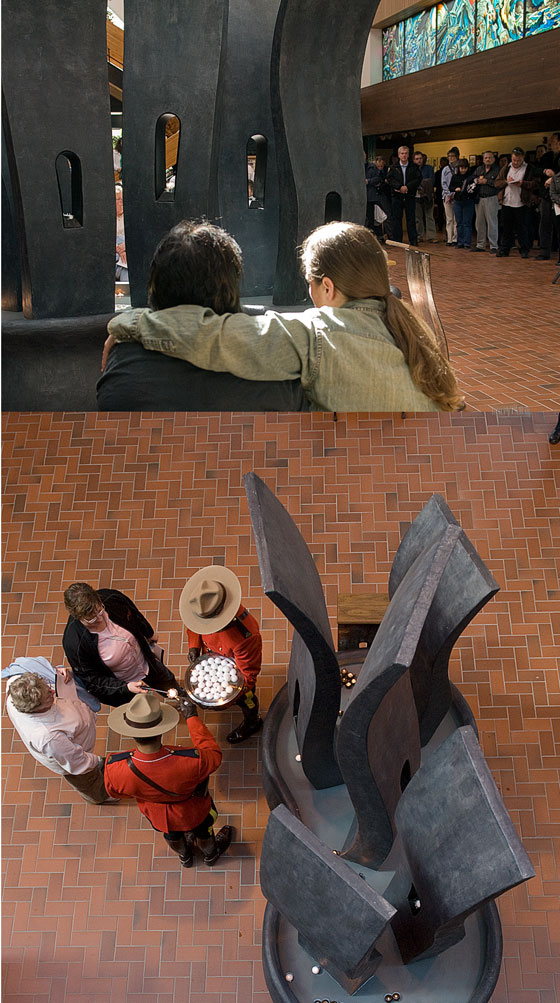
Gracing the main foyer of the Yukon government administration building is a memorial for the countless workers injured or killed on the job.
By Will Johnson on April 29, 2008
Gracing the main foyer of the Yukon government administration building is a memorial for the countless workers injured or killed on the job.
Participants in the National Day of Mourning, held Monday, were invited to contribute a floating candle to the memorial's base.
At last year's ceremony, there were 47 black candles. Each one signified a Yukon worker who had died on the job since 1991.
"Tragically, we have a new black candle to add this year," said Alex Furlong, the president of the Yukon Federation of Labour.
Richard Roger died last year in an aviation accident.
According to Furlong, Roger was a gifted athlete and alpine skier. He was a "friend to many, with a bright smile. He was never too busy for friends. He was a brother, a son, a favourite uncle."
Furlong invited the audience to participate in a minute of silence.
The National Day of Mourning, like Remembrance Day, is meant to be a time of reflection and awareness.
Furlong emphasized that all workplace accidents are preventable, and that education is the key to avoiding the mistakes of the past.
"This is an event that should not have to exist, but it does," said Furlong. "We must learn from the lessons of the past. Not the distant past, either, but last year, and the year before that."
Last year, 2,002 Yukoners reported being injured at work. That is more than 12 per cent of the territory's workforce.
Already this year, there have been more than 300 reported injuries, shaping out 2008 to be another record year for injuries. The most vulnerable group is young workers, particularly those aged 15-24.
"I worry for the lives of young workers," said Furlong, drawing attention to the many young people in attendance at the early afternoon ceremony.
"We are losing the future of our society, our children."
One of the initiatives the federation is sponsoring is a three-day workshop that ends today in Whitehorse.
Youth from all over the territory will be educated on different strategies to keep youth safe at work. Mostly teenage students, the participants were in attendance at the Day of Mourning, wearing matching "We Can Make It Work!" T-shirts.
The ceremony was a somber event, and brought out a large crowd. Family members of injured and deceased workers were there, as well as representatives from the RCMP and the Whitehorse Fire Department.
The vigil's centrepiece was the sculpture, with the crowd circled around its granite-coloured columns.
Each of the columns in the sculpture represents a different group: employers, governance, community, health care providers and, of course, the employees themselves. Representatives from each category lit a candle, a symbolic gesture of commitment to workplace safety.
Based on a concept by Dan Lebrun, the temporary Yukon Worker's Memorial was created by Bela Simo, who has many art pieces around downtown Whitehorse.
"As a machinist, I have known workers who have been injured or involved in fatal accidents while on the job," Simo said in an e-mail.
"It was meaningful to play a part in a memorial that honours these workers and draw attention to the need for safer work environments."
Currently, the Yukon is one of the few Canadian jurisdictions without a permanent memorial.
The Persephone Singers opened and closed the proceedings, wearing black and choosing appropriately sad songs.
The National Day of Mourning began in Sudbury, Ont. Over the years, it has spread across the nation.
The Canadian Labour Congress declared April 28 to be the day in 1984. The date was picked to parallel the day in 1914 when the Ontario legislature passed the first comprehensive Workers' Compensation Act in Canada.
In the Yukon, the Day of Mourning has been observed for several years.
The first public ceremony was held in 2006 and commemorated the 42 Yukon workers who had been killed in the preceding 15 years.
During that same time, thousands of workers were injured on the job. Because of the small population of the Yukon, many residents have been directly impacted by the devastating effects of these tragedies, the ceremony heard.
Be the first to comment