‘We have come a long way since 1961'
A lot can change in 50 years.
By Stephanie Waddell on May 17, 2010
A lot can change in 50 years.
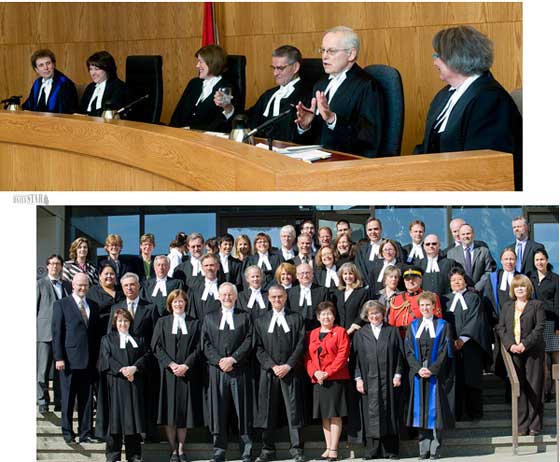
And the Yukon Court of Appeal is evidence of that, a crowded courtroom heard this morning from a number of speakers representing the many facets of the legal system.
About 40 people were gathered in a courtroom to celebrate the 50th anniversary of the appeal court along with the 25th anniversary of the Law Society of the Yukon.
Judges and lawyers acknowledged the two dates and their importance on the Yukon.
"This is an important milestone (for) the Yukon,” Yukon Supreme Court Justice Ron Veale said from the judges' bench.
He sat alongside appeal court justices Elizabeth Bennett, Mary Saunders, Chief Justice Lance Finch, Nicole Garson and territorial court judge Karen Ruddy.
Many speakers looked back on the past 50 years – especially June 9, 1960, marking the creation of the appeal court.
Veale took listeners back to a Yukon where first nations throughout were living traditionally until the Gold Rush when 30,000 people descended on Dawson.
A border dispute with Alaska and a need for order saw the first judge in the territory dispatched from Regina to oversee the Superior Court of the Northwest Territories during the Gold Rush.
In June 1898, the Yukon Act carved the territory out of the N.W.T.
The Yukon in those days had no appeal court, Veale said.
"(It was) sort of a trial judge's heaven,” he said to laughter from the crowd.
It didn't last long though, and by 1899, the Supreme Court of B.C. was hearing appeals from the Yukon.
By 1910, B.C. had its own appeal court and it then took over hearing the Yukon cases.
As the years passed, major events in the territory saw the construction of the Alaska Highway, land claims settlements and self-government agreements for many first nations, and the relocation of the capital city from Dawson to Whitehorse.
"And they're still holding it against us,” Veale commented, once again to laughter.
Pointing to a photo of that first appeal court case in the territory in 1961, Veale pointed out just how much things had changed.
He said someone else had commented on the three "grumpy” old men who oversaw the case. This week, the entire panel of Yukon Court of Appeal judges hearing the appeals will be women.
"This is a history-making event,” Veale said. "We have come a long way since 1961.”
It was a view shared by many in the room, including Justice Minister Marian Horne. She expressed hope that the demographic of judges would continue evolving to reflect the demographics of society.
Among other changes to the court, as Crown prosecutor John Phelps pointed out, while the Yukon may not be unique in the problems it faces such as substance abuse, it is unique in how it addresses those problems.
The first circle sentencing in the country was held in the territory, he said. He also pointed to restorative justice, domestic violence court and community wellness court as examples of the lead the justice system has taken.
"We are trail-blazers,” Commissioner Geraldine Van Bibber said as she wished the court of appeal well in the deliberations of the coming week.
A half century ago, the court took a much more colonial approach to justice, Rod Snow of the Canadian Bar Association told the court.
And Veale was still in public school, Snow said on a less serious note.
"Anniversaries are a time to reflect” on where you're from and where you're going, he said.
As officials commented on the changes that have come in the 50 years since the Yukon Court of Appeal was born, they pointed out the need for the independent judiciary in a free and democratic society.
"(It's) a concept we take for granted in this country,” said Susan Dennehy, president of the Law Society of the Yukon.
While much of the focus was on the 50th anniversary of the court of appeal, also acknowledged throughout the legal officials' speeches was the 25th anniversary of the law society.
As Veale pointed out, just as it is important for judges to rule independently, it is also important to have a strong and independent law society, as it is the lawyers who bring forward the cases judges hear.
"They have to be courageous and independent to do that,” he said.
Be the first to comment