Photo by Vince Fedoroff
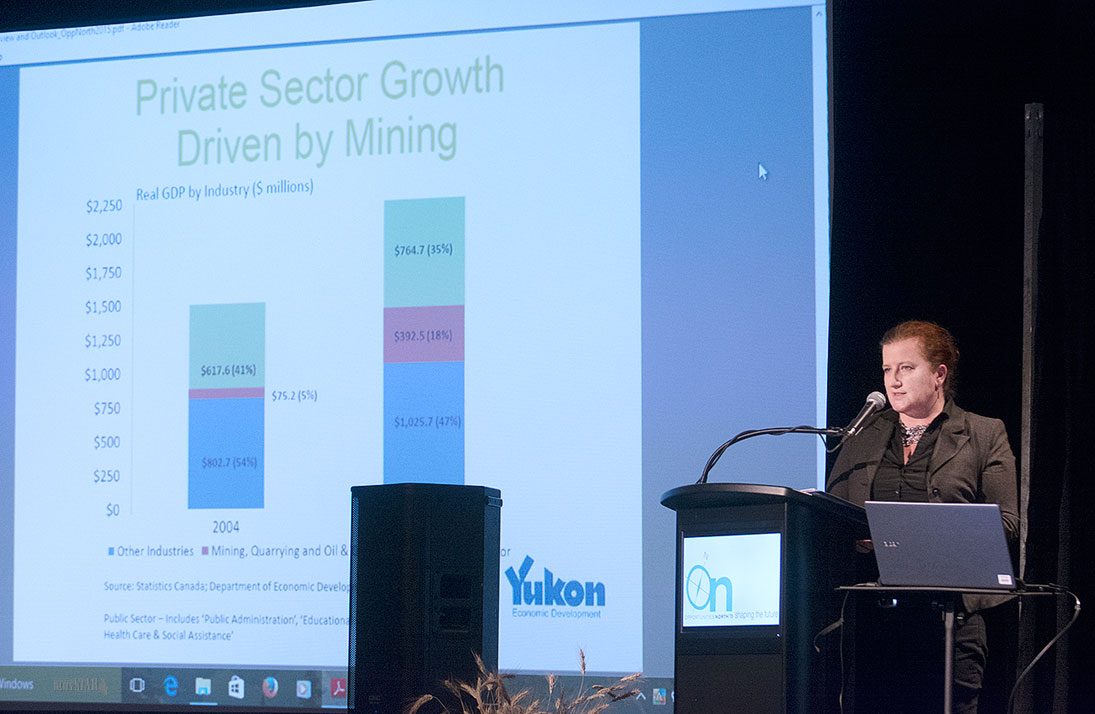
FORECASTING THE FUTURE – Carol MacLellan, the territory’s director of business and economic research, discusses the territory’s economic outlook Wednesday at the Opportunities North business conference.
Photo by Vince Fedoroff
FORECASTING THE FUTURE – Carol MacLellan, the territory’s director of business and economic research, discusses the territory’s economic outlook Wednesday at the Opportunities North business conference.
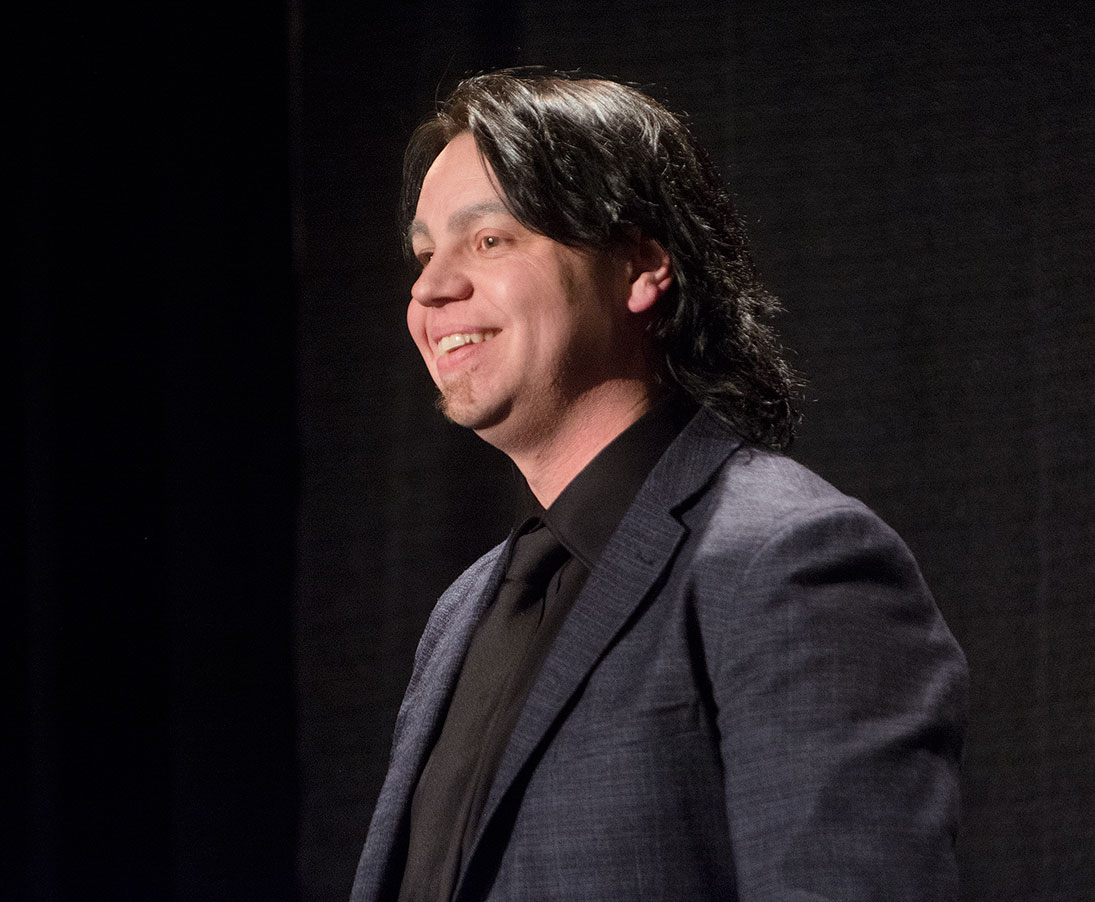
Photo by Whitehorse Star
Jamie Coles
An anticipated increase in the territory’s gross domestic product (GDP) in 2016 is not expected to translate into a higher employment rate for Yukoners.
An anticipated increase in the territory’s gross domestic product (GDP) in 2016 is not expected to translate into a higher employment rate for Yukoners.
Carol MacLellan, the territory’s director of business and economic research, outlined the territory’s economic outlook Wednesday at the Opportunities North business conference in Whitehorse.
While the GDP is anticipated to grow by 3.5 per cent, MacLellan said, the unemployment rate is expected to also rise to 7.5 per cent.
“We should return to positive economic growth,” she said of 2016.
The numbers take into account a number of factors, including having the Minto mine going back to full production this year.
That means, if things continue as anticipated, 2016 woud see an entire year of full production at the mine, thus the anticipated GDP increase.
In an interview following the presentation, Jamie Coles, senior economist for the territory, explained that though the GDP is expected to rise with the mine now at full production again, it’s not likely to have a major impact on the employment rate. Many of those who were laid off earlier will likely go back to work, Coles said, thereby not representing any new jobs.
In outlining the economic outlook into next year, MacLellan made it clear that she and others who work in economics cannot see into the future, but rather look at a number of factors in trying to get an idea of what to expect.
“We do not have crystal balls,” she said.
If that were the case, she said, she would have taken out stocks in Apple years ago and would be sitting on a private island by now.
MacLellan then noted the projections come from “rigorous math” and are based on certain assumptions like the continuation of the Minto mine.
The equation also included the assumption that the other mine sites which have closed over the past year or so will remain closed.
Also factored in are the state of the global economy, exchange rates, energy prices and so on.
“As mining goes down, so do our economic prospects,” she said.
Displaying a number of charts and graphs throughout her presentation, MacLellan pointed out 2015 marks the third consecutive year that the territory’s economy shrunk.
“We had a really good run for about 10 years,” she said, citing 2013 as the first year the Yukon saw an economic contraction.
It’s anticipated 2015 will finish up having seen a six per cent decline in GDP, she noted, though she added the territory is still ahead of where it was a decade ago.
A decrease in retail sales this year is also anticipated as a ripple effect from the mining closures in the territory, though it’s expected to rise in 2016 thanks partly to an increase in population.
MacLellan also pointed out the boost in the territory’s population in recent years – projected to be up to 38,000, mainly in Whitehorse, by the end of 2016 – is having an impact.
“We have seen growth in the labour market,” she said, pointing to the challenge presented by a higher population on employment rates.
Despite the projected rising unemployment rates and so on, MacLellan noted, “There are some bright spots.”
Those include a potential for oil and gas development and major construction projects that are already or slated to get underway, such as the building of the new F.H. Collins Secondary School and the new Sarah Steele Building downtown.
After outlining what may be in store for the territory over the next year and a bit, MacLellan said that looking beyond 2016 becomes more of a challenge.
Many unknown factors could affect the territory’s economy greatly, she said. Those same issues played roles in the 2015 and 2016 forecast like exchange rates, commodity prices and global economic issues.
The Opportunities North conference wrapped up this morning at the Yukon Convention Centre.
See more conference coverage on p. 4 and in Friday’s edition.
In order to encourage thoughtful and responsible discussion, website comments will not be visible until a moderator approves them. Please add comments judiciously and refrain from maligning any individual or institution. Read about our user comment and privacy policies.
Your name and email address are required before your comment is posted. Otherwise, your comment will not be posted.
Comments (12)
Up 5 Down 1
Lost in the Yukon on Nov 4, 2015 at 2:36 pm
I suspect Ms. M as a Director makes in excess of $150,000 (including benefits) ... and if her best line is essentially "we guess" then maybe eliminate her position and give the money to the foodbank
Up 7 Down 0
BnR, JC for Yukon economist of the year on Nov 3, 2015 at 12:47 pm
What meaningless nothing.
Up 6 Down 2
Any at all? on Nov 2, 2015 at 5:56 pm
Have they ever shown any? Not just Crystal.
Up 4 Down 2
BnR the great brain drain on Nov 1, 2015 at 1:25 pm
To bad there is not wisdom of common sense.
The group for common sense in the Yukon
Up 6 Down 13
BnR on Oct 31, 2015 at 12:22 pm
Few things missed...
"Once the world starts to stabilize, the economies will be more predictable"
Well, we all know who is posting this comment, so it's no surprise to read a statement like this. "Once the world starts to stabilize....." That's priceless. More of his economic expertise I guess.
Up 14 Down 2
Werner Rhein on Oct 31, 2015 at 10:30 am
What is this person talking about? "Smoke and Mirrors".
Yes no one has a crystal ball, but they, the Money Industry and Government totally falsify the meaning of Economy.
Money is not the economy, and increases in money do not necessarily mean the economy is getting better or even bigger, let alone actually increasing the welfare of the population.
By Ian Welsh; http://www.ianwelsh.net/what-is-an-economy/
This is the best explanation of "What Economy is"
If only money circulation is increasing but unemployment and average salaries are going down; "Than the economy is going down" because the word economy includes the wellbeing of all people living in the area the economy is compared to.
How much more can we stand of being lied to.
Up 15 Down 3
Bewildered arm chair economist. (Just like you) on Oct 31, 2015 at 10:02 am
I don't know how YTG's master economists make things add up but here's the way I see it. If Minto lays off all the workers the unemployment rate goes up. If the workers go back to work the unemployment rate goes down. It does not remain unaffected because some workers are going back to their old jobs which is not creating new jobs as alluded to by the previously mentioned wizards. Sheesh what do they expect us to believe.
Up 9 Down 2
Few things missed on Oct 30, 2015 at 2:52 pm
Senior care facility.
Federal infrastructure, build Canada and new housing money.
$200 million over 5 years
The Whitehorse Palace Grand building for $55 plus plus plus millions.
Once the world starts to stabilize the economies will be more predictable.
No government can fix the economy.
Only investment into opportunities can!
If any politician comes out and talks about the economy it's full of puuu
The group for better government
Up 20 Down 2
BnR on Oct 30, 2015 at 2:24 pm
It doesn't take a crystal ball to know that an economy based on resource extraction, mining in particular, will be a boom and bust economy, subject to the fickle winds of the markets.
Up 10 Down 10
Salar on Oct 30, 2015 at 7:17 am
Ya we knew you didn't have crystal balls but the balls represented over the past decade did us a lot of good didn't they....take up meteorology at least that won't inflate housing and every other %€#{¥~\|>~~! thing in tiny Yukon....
Up 17 Down 4
June Jackson on Oct 29, 2015 at 10:33 pm
I am writing to add support to B. Foster. Well said Mr. Foster. When is enough enough?
But, it begs the question, enough for who? Is what they have now enough for the career welfare folks? We always hear, seniors programs, pensions are out of money, with a limited fixed income is what seniors have now enough? Canada already has 600K living in poverty. You don't see seniors fighting for more, just fighting to keep what they have. On the other hand, you NEVER hear, "Welfare is out of money". And welfare recipients are constantly asking for and getting more. If we keep increasing the handouts, we can't get by on what we've got..we have to make more money. For every person working, they are paying so 2 people don't have to work. We can only manage our income if everyone pulls their weight. The bigger the drain on existing funds the less we will be able to sustain the status quo. We pay for it when our governments make bad financial decisions.
Nationally, the Harper government, and now Trudeau, has 1 million Canadians a month at food banks, but chose to send 7 billion dollars to Africa. To me, that was a bad decision. Who feeds someone elses family before their own? We need more money.
How good is a trade agreement that we have to pay 11 billion dollars to the auto and dairy industries and we aren't even the first or second, or third or 4th preferential trade partner. Who's paying for that? Yup..we need more money. In theory, I absolutely support you. In practice, do you have, or anyone? Have a plan on how that might work?
Up 38 Down 8
B. Foster on Oct 29, 2015 at 4:07 pm
Growth for the sake of growth, the ideology of the cancer cell. I'll never get the expectation of infinite growth via finite means. Would a steady state economy be so bad at times? Must we always strive to chronically advance the GDP (our capacity to purchase / consume)?