Photo by Whitehorse Star
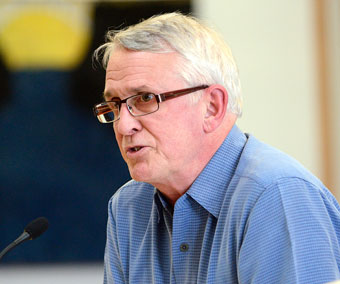
Yukon Energy president David Morrison
Photo by Whitehorse Star
Yukon Energy president David Morrison
The energy crunch is coming, one way or the other, acknowledges Yukon Energy president David Morrison.
The energy crunch is coming, one way or the other, acknowledges Yukon Energy president David Morrison.
He said Tuesday evening the publicly owned utility will need to increase its generating capacity in three or four years based on domestic growth alone.
If a greater industrial load materializes in the form of two or more new mines, as many expect, the crunch would be that much greater, and possibly much, more quickly, Yukon Energy anticipates.
Morrison and several other staff members from the corporation hosted another public meeting last night to talk about Yukon Energy's outline for a 20-year resource plan to meet growing demand for electricity.
Figuring out how to go about providing for the territory's short- and long-term future is something of a juggling act, the president told 25 or 30 people in the audience.
He said the Yukon is in a special category, with its relatively small population and its isolation, with no ability to sell surplus power to neighbours.
Making a mistake in choosing how to grow the territory's energy capacity could turn into an expensive bite for Yukoners, Morrison said.
"It's really important we get the right size, the right environmental alternative at the right cost, and at the right time,” he said.
The 20-year plan lays out the number of different options, costs, benefits and risks, and will serve as a guideline for the corporation to follow.
It's expected the resource plan will be ready this fall for review by the Yukon Utilities Board.
Besides Tuesday evening's meeting here, the corporation hosted a public meeting in Haines Junction Monday night. Upcoming meetings are scheduled for Carmacks, Dawson City, Mayo, Watson Lake and Faro.
Yukon Energy is seeking input into its guideline for the future which speaks about offsetting diesel fuel with liquified natural gas, installing large wind generating capacity, and building a biomass – wood burning – generator in Haines Junction.
There are three initiatives to raise lake levels and storage capacity in Marsh Lake, Mayo Lake and Aishishik Lake to boost the amount of water available for hydro-generation in the winter months.
Conservation, turning off the lights, is key, as well as the easiest, cheapest and quickest way to tackle growing demand, says the resource plan.
Yukon Energy is currently looking at one large hydro project on the Pelly River, but that is many, many years away, said the corporation's president.
Renewable solar power, Morrison suggested, is something of a long-shot because it's still quite expensive.
Drawing geothermal heat from underground hot water sources to create steam for driving generators is still in its infancy in Canada because of its scarcity, he added.
Drilling a single hole to shoot for a source of hot water can cost $6 million or $7 million, so one had better be sure what he or she is shooting for, he said.
Morrison said they've been chasing a hot water source in Whistler, B.C. for 25 years.
Some in the audience challenged the ethics of using imported natural gas to power generators instead of diesel, arguing the extraction of gas is not without its environmental sins.
Trucking in liquified natural gas from the south, it was said, would be the ultimate NIMBY: don't want to drill in our back yard, so we'll let Alberta do the drilling and deal with the fallout and Yukoners can live off the gravy.
Others told Morrison if Yukon Energy is courting the idea of replacing diesel with natural gas, it should be prepared to invest in baseline research in the Yukon's North.
If the publicly owned utility might buy natural gas from northern Yukon some day, as has been suggested, it should be prepared to demonstrate the production of gas in the North – which may involve fracking – can be done safely, and cleanly, it was said.
Morrison explained in an interview following the two hours of presentations and questions that the resource plan is very much a list of options – one which comes with uncertainties.
Whether the public or the utilities board and Yukon Water Board would approve another metre of storage in Mayo Lake is uncertain, he said, adding it's the same with the proposal to raise the storage in Marsh Lake by a foot.
Morrison said there are serious questions when it comes to wind generation, and whether there's a place for it and its cost on a relatively small grid.
The 20-year plan, he explained, sets out the options, though much needs to be done before Yukon Energy chooses what path to go down.
"We do not want to be left with a Faro hangover,” Morrison said.
When the Faro mine closed in 1998, it was by far the largest paying customer on the electrical grid.
Its loss left a large hole in revenue to pay for operating the system – a hole that was quickly filled in with a subsidy program from the Yukon government to prevent a spike in electrical rates. The subsidy remains in effect.
Morrison told the audience there are a number of moving variables the corporation is still trying to wrap its head around.
Victoria Gold is planning to tie its Dublin Gulch gold mine into the grid, as is the revived Brewery Creek operation, he pointed out while noting the uncertainty with the global economic climate.
The new Whistle Bend subdivision in Whitehorse will require as much power as both mines when it's fully built out, though just how quickly the subdivision will fill up is still a question, he said.
Morrison explained Yukon Energy always has diesel generation to rely on as it searches for the alternatives, so it's not as though the grid is going to run out of electricity.
The trick, he said, is finding an alternative to diesel that is economical in the summer and winter.
Building a huge wind farm would likely pay for itself in the winter when demand is highest, but maybe not in the summer, when demand is lowest and there's lots of water for hydro-generation, Morrison explained.
"If you are displacing hydro in the summer, it's not economical,” he told the audience. "Alternatives must be economic, and not just in the winter.”
Figuring out what demand will be and finding the right fit with new alternatives to diesel is the challenge, he said.
"Quite frankly, it (demand forecasts) change every month,” he said. "We can't afford to make big mistakes.”
In order to encourage thoughtful and responsible discussion, website comments will not be visible until a moderator approves them. Please add comments judiciously and refrain from maligning any individual or institution. Read about our user comment and privacy policies.
Your name and email address are required before your comment is posted. Otherwise, your comment will not be posted.
Comments (9)
Up 0 Down 0
Anonymous on Aug 21, 2012 at 8:50 am
@ Hold on there Partner,
Good call! I can't believe YEC neglected to even think of the Kokanteneelee.
Up 0 Down 0
Patrick on Aug 20, 2012 at 9:22 am
‘We can't afford to make big mistakes'
How many years can a corporation keep saying an energy crunch is coming without effectively moving forward on new energy resources.
Its pathetic. We have a problem because they did not move forward about 15 years ago.
Up 0 Down 0
Hold on there Partner on Aug 20, 2012 at 12:15 am
Why is there no mention of one of the biggest energy sources in the Yukon?
I speak of the Kokanteneelee gas field in the SE Yukon.(liquifey there and truck)
Up 0 Down 0
The artist formally known as Gimp on Aug 16, 2012 at 11:20 am
News flash!
Using diesel to move truckloads of diesel so YEC could burn diesel was the biggest mistake.
Cow toeing to the mines, the second biggest mistake. Residential users are your meat and potatoes, we are here every day regardless of the global economy, local economy or metal prices. We are the ones who deserve the breaks not the 'industry of the day'.
YEC is decades behind in providing energy requirements and asking for residential users to 'conserve' to enable their incompetence and lack of planning would be laughable if it weren't so sad. We already conserve, especially given your bloated rates.
Up 0 Down 0
bobby bitman on Aug 16, 2012 at 8:41 am
How much of our electrical demand problem is due to forecasts to supply electrical energy to enormous mining operations who should be required to build their own power sources?
Up 0 Down 0
bobby bitman on Aug 16, 2012 at 8:40 am
How many people are heating with electric baseboard due to the ever changing insurance and city requirements for oil tanks? (tank must be inside, tank must be outside, tank must be double walled, required base design for tank changing wildly on a regular basis, etc etc)
Up 0 Down 0
Josey Wales on Aug 15, 2012 at 10:49 am
Dude even the small wee "mistakes" made by your crew create a huge cost to loss of production, business, damage to machinery, food wasted as it is half cooked blah blah blah re :electron flow!
Speaking of which I wonder what the latest lame excuse we will be given for yet another loss of power in Porter Creek...maybe yet another complete blackout territorial wide?
If only we could synchronize these shut downs between this crew and Northwestel?
At least it would reduce our disappointment time by 50% if we could?
Up 0 Down 0
Already pinching KWHs on Aug 15, 2012 at 9:41 am
Turn the lights out he says...My home and the homes of all our neighbors already have low wattage bulbs,energy efficient appliances, and timers on everything else possible. what else is there to do?
What I do observe is all these new condo buildings going up relying on electric heat because it is the cheapest,easiest, most profitable heating system to install. Unfortunately it doesn't do anything but add to the coming power crunch.
Up 0 Down 0
Jackie Ward on Aug 15, 2012 at 9:40 am
100% propaganda. Just conditioning the public for higher bills. It's not our problem there is more demand. We each pay our share and just like everything else in this world it's never enough for these CEO's.