‘We are trying to roll over the elephant'
They're calling it the beginning of a new era in the management of the Yukon's fish and wildlife.
By Chuck Tobin on December 10, 2009
They're calling it the beginning of a new era in the management of the Yukon's fish and wildlife.
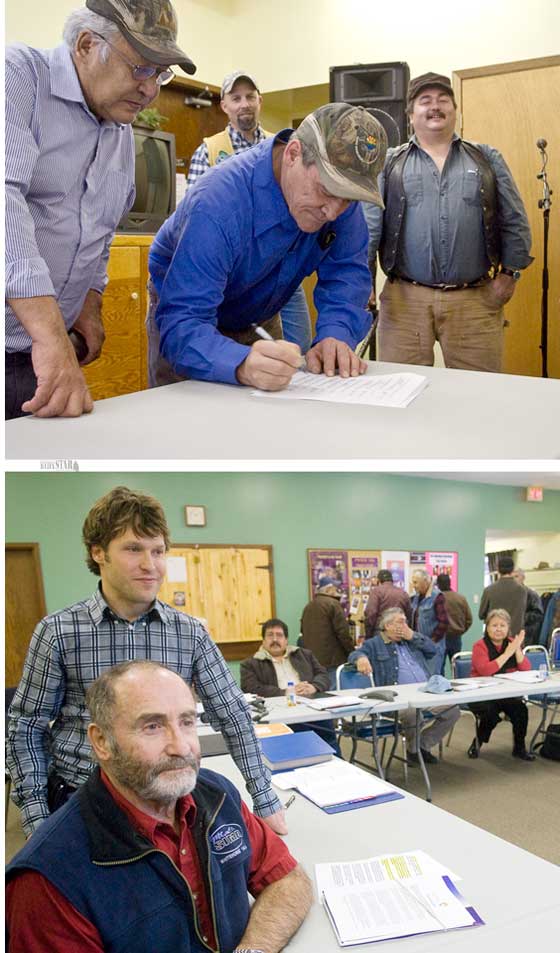
Representatives of renewable resource councils from across the territory gathered in Whitehorse on Wednesday afternoon.
They were in the capital to sign a memorandum of understanding with the Yukon Fish and Wildlife Management Board and the Salmon Subcommittee.
The stated intent is to build a stronger line of communication between the central management board, subcommittee and the local councils, to create a stronger and more representative approach to managing wildlife.
While it carries no legally binding obligations, and will have no impact on the individual authority given to each party under the Umbrella Final Agreement, the agreement clearly states a commitment to work closely together.
"I think we are doing this for our future generations, and I am glad to be a part of it,” Robert Bruce, chair of the North Yukon Renewable Resource Council, said in a brief statement following the memorandum signing.
The agreement, said Bruce, embodies the spirit of the document that is the foundation of aboriginal land claims in the Yukon: Together Today for Our Children Tomorrow.
With an influx in hunting pressure throughout the Yukon, and the with issues arising out of climate change, it is important to tackle the future together, said Frank Patterson of the Mayo District Renewable Resource Council shortly after signing the memorandum.
Don Hutton, the co-chair of the management board, told the community representatives the memorandum marks the beginning of a new era of wildlife management in the Yukon.
With the completion of the board's year-long 2020 exercise to identify priorities for the next decade, members decided it wasn't enough just to produce a document and hand it over to the government, Hutton said.
". . . To tell someone that this is how we think you should act carries little weight ... far better to show them how, to lead the way,” Hutton said.
"So this is what we are starting today by signing a protocol with our partners, the RRCs and the Salmon Subcommittee to work together for our common cause.”
He said management of the territory's fish and wildlife is lacking leadership.
Already, Hutton pointed out, the board has forwarded recommendations to Environment Minister Elaine Taylor to "begin preparing a Yukon fish and wildlife strategy to establish a framework of guidelines, policies, programs and, most importantly, priorities for the management of Yukon's fish and wildlife.”
Under the Umbrella Final Agreement, the template for individual land claim settlements in the Yukon, the board and subcommittee were established as independent bodies to make recommendations to the Yukon and federal governments on territory-wide management issues, half of the 12 members appointed by the first nations and half by the governments.
Renewable resource councils were established as independent bodies to make management recommendations at a local level. In the case of recommendations regarding fresh water fish and wildlife,
the minister of Environment has the final say, and the federal minister of Fisheries and Oceans has the final say when it comes to salmon.
In an interview after the signing ceremony, Hutton explained while the board, the resource councils and the subcommittee have been fulfilling their individual responsibilities over the years, it's been pretty much in isolation of each other.
All of the parties, the board included, were operating in an adhoc, knee-jerk fashion, reacting to issues as they arose, rather than planning into the future to avoid those very issues, he explained.
The co-chair and a veteran of five years on the management board said in his first three years, he never once met with a local renewable resource council.
The board, he noted, began its 2020 visioning project a year ago because it wanted to change the approach to management; it was searching for more public input and a more inclusive relationship with Yukoners.
The spirit and intent of the Umbrella Final Agreement, he suggested, was an open and all-inclusive community approach to management, for the benefit of all Yukoners.
He said it wasn't looking like that spirit and intent was being fulfilled the way it was going.
Many saw the management board as an elitist entity, and the board's been told that, he said.
Some, he added, thought it was a board working for the government.
The co-chair said he hasn't seen a member of the public at a management board meeting in three years.
Nothing is going to change overnight, but change is what is envisioned by the memorandum, Hutton emphasized.
"We hope this is a pivotal point, and we'll be moving into a new era,” he said. "It may be messy for a while; change does not come easy, particularly when you are talking about changing government.”
For instance, he said, hopefully there will come a day when the board and resource councils are at the table with a voice when the Yukon government plans its budget priorities for fish and wildlife management in the upcoming year.
Rather than the debate between Environment Yukon and the Lake Laberge Renewable Resource Council on the approach to managing Dall sheep on Pilot Mountain amid rising hunting pressure, he said, why not have a joint-management plan?
"Let's get the department and renewable resource councils together; let's talk,” Hutton told reporters. "It's not about who has the better data, it's about the sheep.”
The co-chair said members of the board have met a couple of times in the last two weeks to discuss the new approach with the Environment minister, and Taylor has put forward a couple of ideas of her own.
In time, he added, it would be ideal to see the relationship grow to include the individual first nations as they prepare their wildlife management strategies.
"We know it will take a lot of time, and we will have a lot of ups and downs,” Hutton said. "We are trying to roll over the elephant, if you will.”
The Umbrella Final Agreement states: "In each Yukon First Nation's Traditional Territory, a Renewable Resource Council shall be established as a primary instrument for local renewable resources management in the Traditional Territory as set out in the Settlement Agreement.”
"Primary instrument management is community-based management,” Wade Istchenko, co-chair of the Alsek Renewable Resource Council, told the audience after signing the memorandum.
Comments (1)
Up 0 Down 1
francias pillman on Dec 10, 2009 at 11:13 am
I'm glad you follow what elaine taylor say. She has no education on any of the portfolios she posses. What a joke. Do what your master says eh? Critical thinking is frowned upon.