Photo by Pierre Chauvin
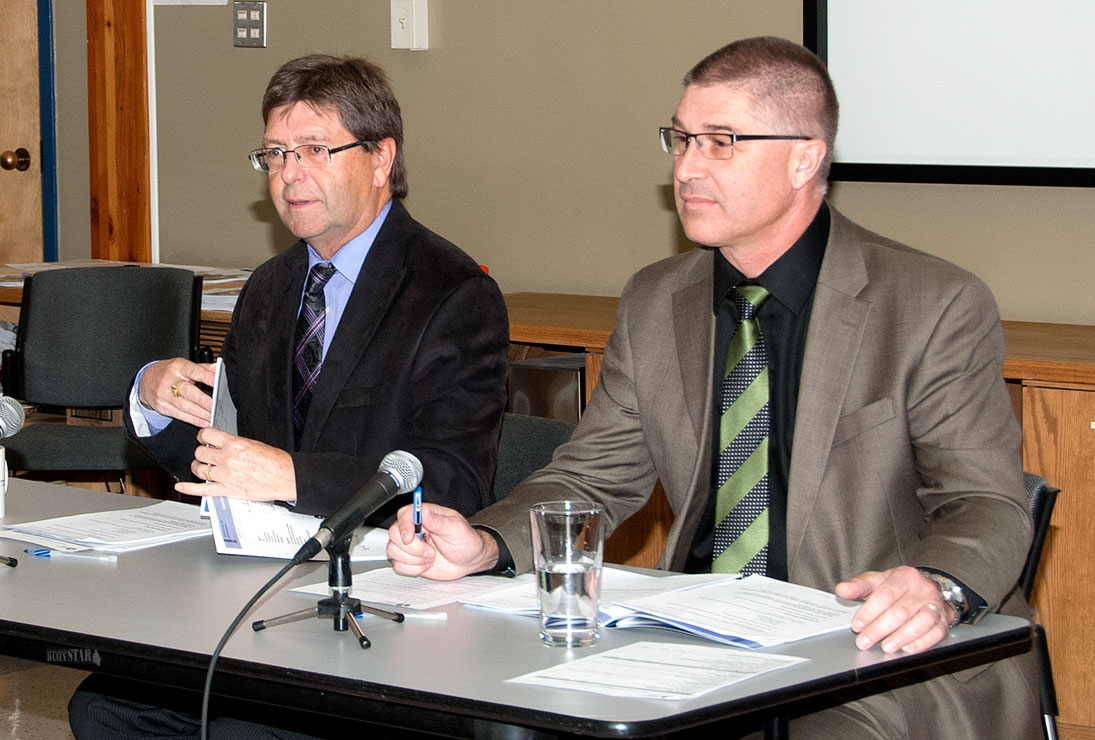
MONEY BACK –Mark Pike, left, and Kurt Dieckmann announce on Thursday the territorial workers’ compensation board will return $10 million to Yukon businesses.
Photo by Pierre Chauvin
MONEY BACK –Mark Pike, left, and Kurt Dieckmann announce on Thursday the territorial workers’ compensation board will return $10 million to Yukon businesses.
The Yukon Workers’ Compensation Health and Safety Board is dealing with an unusual problem: it has too much money.
The Yukon Workers’ Compensation Health and Safety Board is dealing with an unusual problem: it has too much money.
Its funding policy requires the board to increase payments when the compensation fund is below its target, and to return money to employers when above its target.
This year, on top of $3.9 million given back through reduced rates, the board decided to return an extra $10 million, and to further reduce rates for 2016, at a cost of $5.2 million.
The announcement was made at a press conference on Thursday.
Every employer in the territory pays into the fund designed to compensate injured workers.
Currently, it covers 21,500 employees.
But in the past years, the fund has grown way beyond what’s needed, chair Mark Pike said.
Employers pay annual rates calculated based on the industries they’re in and the history of injuries in that industry.
The rates cover the cost of compensating injured workers for that year, and the future costs of those injuries.
Money set aside for future cost is invested, and a return on investment of six per cent is needed for the fund to stay afloat.
But the board investments performed so well – nine per cent over the past five years – that it had a $52 million surplus in the fund as of last December.
Since 2009, the board has returned $5.5 million through lower assessment rates, but that still wasn’t enough to keep the surplus down.
Reduction in claim costs also increased the surplus.
The fund target is between 121 and 129 per cent of the money needed to compensate injured workers. The buffer is there to protect against market fluctuations and “extraordinaries market calamities,” the board said.
“Our funding policy has a buffer built into it, (and) we've gone far above that buffer,” said Pike.
The decision to give back $10 million wasn’t easy for the board, said Pike, especially in light of the five workers who died last year.
“Reducing the rates in the shadows of these deaths and injuries runs counter to the spirit of the compensation system,” he said.
“However even with that, we have to respect that funding policy.”
Ultimately, the board wants to eliminate the surplus completely, which in turn will force the rates to increase.
“If we lower the rates too much, people don’t know what the true cost of caring for injured workers is,” explained Kurt Dieckmann, president of the board.
“And employers stop paying attention.”
The reduced rates for next year are about seven per cent on average, the highest decrease being in construction, repair and demolition, benefiting from a 15.7 per cent decrease in their rates, and the lowest is in the service industry category “high”, with a two per cent decrease.
The decreases come after a tragic year, Pike said during the press conference, asking for a moment of silence in memory of the five workers who died last year.
“This is the worst year in recent history and it demands we do better,” said Dieckmann.
“The impact of those five deaths will reverberate in our communities for years.”
Last year almost 1,000 Yukoners were injured badly enough to see a doctor, and 435 required time off.
This year numbers are already higher, as the sign outside the board office showed 1,105 workers have been injured since Jan. 1.
While the Whitehorse Chamber of Commerce is glad the board decided to give back the surpluses to businesses, it disputes the fact those were mostly caused by over-performing investments.
“The surplus wasn’t just because of their investment income,” said Rick Karp, the chamber’s president.
“The surplus came from the business community.”
The surplus also came from lower compensation costs, said Karp.
“Both workers and employers have been doing much better jobs at reducing workplace injuries,” he said.
The chamber is also requesting that the share of the $10 million the Yukon government will get back – which should be quite significant as it is the biggest employer in the territory – should be reinvested in workplace safety programs.
As the board hasn’t decided yet how much each employer will get back from the $10 million, the Yukon government told the Star it couldn’t comment yet on the chamber’s suggestion.
In order to encourage thoughtful and responsible discussion, website comments will not be visible until a moderator approves them. Please add comments judiciously and refrain from maligning any individual or institution. Read about our user comment and privacy policies.
Your name and email address are required before your comment is posted. Otherwise, your comment will not be posted.
Comments (4)
Up 24 Down 3
Joe on Sep 26, 2015 at 5:49 pm
I certainly hope this doesn't result in bonuses for management. It would be criminal for them to have charged too much to employers then claim a surplus and earn bonuses. In reality there should be punitive measures taken on management due to over assessments.
Up 19 Down 15
Hmmmm on Sep 26, 2015 at 8:05 am
It's too bad employers are getting the money back instead of poor workers that have been hurt. As an employee, speaking from experience, it is like pulling teeth trying to get your fair share as an injured worker. It's no different than any other insurance company where they try their damndest not to pay out. Unfortunately, I have been unsuccessful in my attempts and I have now given up because of the frustration of dealing with WCB. I wonder how many other injured workers like me that are out there.
Up 24 Down 1
Just Say'in on Sep 25, 2015 at 11:48 pm
I bet that they managed to pay for the huge building expansion and all the employees to fill it before noticing the excessive overcharging to the businesses.
Up 23 Down 3
Chris Klassen on Sep 25, 2015 at 5:48 pm
So returning the 10 million dollars to responsible employers that try daily to keep there employees safe runs counter to the principles of the program? So clearly this is not an insurance, nor a pool to draw on. It is a punitive measure developed by Suits to keep their thumb on those horrible employers. Really if we get right down to it, we should all have desk jobs for the government and bubble wrap ourselves when we step out of our seat.