Photo by Whitehorse Star
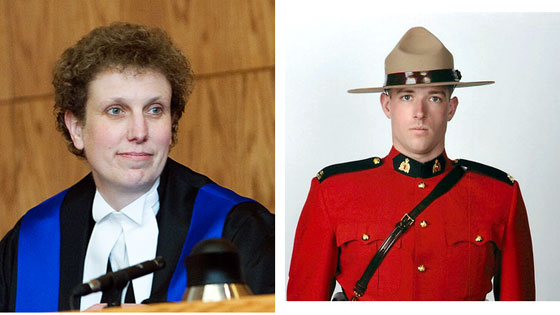
Karen Ruddy and Const. Michael Potvin
Photo by Whitehorse Star
Karen Ruddy and Const. Michael Potvin
The inquest into the 2010 death of a Mayo RCMP officer will go forward as planned after the federal government lost its bid to limit the territorial coroner's jurisdiction.
The inquest into the 2010 death of a Mayo RCMP officer will go forward as planned after the federal government lost its bid to limit the territorial coroner's jurisdiction.
In her decision released this morning, territorial court judge Karen Ruddy, who will be acting as the coroner in this case, ruled that the main purpose of an inquest is to address the public interest and prevent future deaths.
"Any inquiry into RCMP administration, operation and management would be not only incidental to this public purpose and therefore constitutionally permissible,” she said, "but also necessary to ensure a full and complete understanding of what led to the unfortunate death of this young officer and how similar deaths can be prevented.”
Const. Michael Potvin drowned in the Stewart River on July 13, 2010.
The 26-year-old Mountie was out performing maintenance on the boat with his supervisor, Cpl. Brent Chapman, when it capsized.
Neither officer was wearing his personal flotation devices at the time.
Chapman stayed with the boat and was later removed from the water by witnesses who paddled out to rescue him.
Potvin's body was recovered from the river 58 kilometres downstream from the capsizing site on July 30, 2010.
In January 2012, then-chief coroner Sharon Hanley announced she would be holding a public inquest into the death.
In May, weeks before it was scheduled to go forward, the inquest was put on hold while lawyers for the federal government argued over what would fall under the coroner's jurisdiction.
The federal government lawyers questioned whether a coroner's inquest held under territorial legislation can look into the administration, operations and management of a federal body like the RCMP.
They also claim a jury in a coroner's inquest has no authority to make recommendation regarding RCMP policy.
Lastly, an inquest would be redundant, they said, given the number of federal investigations and reviews which have already taken place.
Lawyers for the coroner opposed any limitations, arguing an inquest is still in the public interest no matter how many other investigations have taken place.
The hearing was held in front of Ruddy.
In her decision, she said she recognized this situation may be unique because Potvin was an RCMP member who was on duty but not involved in public policing duties at the time of his death.
"The Attorney General of Canada argues that this makes his death largely an internal matter. I disagree,” Ruddy said.
She points to two reasons for holding an inquest as a matter of public interest.
"Firstly, the community of Mayo is a small one, and RCMP members posted there quickly absorb into the social fabric of the town,” she said.
"That Const. Potvin was a member of the community as well as a member of the RCMP is evidenced by the number of community members that rushed to the river and attempted to rescue the two officers after their boat capsized.
"Secondly, the community has a clear interest in ensuring that boats and other equipment used by the RCMP are in good working order and that policing practices are safe and effective.
"Indeed, the boat being tested by the officers working the night of July 13, 2010, could have easily been required in a search and rescue operation that more directly affected the public.”
An inquest into Potvin's death cannot be meaningful if it's limited to the immediate and undisputed cause of death — drowning, Ruddy said.
"The RCMP's handling of the boat in question, including maintenance and modifications, must be addressed to give the public an accurate and complete picture of the circumstances leading to Const. Potvin's death.”
If the lawyers have concerns about specific pieces of evidence, those could be discussed individually, she said.
As for whether a coroner's jury has the right to make recommendations regarding the RCMP, Ruddy said recommendations are necessary and in the public interest.
"It must be remembered that the recommendations made by a coroner's jury are not binding; the RCMP cannot be forced to adopt them,” she said.
Ruddy suggested all public institutions would be interested in hearing recommendations from a coroner's jury and at least considering their feasibility.
The eight federal investigations completed after Potvin's death are not the same as an inquest, the judge said.
"While I appreciate that these investigations have covered some of the same ground that the inquest will likely cover, they were conducted for purposes distinct from the public purpose of the inquest.”
The RCMP have released some details from those reports.
Some of the finding include that the officers were not sufficiently familiar with the boat nor the specific waterway prior to putting it into service for the season.
Both RCMP members had been wearing their personal floatation devices earlier in the trip, but when the incident took place, neither had them on.
Testing of the boat also determined that over several years, modifications had been made to it.
Those modifications, combined with environmental and mechanical factors, resulted in water coming over the transom, which made the craft unstable in the water.
Investigations identified a blockage in the fuel system as the cause for the motor failure.
It was determined that it was unlikely that the blockage would have been diagnosed in the field, but would best be corrected through scheduled service and repair, the RCMP said.
Police say they have already taken many steps to improve safety following Potvin's death.
Suzanne Duncan, lawyer for the Attorney General of Canada, said today she is still reviewing the decision and could not comment on the ruling.
Current chief coroner Kirsten Macdonald said the inquest is now scheduled for this fall, with a finalized date to be announced later.
In order to encourage thoughtful and responsible discussion, website comments will not be visible until a moderator approves them. Please add comments judiciously and refrain from maligning any individual or institution. Read about our user comment and privacy policies.
Your name and email address are required before your comment is posted. Otherwise, your comment will not be posted.
Comments (1)
Up 0 Down 0
Mayoite on Aug 7, 2012 at 1:29 am
I totally agree with the judge, I'm glad she put forward the community's interest. We are all curious as to what happened, I've been following every story. RIP Const. Potvin you were an excellent police officer!