Waxing technical at the Haywood Ski Nationals
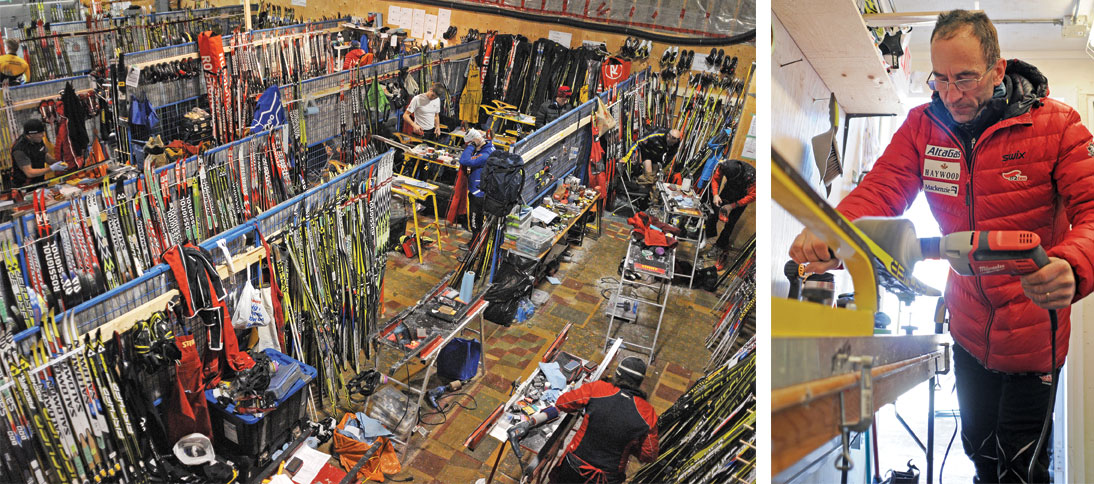
In a garage beside the Mount McIntyre Recreational Centre, dozens of people, protective respirators on, are working hard to get one of the most technical aspects of cross-country skiing done right: waxing.
By Pierre Chauvin on March 23, 2016
In a garage beside the Mount McIntyre Recreational Centre, dozens of people, protective respirators on, are working hard to get one of the most technical aspects of cross-country skiing done right: waxing.
At the 2016 Haywood Ski Nationals, special wax technicians spend hours before the races start to find the right wax for the race conditions that day.
Lately, the conditions have been quite difficult in Whitehorse.
“Anything around zero (degrees) becomes really tricky,” Team Yukon head coach Alain Masson said in an interview this week.
During the day, the sun melts parts of the tracks, resulting in wet snow, while parts of the track in the shade have firm, dry snow.
“It’s extremely difficult for coaches and technicians,” said Masson.
While wax itself won’t magically make a skier win, in tight races where each second counts, the right wax can give skiers the competitive edge they need.
Masson knows what he is talking about.
The coach of the Yukon cross-country ski team since 1996, he took part in two winter Olympic Games, participating in 50- and 30-km cross-country races.
He’s also served as a wax techician for Canada at three Olympics, and seven world championships.
Ski wax comes in all shapes and forms: powder, liquid and solid waxes are lined up on the shelves of the sea-can container Team Yukon uses to perfect their skis.
The coaches and wax technicians look at the different sections of the race trail to determine whether the majority will be in the sun or in the shade, as waxes are suited for dry or wet conditions.
“It’s always a compromise,” said Masson.
The wax applied to the ski also depends on the technique cross-country skiers use.
Cross-country skiers can kick with one ski and glide with the other in a forward motion for the classic style, or they can skate-ski.
For the first technique, skiers need two types of wax.
The kick wax, placed only on the part of the ski underneath the feet, gives them enough grip on the snow so they can propel themselves.
And because cross-country skis are curved, the kick wax doesn’t touch the ground when the skiers are gliding.
The glide wax, which is applied to the rest of the ski, reduces friction between the ski itself and the snow.
For skating races, it’s much simpler: the skiers only use glide wax, said Masson.
The petroleum-paraffin mix repels moisture and dirt, he said.
For a team of 20 skiers, like Team Yukon, it takes five hours the night before a race, and three to four hours the morning of, to get the waxing done.
At higher performance levels, such as the Olympic Games, there can be up to 10 wax technicians for eight skiers, Masson said.
And elite athletes don’t show up to competitions with just one set of skis; they can bring up to 30 pairs.
At the Nationals, skiers bring up to 15, he said.
For each race, that means two to three pairs of skis per athlete are waxed.
“It’s a huge amount of work,” said Masson.
See additional coverage.
Comments (1)
Up 1 Down 1
Terry Hertel. Of Hertel wax on Mar 24, 2016 at 4:57 am
You may consider our all temperature waxes. We have a Spring Solution that changes the element polled to a slick wax rather than sticky.