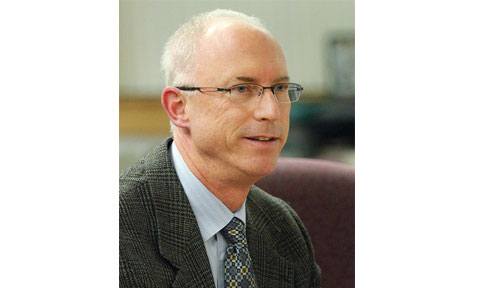
Photo by Whitehorse Star
Pictured Above: DWIGHT REDDEN
Photo by Whitehorse Star
Pictured Above: DWIGHT REDDEN
The Yukon Environmental and Socio-economic Assessment Board has recommended that the Watson Lake bi-fuel project be allowed to proceed.
The Yukon Environmental and Socio-economic Assessment Board has recommended that the Watson Lake bi-fuel project be allowed to proceed.
If eventually approved by the Yukon government, it would be the territory's first liquefied natural gas project.
In a decision released yesterday afternoon, the assessment board ruled the project by Yukon Electrical Company Limited and ATCO Gas could move forward subject to certain conditions regarding air quality and health and safety.
"We are very pleased with the decision,” Dwight Redden, the electrical company's general manager, said today. "It fits in with our timeline to implement phase one this fall.”
The project's first phase will convert one of the six diesel-fired electrical generators at Watson Lake to a bi-fuel system able to burn diesel and natural gas.
The company claims 50 per cent of the diesel consumed by the generator is expected to be displaced by natural gas, equating to a reduction of on-site carbon dioxide emissions of approximately 300 tonnes per year — equivalent to permanently removing 60 vehicles from the road annually.
That phase will require installation of a double walled vacuum insulated cryogenic tank, a secondary containment, gas vapourizers and enclosure and construction of an LNG impoundment sump.
If phase one is successful, the next step will be to modify the five remaining diesel generators to bi-fuel systems and possibly install a second cryogenic tank.
That phase would begin in 2015.
The recommendation has been forwarded to the Yukon government for a final decision. The government can either accept, reject or alter the recommendation.
The YESAB decision lists a number of terms and conditions along with its recommendation.
They include that the electrical company monitor the air contaminant emissions from the first phase and monitor greenhouse gas emissions including CO and methane.
The company "shall develop, in discussion with regulators, suitable monitoring or modeling techniques to understand the constituents of unburned HC emissions. Specifically, the Proponents shall monitor or estimate volatile organic compounds (VOCs), polycyclic aromatic hydrocarbons and benzene emissions,” the report says.
The same type of monitoring is to take place for the diesel-only system so that a comparison can be made.
"If air contaminant levels are found to exceed ambient air quality standards and/or greenhouse gas emissions targets, the proponents shall implement corrective measures to ensure that standards and targets are met. If corrective measures cannot be successfully implemented, Phase II shall not proceed.”
All the results of these tests are to made available to the Yukon Government, Liard First Nation, the Ross River Dena Council and the Watson Lake YESAB office, says the recommendation.
The idea of using liquified natural gas has generated intense debate and discussion around the territory as well as many submissions to the YESAB website during the consultation process.
Both the Liard First Nation and the Ross River Dena Council raised concerns about the project. The group Yukoners Concerned About Oil & Gas Exploration has also been a vocal opponent.
Redden acknowledges that there are two sides to any situation, but says he was "encouraged by the positive support we've had as well.”
Some people raised concerns about the safety of LNG while others questioned whether hydraulic fracturing will be used to get the fuel.
For now, the liquefied natural gas will be sourced from a production facility in Delta, B.C. and brought to the Watson Lake Power Plant.
The British Columbia facility uses a "consortium” of gases, collected from "multiple wells that feed into a vast piping system,” Redden said.
He agrees that there is no way of knowing for sure if the gas used in the Yukon came from conventional or unconventional means like hydraulic fracturing.
Back in February Redden said the initial cost of the project would be around $300,000.
Transportation costs are by far the most expensive part of using LNG in the territory, he said today.
Currently the company is in the process of negotiating a short-term contract with the B.C. company and then will look for a source that is closer.
Even if a closer source is not found, phase two may lead to a lower price because the company would be buying a higher volume of LNG, Redden says.
Depending on the route of transport, the distance travelled within the Yukon varies, the YESAB report says.
If transported via the Stewart-Cassiar Highway, the distance travelled within the Yukon is approximately 25 km; if the route is via the Alaska Highway, the distance travelled within the Yukon is approximately 13 km.
Redden said he believes people will eventually become comfortable with the idea of LNG.
"I think it will be accepted as just one of the many sources we have in the Yukon...I think people will get comfortable with it.”
This is not the last time YESAB will have to consider a project involving LNG.
Yukon Energy hopes to have a proposal before the board by the end of the month for a project to replace two old diesel generators at the Whitehorse Rapids Dam with two natural gas generators.
In order to encourage thoughtful and responsible discussion, website comments will not be visible until a moderator approves them. Please add comments judiciously and refrain from maligning any individual or institution. Read about our user comment and privacy policies.
Your name and email address are required before your comment is posted. Otherwise, your comment will not be posted.
Be the first to comment