Photo by Whitehorse Star
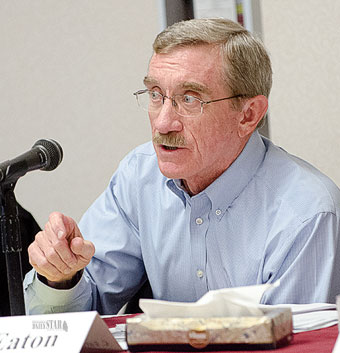
OPTIMISTIC – Chuck Eaton, owner of the company which wants to re-process tailings at the old Whitehorse Copper Mine, is happy with the way the water board hearings went this week.
Photo by Whitehorse Star
OPTIMISTIC – Chuck Eaton, owner of the company which wants to re-process tailings at the old Whitehorse Copper Mine, is happy with the way the water board hearings went this week.
Two days of Yukon Water Board hearings into the proposal to reprocess tailings at the former Whitehorse Copper Mine wrapped up Thursday afternoon.
Two days of Yukon Water Board hearings into the proposal to reprocess tailings at the former Whitehorse Copper Mine wrapped up Thursday afternoon.
While there was no opposition to the project, there were calls for strict monitoring of the water quality on-site and off-site to ensure the work does not cause elevated levels of arsenic, uranium and other minerals and compounds.
In keeping with standard water board procedure, board chair Ron Johnson did not announce or suggest a timeline for a decision, though it's not unusual for the independent body to deliberate for several weeks if not months on such matters.
Eagle Whitehorse has indicated it wants to begin preparation work this spring, with an aim of being in production in July or August.
The subsidiary of California-based Eagle Industrial Minerals is estimating a local economic stimulus of $19 million annually, including 20 to 25 full-time seasonal jobs and a $9.5 million trucking contract to ship the product to the port of Skagway.
The company is seeking a 15-year water licence for five or six years of production, and ongoing reclamation and monitoring work.
The proposal is to reprocess the 10.1 million tonnes of tailings and recover approximately 1.8 million tonnes of the magnetite or iron ore, which was selling Thursday for $145 a tonne, delivered to China.
The company intends to put the tailings through a plant where the iron ore will be extracted with industrial magnets.
Company owner Chuck Eaton said this morning he was pleased with how the hearings went. He added he appreciated the input from the two official interveners: Environment Yukon and the Yukon Conservation Society.
"We agreed to changes in the project that will make the project better,” he said. "So that was really useful.”
Eaton said he and his team believe it is possible to receive a licence in early to mid-February, which would allow production to begin this year.
Receiving the licence in May or June would likely be too late, given the time required to order the necessary equipment and arrange contracts like the truck haul.
March, he acknowledged, would be pushing it, but even if the company could get in two or three ship loads, it would probably make sense to fire up this year.
While there was no outright opposition during the hearings, Yukon government staff and Lewis Rifkind of the conservation society hammered home the importance of water quality and ensuring residential water wells in the area are not affected.
The only member of the public to address the board, Angela Sabo, said she understands natural levels of uranium are elevated when rock containing uranium is moved from its natural state and crushed.
Sabo said it's also her belief that levels of uranium inside the Little Chief Open Pit Lake, which the company plans to recycle as its primary source for processing water, is already above natural concentrations.
What happens to the uranium levels if the tailings are agitated again? Sabo asked members of the board, as she requested them to ensure mandatory monitoring guidelines to check uranium concentrations.
Eaton told the board he does not want specific monitoring requirements for uranium built into the licence, because he and his consultant don't believe the project will have any impact on uranium levels.
The company, however, will monitor uranium levels, and include the information in its annual report, he said.
Eaton said the company's adaptive management plan will contain provisions to address uranium concentrations if the uranium "doesn't behave the way we think it will.”
Steven Usher, a senior hydrologist retained by Environment Yukon for the hearings, indicated uranium is on the radar, which is why Environment Yukon wants to see mandatory monitoring requirements built into the licence.
But uranium is not something he's losing any sleep over, he told the board.
Usher said it's reasonable to accept the company's position that it will not be causing any increase in uranium levels because it's not going to grind or crush the tailings.
On the other hand, they do plan to stir them up, and that's why Environment Yukon is looking for some licence requirements, Usher said.
"In my mind, monitoring will be key to see if it (uranium) is mobilized, and the adaptive management plan could react to that,” said the hydrologist.
"I would see this as an incidental concern. I do not want to belittle concerns about uranium but if it does increase, it will not increase a lot.”
Maps were presented by Eagle Whitehorse to show what the company maintains are naturally occurring levels of uranium in the general area.
The maps of surface monitoring stations and groundwater wells at the mine site and in the general area show varying levels of concentrations for uranium and other metals.
A surface monitoring station at the north end of Miles Canyon, for instance, shows levels of uranium at somewhere between half of the amount to the amount allowed under the Canadian drinking water standards. There was little or no trace at the south end of the Canyon.
Similarly, four surface stations around Canyon Crescent, downhill from the mine site and the neighbourhood mentioned most this week, showed little or no trace of uranium, arsenic, selenium or molybdenum.
But one water well for the new Whitehorse Copper subdivision, which is separated geologically from the mine site, shows a concentration of uranium equal to or greater than drinking water standards.
The Eagle Whitehorse owner said he is abundantly confident the degree of monitoring security the company intends to install will ensure if there is a problem – and they're certain there won't be – they'll be able to address it before there are any negative impacts.
In order to encourage thoughtful and responsible discussion, website comments will not be visible until a moderator approves them. Please add comments judiciously and refrain from maligning any individual or institution. Read about our user comment and privacy policies.
Your name and email address are required before your comment is posted. Otherwise, your comment will not be posted.
Comments (1)
Up 0 Down 0
north_of_60 on Jan 18, 2013 at 12:13 pm
"Eagle Whitehorse is applying for a 15-year water license to reprocess the tailings over a five- or six-year-period, with room to spare for reclamation in the post-production years and ongoing monitoring of water quality leaving the site."
That's not good enough. Nothing will prevent them from walking away and leaving a mess once they've extracted the valuable materials.
NO APPROVAL unless the reclamation runs concurrently with the mining.