Photo by Vince Fedoroff
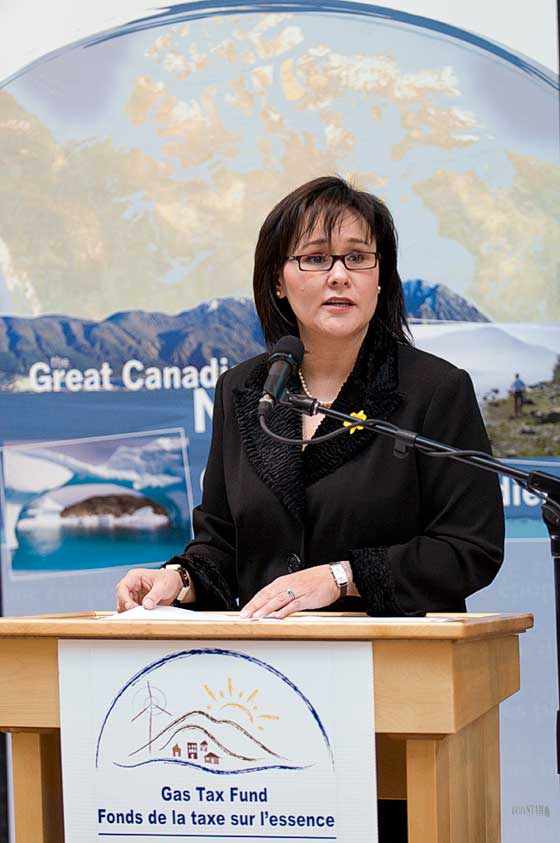
HEALTH MINISTER COMES TO TERRITORY - Federal Health Minister Leona Aglukkaq speaks to the media and other interested onlookers at this morning's news conference on infrastructure funding in Whitehorse.
Photo by Vince Fedoroff
HEALTH MINISTER COMES TO TERRITORY - Federal Health Minister Leona Aglukkaq speaks to the media and other interested onlookers at this morning's news conference on infrastructure funding in Whitehorse.
"It's been a long time coming," is how Andy Carvill, the Council of First Nations' grand chief,
"It's been a long time coming," is how Andy Carvill, the Council of First Nations' grand chief, describes the $8.5 million to be spent on improving the water quality in several Yukon first nations communities.
This morning, federal Health Minister Leona Aglukkaq joined Archie Lang, the Yukon's Minister of Public Works, for a "ceremonial" signing of a working together certificate.
The photo op and brief press conference, held in the main hall of the Yukon government administration building, trumpeted more than $250 million in infrastructure spending for the territory over the next five years, $182.9 million of which has already been announced.
Among the projects were water systems upgrades for Haines Junction, Teslin, Ross River, Marsh Lake and for the Carcross-Tagish First Nation and Champagne and Aishihik First Nations.
Asked why it took so long to address water quality in the territory, particularly for first nations communities, Lang said his government has been working on the problem "for the last four or five years.
"We've addressed these issues over the years within our own budget, so to say that we've ignored the issue is not factual," said Lang.
Carvill doesn't quite see it that way.
"I'm somewhat perplexed about some of the comments around working with first nation governments to ensure water safety," Carvill said. "If we talk to the Little Salmon-Carmacks chief, we may get a little different story."
Last summer, members of the Canadian Auto Workers union donated their time and expertise to repair 27 of 57 wells in the community that provide clean drinking water to 320 people. This summer, those union members are expected to return and finish the work.
Little Salmon-Carmacks Chief Eddie Skookum described trying to work with the federal government to remedy the situation, plaguing the community since 2006, like this:
"After repeated, unsuccessful efforts to get Indian and Northern Affairs to look at the issue, we welcomed the CAW volunteers' support and assistance. Safe, clean drinking water should be a right, not a privilege in this country."
The community is not slated to receive any of this clean water funding.
Adding to first nations' woes is the current funding arrangement whereby many of the federal dollars earmarked for aboriginal governments go to the territorial government first.
"The money's got to stop flowing to YTG and the YTG (must stop) acting as a Big Brother or Big Sister to first nations governments," said Carvill.
This issue was recently highlighted after the YTG opted out of funding the Angels' Nest shelter for young adults, leaving several first nations scrambling.
In August 2008, Ta'an Kwach'an Council Chief Ruth Massie told the Star the government was obligated to acquiesce its hold on federal dollars so the first nation could bring the project to fruition.
"Presently, the YTG receives funding for first nations, and we let them know in a meeting that they can extend our money to the need, which is Angel's Nest," she said.
Today, clean drinking water rather than homelessness took centre stage, but issues of funding were the same. Carvill said first nations are tired of supplicating to the territorial government for money that belongs in aboriginal hands.
"(It's) got to start flowing to first nations governments."
Today's other funding announcement was another $60 million for municipalities, derived from the federal gas tax and to be doled out between 2010 and 2014.
The deal extends a previous fiscal arrangement that expires at the end of this year.
In order to encourage thoughtful and responsible discussion, website comments will not be visible until a moderator approves them. Please add comments judiciously and refrain from maligning any individual or institution. Read about our user comment and privacy policies.
Your name and email address are required before your comment is posted. Otherwise, your comment will not be posted.
Be the first to comment