Wary waterfront residents taking precautions
The Reids bought their lake front property in 1967.
By Ainslie Cruickshank on August 10, 2012
MARSH LAKE – The Reids bought their lake front property in 1967.
It was one of the old-style cabins, like their neighbours', back then – but it doesn't look like that anymore.
About five years ago, they tore down the old one and started building what is better described as a summer home.
Dave designed it himself, Rusty, his mother, proudly told the Star Thursday afternoon, while sitting in the almost-complete living room of the main house, looking out over the lake.
Just behind the main house is Rusty's apartment, also newly built.
The Reids' property is one of the highest on Marsh Lake, so they aren't too concerned about the rising water levels in the Southern Lakes.
They've been told this year's flood levels will probably be similar to the levels in 2004.
"(It) was mostly a non-event, most people don't even remember anything from 2004. We're also the highest property on this beach here,” said Dave.
"We're not concerned for us individually; our property's OK. But there is concern for some of the other people, so I'm concerned for some of the other people but not for us.”
Ric Janowicz, the manager of the hydrology branch within the Department of Environment, said today "a few people are inconvenienced for sure at that level (2004), but the majority are not.
"Once it goes above that, then it's a lot more serious.”
The Southern Lakes are primarily a glacial system, Janowicz explained.
"That's why it peaks late in the summer, like it will, because it hasn't peaked yet.”
"It peaks after the heat of the summer temperatures, which are maximized in July.”
Snowpack and rainfall also contribute to the rising water level, and Janowicz said the snowpack is quite a bit above average this year.
A report released Thursday by Wildland Fire Management said the snowpack is 136 per cent of normal.
"The rainfall is contributing, the rainfall we've had in the last couple of days though it's not as much as we initially anticipated, the amounts are causing the water level to come up now,” said Janowicz.
"At this point, I don't expect it to go above 2004 (levels) unless it gets really warm or we get a lot of rain, but temperatures are tapering off now pretty quickly historically.
"Once we get to the middle of August, well, summer's over, hate to tell you that.”
While the flood isn't expected to be anywhere close to what it was in 2007, people are much better prepared than they were then, Dave said Thursday.
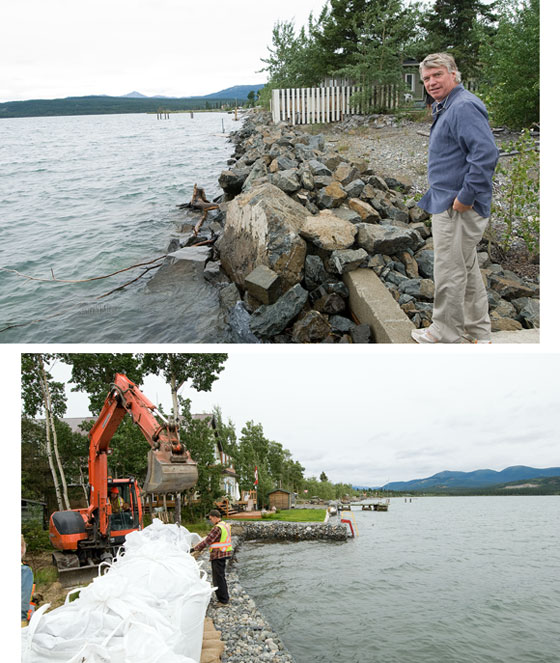
"After 2007, in 2008 everybody started saying, ‘OK, we got away with it this time' and we all started doing the rock thing, and we're much better prepared on an individual level and the government too.
"Last time water was coming in and you still couldn't get sand bags ... now it's like, ‘here's your sand bags.' I don't even think it's even going to be that bad, but everybody's on top of it this time.”
Large sandbags, called Super Bags, have been placed in various locations along Army Beach, including along the beach front of some high-risk properties.
Public access to the beach has been closed and Pearson Road is being raised to minimize effects of flood water.
As of Thursday, 26,500 sandbags had been distributed around the Southern Lakes area.
Wildland Fire Management has recommended Southern Lakes residents prepare for possible flooding by taking extra precautions to flood-proof properties.
They can do so by moving hazardous materials to a safe location, removing belongings from crawl spaces and basements, knowing how to shut off electricity, fuel tanks, furnace fuel lines, and propane lines, preparing a personal emergency plan and ensuring they can be self-sufficient for at least 72 hours.
Thursday's latest information from Wildland Fire Management rated the flood risk for Marsh Lake, Carcross and Tagish as high.
The water level was 0.24 m below flood stage and was stable, but the report said a return to normal temperatures and/or moderate rainfall amounts would raise the water level.
"Peak water level normally occurs in August and is expected to reach the flood stage level of 3.43 m during the second or third week of August,” it said.
Remembering back to the 2007 flood, Rusty and Dave said the one positive that came out of the disaster was the community support.
"The funny thing is how a disaster like that brings the community together, because you're all down there filling sand bags together and talking and there's somebody making coffee and soup and lunches, we were really like one big community. I liked that part of it,” said Rusty.
"People came out from town and said. ‘here we are – what do you want us to do?' ” Dave added.
Be the first to comment